| Home | About | Blu-ray | DVD Reviews | Upcoming DVD Releases | Contest | Podcasts | Judges | Jury Room | Contact |
|
|
|
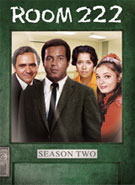
All Rise...Judge Bill Gibron went to a very cool school as well. Editor's NoteOur review of Room 222: Season One, published March 23rd, 2009, is also available. The ChargeApparently, at one time, we could all get along… The CaseNobility and entertainment rarely go hand in hand. Good intentions don't always equal a good time. Over the course of most modern examples of art; something that strives to have a social, political, or moral compass occasionally finds itself lost; adrift in a sea of competing commercial and content claims. Finding a proper balance then is almost impossible. Take the noted late '60s/early'70s TV series Room 222. Coming as the powder keg of civil and national unrest was reaching a lit fuse critical mass, it combined To Sir with Love with LA-based liberalism to highlight a myriad of up to date or "current" issues within a scholastic setting. While striving to add as much high school as Hell-arious comedy to the mix, creator James L. Brooks (who would go on to Me Decade dominance with The Mary Tyler Moore Show) was also aiming to break molds and push boundaries. Why did a filmed laugher only have to cater to wit? Similarly, does a drama have to be so humorless? The results set a benchmark that would seep into every segment of the otherwise onerous broadcast wasteland. But does it still hold up today—meaning, can a modern audience, knowing full well what came before (or, frankly, who doesn't give a frizzy afro about the past), enjoy such a series? Shout! Factory seems to think so, having already released Season One on DVD back in 2009. The four disc Season Two set is similarly styled, providing 26 episodes of the uneven but effective show. For those unfamiliar with the various characters and narrative threads, here is a brief rundown. Pete Dixon (Lloyd Haynes, Good Guys Wear Black) teaches history at one of those "typical" TV high schools (Walt Whitman High, to be exact) where the real world often visits, but rarely stays. Gal pal (and guidance counselor) Liz McIntyre (Denise Nicholas, Capricorn One) offers perspective and personal attention, while the perky Alice Johnson (Karen Valentine, Hot Lead and Cold Feet) tends toward naiveté and student teacher optimism. They all fall under the good-hearted but bitter tutelage of principal Seymour Kaufman (Michael Constantine, The Reivers), the seen-it-all administrator who borders the broad baseline between The Establishment and doing the right thing. Into their midst comes a wealth of major (and minor) student characters, familiar faced recurring roles, and one-off guest stars. Specifically, storylines offer the following: Disc One Disc Two Disc Three Disc Four In some ways, Room 222 is as daring—and dated—as hearing All in the Family's Archie Bunker run through a litany of racial epithets. It stands in stark contrast to our post-millennial mindset, believing as it does that the educational system is more than just a rote memorization warehousing for our nation's ADD-addled and Ritalin-fueled youth. It strives to present compelling and/or controversial issues with as much verve and vision as possible, and when it works, you recognize what the current prime time line-ups are lacking. But this is not a flawless revisit to a seemingly enlightened era. For everything it "gets" right, Room 222 is occasionally clunky and contrite. Race is at the center of, and frequently clouds, the ability to amuse. Granted, this was all still new ground for the series, but in our present PC-dictated dynamic, some of the plotpoints (and more than a few stray slang terms) quickly turn nostalgia into an uncomfortable lesson in awkward integration (both in front of—and behind—the camera). While the show wasn't always focused on message or agenda, it did tend to rely on it more than the standard sitcom formulas. Highlights here include "A Sort of Loving" (where "rapping about dope" becomes a gateway to more insightful conversation), "I Hate You, Silas Marner" (which uses the title tome as a contrast with Joseph Heller's counterculture war hit), and "The Valedictorian" (an attempt to reconfigure recent student uprisings and nonconformity into the half hour TV setting). Elsewhere, "The Fuzz that Grooved," "Captain of the Team," and "Adam's Lib" nearly drown in their slick sense of hipster cool. Still, the show could find a way to work the standard coming of age plotlines into the mix, as when the resident 'class clown' runs for Student Council ("The Laughing Majority") or when an aging, angry teacher ("Mr. Bomberg") is put in perspective. Brooks and company never forgot the show's setting ("Hip Hip Hooray" centers on school rivalries, while "Cheating" is rather self explanatory) and frequently went overboard into well-intentioned tripe ("The Last Full Moon" revisits recently married teens Charlie and Abbie while "If It's Not Here, Where Is It?" deals with Vietnam). As with any second season, characters are challenged and manipulated, but the reasons for success remains solid. At its heart though, Room 222 is an intriguing entertainment that loses some of its luster, if not much of its power, with the passage of time. As for the DVDs themselves, Shout! Factory was criticized last time around for providing less than pristine transfers, especially when it came to the earliest episodes of Season One. This time around, the 1.33:1 image is consistently better, even if the standard commercial fade outs from the era give away the print's more dated elements. Colors are bright without being overly fuzzy or faded, and details are deep without a lot of sharp contrasts. Granted, there are lots of age issues here and there, as well as a few syndication snips, but for the most part, the presentation of Season Two exceeds that of the first set. As for the sound situation, Dolby Digital Stereo 2.0 is really nothing more than the original Mono tracks modified to play through both channels. The music is therefore tinny and thin, but the dialogue is direct and upfront. Unlike the first time around, however, there are no bonus features to speak of—unless you count the occasional famous face (Richard Dreyfuss, Kurt Russell) that shows up in the halls of Walt Whitman High School. Over time, TV learned to embrace the sensational and the socially relevant, though occasionally missing the mark (child abuse, mental illness) by more than a few years. Room 222 can be seen as starting a real revolution toward a more philosophically conscientious medium. As with most opening salvos, however, it does not define it—for good and for bad. The VerdictNot guilty. Give us your feedback!Did we give Room 222: Season Two a fair trial? yes / no Other Reviews You Might Enjoy
• American Pie Presents Band Camp |
|
DVD | Blu-ray | Upcoming DVD Releases | About | Staff | Jobs | Contact | Subscribe | | Privacy Policy
Review content copyright © 2010 Bill Gibron; Site design and review layout copyright © 2015 Verdict Partners LLC. All rights reserved.