| Home | About | Blu-ray | DVD Reviews | Upcoming DVD Releases | Contest | Podcasts | Judges | Jury Room | Contact |
|
|
|
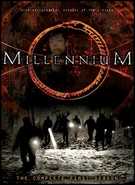
All Rise...Appellate Judge Michael Stailey never once wondered why Chewbacca wasn't in this series. Editor's NoteOur reviews of Millennium: The Complete Second Season (published October 12th, 2005) and Millennium: The Complete Third Season (published March 1st, 2006) are also available. The ChargeHis curse is your salvation Opening StatementWith The X-Files established as a cult classic series, creator Chris Carter went looking for a new challenge. Enter former FBI profiler Frank Black, a man delving headfirst into the dark recesses of the human soul, shining light on the horrors that men and women do. The question is: How long can a production team live in a dark and disturbing world before it begins to consume them? Facts of the CaseFrank Black (Lance Henriksen, Aliens): Decorated member of the FBI's Behavioral Science Unit, loving husband, devoted father, and a man recovering from a career ending nervous breakdown. Frank has left the Bureau, packed up his family and the shattered pieces of his psyche, and moved back home to a quiet, simpler life in the Pacific Northwest. If only it were that easy. Suppressing your natural talents and abilities never works. Your life's purpose will find ways to haunt you until you accept yourself for who and what you are. While working part-time as a consultant to The Millennium Group—a team of former law enforcement officials whose mission is to unravel the mysteries of the coming millennium—Frank is drawn back into profiling by an old friend (Bill Smitrovich, Air Force One) who needs his help tracking a serial killer. All it takes is one taste of the old life and Frank's natural gifts are brought screaming back to the surface, much to the concern of his wife Catherine (Megan Gallagher, National Lampoon's Van Wilder). Unfortunately, his work with the police and the Millennium Group draws Frank deeper into the darkness while he desperately tries to maintain a strong link to his perceived "normal" life. The Evidence"When you look into the darkness of a man's soul, it is a solitary act. It cannot be shared."—Caine (David Carradine), Kung Fu Millennium was a show ahead of its time. Growing out of an X-Files episode in which Mulder and Scully track a serial killer, Chris Carter wanted to move away from the supernatural and focus on the evils of humanity. The format was to be a murder mystery of the week underscored by a growing tide of apocalyptic events. With the ratings and revenue The X-Files had brought the Fox network, Carter had the leverage to skirt the traditional pilot process and develop his new series away from the prying eyes and tampering hands of network executives. This gave him the advantage of creating a world darker than television had ever seen. There is no conceit to the paranormal here. Evil is a force of nature, whose truth is so much stranger than fiction. The show's subject matter preyed upon the growing fears of an American public riding high on the economic prosperity of the Clinton administration. However, success often breeds complacency and paranoia. Carter and his team used these oft-unspoken fears to craft a world in which the harsh reality of life operates just below the surface of our perceptions. Our hero, Frank Black, is a quiet, self-reliant everyman who has experienced the full spectrum of life and serves as our eyes and ears. Assumptions, pre-conceptions, and long held beliefs are challenged and shattered as the layers of waking life are peeled away to reveal the stuff of children's nightmares. Forget Frankenstein, Dracula, Freddy Krueger, and Jason Voorhees. The real monsters are our neighbors, friends, family, and colleagues whose corruption and primal urges have been cultivated and gone unnoticed for far too many years. Layered with social commentary, Millennium explores the human psyche in ways no other series ever dared. The '90s saw a rapid acceleration in our lifestyle: cell phones, the Internet, and 24-hour entertainment. Things we now accept as necessities just being introduced and radically changing the way we worked and lived. Frank's insight into the minds of troubled souls reflects the visual, auditory, and informational overload we all face. Our senses are bombarded with stimuli 24 hours a day and the brain has little or no time to process it all. As a result, we stress and rage, becoming addicted to anything that will numb the pain or distract us from life's pressures, if only for a little while. I know it's cliché, but I'm drawn to Stan Lee's often-overused expression that, "With great power comes great responsibility." We all have unique talents and gifts, but few of us embrace them. It's easier to live a less complicated existence, seated on a bus someone else is driving. Frank left Quantico because he was no longer able to filter and process the evil he faced on a daily basis. Yet, he now realizes the only comfort and safety he can create for himself and his family is by facing this evil head on, bringing it kicking and screaming out of the darkness and into the light where its power is vanquished. In a zen-like respect, Frank is an anomaly, throwing off the universal balance between good and evil. This becomes a stronger theme in Season Two, but here we see a one-man army taking on the forces of darkness, not because he has to, but because that's who he is and what he's meant to do. Sounds like a tremendous setup, right? So why didn't the show catch fire like its paranormal predecessor? The series was given the much coveted Friday night slot in which X-Files thrived. It had a built-in fan base of Chris Carter enthusiasts. It even had full network promotional support. What went wrong? Several things… All Too Real An Overwhelming Experience Downright Confusion Frank's gift of insight was a source of consternation for fans and casual viewers alike. The way the show was edited, using quick cuts and accelerated framing to visualize what Frank saw in his mind's eye, gave many people the idea that his powers of deduction were psychic or in some other way supernatural. This was not the case. Frank's gift is nothing more than a unique ability to synergistically combine diverse and seemingly unrelated pieces of detailed evidence producing a sensitivity and insight into the thought processes of the human mind. Let's be honest, getting inside the head of someone battling an encompassing darkness is not something anyone would casually choose to pursue. It's a talent Frank discovered early in his FBI career and is only now learning to control. One of the reasons he joined the Millennium Group was their offer to help him hone this skill and compartmentalize his personal and professional lives. With the former he will find success, but the latter he discovers is little more than a pipe dream. Several things did go right for Millennium… The Cast The Production Design The Writing Presented in 1.33:1 full frame format, Millennium's transfer is good but not flawless. The grain seen in the pilot episode lends itself to the intense, gritty atmosphere, but lacks the sharp detail of later episodes. The color levels are exceptional, given the majority of the series takes place at night or under threatening skies. The imagery gives off a strange tactile sensation: You can feel the damp cold, smell the rotting flesh, and you'll often be compelled to take a shower afterwards to scrub off the ick. The Dolby 2.0 surround is clear and resonate, with a rich bass component that emphasizes the lower register of Lance's voice. Mark Snow's spine-chilling score mixes Celtic folk themes with new age chord progressions, creating the perfect soundtrack for this haunting world. Rest assured, there are times it will raise the hair on the back of your neck. Fox pulls together some great bonus features for this set. "Order in Chaos" is a 52-minute behind-the-scenes look at the creation of Season One. Fans of the series will love the insight Carter, Nutter, and others bring forth, while the casual or first time viewers will "get" what the creative team set out to achieve. A collection of network bumpers shows just how much promotional support the network gave in launching the series. "Creating the Logo and Title Sequence" is a ten-minute discussion with Chris Carter, designer Ramsey McDaniel (The X-Files), and graphic designer Justin Carroll (Hamagami/Carroll and Associates) on the tone set by the opening titles. "Chasing the Dragon" is a 23-minute look into the consulting firm that inspired The Millennium Group. While not as mysterious or conspiratory as its fictional counterpart, founder Roger DePue confirms that profiling is not a science, but rather a unique art form. Two episode commentaries round out the extras. Chris Carter gives his play by play for the pilot episode and the process that went into creating the series. Chris is entertaining and his insights rarely disappoint. David Nutter, who directed four episodes in Season One, gives his take on "Gehenna" and the series. David is another powerful creative force in television, having directed the pilot episodes for a number of great dramatic series including Roswell, Smallville, Jack and Bobby, and Dark Angel to name just a few. There's much to learn here, grasshopper! Closing StatementMillennium: The Complete First Season is an impressive display of creative firepower. This is a master class that all hour-long series should dissect and carefully study. For viewers who have never seen the show, those unafraid to get their hands and minds dirty will be bowled over by these tales. Longtime fans of the show will uncover much more a second or third time around. Don't hesitate to add this series to your television on DVD collection. The VerdictAfter careful consideration of all the charges leveled against Chris Carter, his creative team, and Fox Home Entertainment, the only thing this court finds the defendants guilty of is developing a compelling and all too realistic series that television audiences were unprepared and unequipped to handle. Give us your feedback!Did we give Millennium: The Complete First Season a fair trial? yes / no Other Reviews You Might Enjoy
• Bastard Out Of Carolina |
|
DVD | Blu-ray | Upcoming DVD Releases | About | Staff | Jobs | Contact | Subscribe | | Privacy Policy
Review content copyright © 2005 Michael Stailey; Site design and review layout copyright © 2015 Verdict Partners LLC. All rights reserved.