| Home | About | Blu-ray | DVD Reviews | Upcoming DVD Releases | Contest | Podcasts | Judges | Jury Room | Contact |
|
|
|
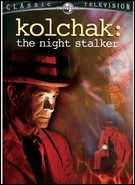
All Rise...Judge Bill Gibron may have seen more TV dinners than dead bodies in his lifetime, but he knows a wonderfully entertaining cult classic when he views one, and Kolchak: The Night Stalker is one highly recommended romp. The Charge"I'm tired of it, Kolchak. I'm fed up! I've got a brother-in-law who's
got a fourteen-year-old kid he's always bailing out of juvenile hall, but I've
got you, and you're worse!" Opening StatementFor many of us, it was a full-blown ritual. It usually began during school. At some point in the day, a friend or associate would approach and try to broach the subject. You had purposefully avoided conversation about it, because you knew it would just jinx your future enjoyment. You knew if someone mentioned it by name, you'd start to obsess on it, the mind concentrating on nothing else as endless classes led to homeroom, and then home. So talk was superficial and cheap, no "Boy I can't wait" or "What do you think it will be about tonight." Instead, eyes and thoughts stayed far away from the prime-time prize. Still, the feeling was palpable. A few hours from now, the biggest badass in the history of broadcast ghostbusting would be on the air, and we would be waiting, a tall tumbler of Hi-C (or Coke, for the more cosmopolitan of the clique) and a bowl of Bugles at our side, ready to indulge in some eerie escapist fun. Yep, Carl Kolchak left that kind of impression on us highly suggestible youth. Ever since we saw him, an everyday Joe in a joke of a suit and a lark of a hat, we loved this demented, disheveled conqueror of the creepy. Whether it was battling a fierce and frightening vampire in The Night Stalker, and later taking on a sinister Civil War doctor with the secret to immortality in The Night Strangler, Kolchak was our Mulder. He was our Frank Black, a supernatural slayer like Buffy in a bad suit. He represented a retro revival of pure horror successfully meshed into the modern mindset. When Carl switched over to a weekly series, we were hopelessly devoted to the schmo, developing the aforementioned oddball behavior traits before each and every broadcast. But Nanna Nielsen did not shine on Kolchak's keepers, and just when we were getting to really know the guy, he disappeared from the boob tube all together (save for CBS late-night reruns, and as a Sci-Fi Chan! nel slot holder). Now Kolchak's entire first (and only) season run is available on DVD from Universal, and it's still as hopelessly addictive as it was 30 years ago. Time may not have been kind to some of the storylines, and the promise of digital preservation does not mean that the series gets the royal remaster treatment, but this is still a wonderfully weird and watchable throwback to the days when broadcast TV took chances. Sometimes, the attempts failed, but in other instances, they produced some clever and kitschy entertainment. Facts of the CaseThere were only 20 episodes of Kolchak: The Night Stalker produced, and each one sat upon the following series premise. After being run out of Las Vegas for his vampire story, and with a similar stint in Seattle ending for equally unbelievable reasons, reporter Carl Kolchak and his editor pal Tony Vincenzo find themselves working for the Independent News Service (INS) in Chicago. They are surrounded by some eccentric co-workers including Ron "Uptight" Updyke, the matronly Miss Emily, and Monique Marmelstein, a nosy niece intern of the publisher. While Vincenzo wants to get away from the sensational stories that got he and Kolchak in trouble before, his pal just can't stop stumbling into the supernatural. As a result, they constantly butt heads over content and editorial approach. Kolchak's adventures in the realm of the paranormal and bizarre continue as follows: Disc One, Side A: • "The Ripper" (Monster: Jack the Ripper) • "The Zombie" (Monster: a zombie) • "They Have Been, They Are, They Will Be…"
(Monster: unseen aliens) • "The Vampire" (Monster: a vampire) Disc One, Side B: • "The Werewolf" (Monster: a werewolf) • "Firefall" (Monster: a doppelganger) • "The Devil's Platform" (Monster: Satan / hell
hound) • "Bad Medicine" (Monster: Diablero—Indian
medicine man) Disc Two, Side A: • "The Spanish Moss Murders" (Monster: a
peremalfait—swamp monster) • "The Energy Eater" (Monster:
Matchemonedo—invisible Native American bear god) • "Horror in the Heights" (Monster: Rakshasa—a
malevolent spirit) • "Mr. R.I.N.G." (Monster: a robot) Disc Two, Side B: • "Primal Scream" (Monster: a prehistoric ape-like
humanoid) • "The Trevi Collection" (Monster: a witches' coven) • "Chopper" (Monster: a headless motorcycle rider) • "Demon in Lace" (Monster: a succubus) Disc Three, Side A: • "Legacy of Terror" (Monster: a mummy) • "The Knightly Murders" (Monster: a killer knight) • "The Youth Killer" (Monster: Helen of Troy) • "The Sentry" (Monster: A Godzilla-like lizard
creature) The EvidenceSince the dawn of the new millennium, we have more or less given up on monsters. The old-fashioned belief in the boogieman and the local legends of haunted houses and ghostly apparitions have all but faded into the woodwork of modern worries. Molesters and thrill killers are the new ogres that unsettle our sleep, and we are more likely to delve into the mind of a serial slayer than argue over the existence of vampires. In this technologically complex realm, we dismiss that which does not come to us from the never-resting mantras of the mass-media machine. Today, bloodsuckers are just confused Goth kids, werewolves are painted with bizarre ethnic origins, and zombies are relegated to bit players in some first-time filmmaker's living dead epic. Where once monsters were the major macabre movement, they have been uprooted and replaced by their far more marketable human counterparts. But, boy, back in the '70s, we really loved our beasts. We were obsessed with Bigfoot, went loony over that shy sea creature from Loch Ness, and couldn't get enough of those Chariots of the Gods with their ancient astronauts doodling all over the desert Southwest. We relished any show that dared to lift the veil off the mystery of monsters, and wanted to champion those who would disprove, or protect us, from their supernatural sway. Carl Kolchak, decked out in a singular set of clothes that made him part-schlub, part superhero, became our divine hammer. He dared to expose the existence of vampires in Las Vegas (in the hugely successful TV movie The Night Stalker) and went on to uncover more paranormal portents in the soon-to-be grungy city of Seattle (in the sequel The Night Strangler). With his iconic look, hokey hat cocked snidely on his head and a skeptical glint in his eye, Kolchak became the idol of the arriving adolescent, the fiery defender of the Fourth Estate who had the unfortunate luck of using ghouls, not grand juries, as the basis for his brazenness. An episodic series was inevitable (Stalker and Strangler had been ratings dynamite), and ABC's decision to give Kolchak a weekly platform was seen as sweet vindication for those who enjoyed the otherworldly and ethereal. Though Dan Curtis, the man behind the gothic soap Dark Shadows and the Stalker and Strangler teleplays, was gone (he'd had a falling out when a third film failed to materialize), everyone was convinced it was a good idea. The formula—old-fashioned beast in modern metropolis—was easily reconfigured to the hour-long format…or so everyone thought. However, after a single season and 20 scattershot episodes, Carl Kolchak lost his byline and disappeared from screens for almost 30 years (that bastard offspring currently clogging up the broadcast schedule excluded). Now Universal has finally found it in its cheaply produced DVD-18 hearts to give us the classic series, bare bones and barely considered. Spread out over three-and-a-half sides of four discs, these uncut and somewhat restored episodes prove their point better than any 5,000 word treatise. When Kolchak: The Night Stalker was good, it almost met the quality of its TV movie brethren. When it was weak—which wasn't all that often—it was still a clever campy hoot. Anchored by an amazing performance by Darren McGavin in the lead role (no Eurotrash fashion plate can fill this Kolchak's white PF Flyers) and supported by an equally effective foil in Simon Oakland's Tony Vincenzo, the series version of Kolchak may not resonate with the same sense of the sinister as its long-form counterparts, but it was enjoyable while it lasted. First, no matter its flaws, Kolchak: The Night Stalker was and is a well-written show. Though the eventual episode may not fully realize the scripting provided, there was a concerted effort to make each plot as believable as possible. The monsters weren't just anomalies passed off as some kind of supernatural fluke. The Night Stalker kept its creeps firmly founded in religious and cultural dogma, adding authenticity to what was already a pretty wacky watershed. Besides, each show still had good narrative drive, with the plot mechanics humming along efficiently over some of the more problematic points in the subplotting (never the show's strong suit). Aside from the frights, however, the dialogue was deliciously catty and cynical, with Kolchak and Vincenzo's volleys the stuff of televisual legend. When they got going, when the blood rushed to Oakland's head and Kolchak adjusted his equipment and stuck out his finger, you knew it was on. The two battled with an intelligence and a style that would come to define the friendly fracas between major players in many a TV series to come afterward. This is because The Night Stalker was and is, at its core, a character-driven show. It plugs along on the personalities of its featured players and makes sure that they remain well drawn and three-dimensional. Kolchak is a very complex man, logical and yet slightly superstitious. He wears the war wounds from his battles with the forces of darkness like shrouds over his shoddy, cheap suit, and keeps that "$2 hat" on his head to hold in all his thoughts—and all his screams. Vincenzo violates every unwritten ethical principle while preaching a strict code of conduct, his desk job hampering what is obviously a Kolchak level of curiosity. Though he yells and screams, Vincenzo never once fires or reprimands Kolchak in a definitive (or visible, at least to the home audience) manner. He wants him to succeed. It means a great deal to both of them. Redemption is the main theme of Kolchak: The Night Stalker. Our hero is hampered by a reputation for being excitable, daffy, and more than a little dangerous. Weirdness seems to follow this intrepid reporter and he is out to clear his name once and for all. Kolchak knows the truth, and knows that the proof of said is out there. But he also sees the situation from the eyes of his skeptical associates. Part of the fun of each episode is watching how concrete verification and available evidence seemingly slips through Kolchak's hands again and again. Photos are confiscated, tapes destroyed, and his agitated outsider persona renders him alone when most of the bad supernatural shite goes down. Thankfully, our jaded journalist takes it all in stride. He jokes away his failures and makes light of even the most life-threatening events. One of the best things about Kolchak: The Night Stalker is the nimble shifts in tone and mood. At one moment, we could be drenched in the most heinous of horrors (at least, by TV standards), only to have a scene of outright humor the next. The switch is effortless and comes directly from the characters. Sure, a few special guest stars are brought in to add name value, but they tend to stop the situations cold. They're ancillary assets to the show, not as important as our Kolchak/Vincenzo/Cop/Creature core. There is no denying that there are some wonderful episodes here. Disc One gives us three. "The Ripper" updates the "Jack is Back" concept of the White Chapel killer with a style and story reminiscent of Kolchak's original clashes with the Vegas Nosferatu. "The Zombie" is even better, as we get one of the eeriest scenes in the series, ever. After locating the reanimated corpse, our hero must pour salt in its decaying mouth and…sew it shut. The entire scene is played for palpable suspense, and the shocking payoff is icky icing on the creepy cake. Finally, by tying in the initial Stalker film to the TV show, "The Vampire" recalls the reasons why we are now watching Kolchak once a week. Carl's brandishing of a makeshift cross and the bloodsucker's death are two of the series most memorable moments. Disc Two derives most of its macabre from spirits and demons, with the best being "The Spanish Moss Murders," "Horror in the Heights," "Chopper," and "Demon in Lace." Each episode has a wonderful creature at the forefront (bayou beast, evil spirit, headless killer, and succubus, respectively) and the installments all handle their horror with matter-of-fact aplomb. Highlights include the kindly killer concept of "Heights," where people see the deadly specter as someone they trust, and Richard Kiel under several pounds of pond scum essaying the title role of Peremalfait (sounds like something Emeril Lagasse would cook up, right?) in "Spanish Moss." The last DVD here is the most schizophrenic. It has one decent installment ("The Knightly Terror"), two that stumble a little in the execution ("Legacy" and "The Sentry"), and one totally off-kilter entry. Anyone interested in former That's Incredible co-host Cathy Lee Crosby as Helen of Troy can check out this otherwise weak installment. Indeed, "The Youth Killer" is kind of indicative of where the series might have been headed. The final few shows are somewhat sloppy, as good ideas (prehistoric lizard, human sacrifice, a la the Aztecs) became middling in execution, and the incredible camp value found earlier in the series sort of dried up. Indeed, there were times toward the end of the series run when all an episode had going for it was McGavin's galvanizing personality and the narrative's natural tenacity. Still, the good far outweighs the bad. Moreover, it's entertaining to poke fun at the failures. There is nothing scary about a demonic dog, and "The Devil's Platform," with its odd combination of politics and Satanic pups is just silly. If you want to see what Eegah! might have looked like had the focus of that sad flop been on Native Americans, not Neanderthals, then get a load of Richard Kiel's other appearance here as the Diablero, a wannabe of Tom Sawyer's Injun Joe. Mr. R.I.N.G. is a robot that even the carnal computer from Demon Seed would have a hard time mercy dating, and a ball of energy or a laughable lupine are not the stuff of sufficient scares. Still, Kolchak: The Night Stalker keeps it together on the back of its sensational cast and literary legerdemain. Sure, this is all as cornpone as a hillbilly's holiday meal, and cannot compare to the modern motion picture presentation of evil. The reanimated bad guy in "The Zombie" is not even comparable to the laughable legions of undead idiots in a low-budget horror romp. What Kolchak has is heart and chutzpah. It wants to place unreal events directly into the real world, and see how the two would interact and interrelate. It gives us a protagonist to really root for, scenarios that seem sane and rational, and an explanation for even the most outlandish and outrageous balderdash. Fans who fell in love with the series and always wondered when it would see the light of digital day should jump on this presentation before the dreaded OOP starts shows up in inventory listings. Those of you who've never experienced the crazed confidence and delightful deception of Carl Kolchak need to do yourselves a favor and pick up this set as well. You may not cotton to its corniness at first, but it will surely get under your skin, and without some immediate CCs of DVD, you'll go through major Kolchak withdrawal. It's not a pleasant experience. Just ask those of us who've waited a long, long time to re-savor the scares and re-witness the wackiness. As a presentation, the digital version of Kolchak: The Night Stalker suffers from some good news/bad news issues. The good? The fact that we finally have the entire Kolchak saga on DVD (MGM/UA released the TV movies last year). And the bad news? The audio is clear and crisp, but the visuals are far from perfect. Granted, these are the complete shows—unedited and re-spliced together after some attempts at fashioning them into feature-length TV movie presentations in the '80s. Also, the full-screen image is acceptable, devoid of the defects we usually associate with analog transfers. But the image is still far from perfect. The colors are faded and, in some cases, the commercial cutaways look generations old. We get a few moments of grain here and there, and by the end of the series, the location footage shot in Chicago starts to look a little gamy. It really stands out compared to the newer "L.A." version of the Windy City that Kolchak parades through. Don! 't misunderstand, the picture is fine for a 30-year-old program with a decidedly cult following, but it is not the pristine package we'd hoped for. Want more bad tidings? There is not a single show-specific extra here. We are treated to some Universal previews at the start of Disc One, Side A, but that is it. With McGavin ailing and the rest of the cast dead or indisposed, commentaries and interview featurettes seem out of the question. But what about a conversation with The X-Files' Chris Carter? He had nothing but praise for the series. So did Guillermo Del Toro. Why not get a celebrity celebration of the title to help newcomers understand the show's heritage and lineage. Or why not bring author Mark Dawidziak in for a chat. He wrote the excellent (if a tad geekish) The Night Stalker Companion, and could flesh out the history and the production problems with the show. Context is important to selling a series to others beyond the faithful few. Universal really dropped the ball on this one. Closing StatementEven as we watched the closing moments of "The Sentry," there were those of us that knew it would be the last time Carl Kolchak ever challenged the forces of darkness in that toddling town of Chicago. What once made The Night Stalker so inventive and fun now seemed tiresome and tame. Kolchak never won, the monster of the week always seeming to escape outright detection until Carl found it and killed it. Then all he had left was a nice voiceover narrative, and a decidedly bruised ego. So it may sound to some like Kolchak: The Night Stalker is an unnecessary walk through an unusually dark alley down by memory lane. Actually, the opposite is true. Seeing the show again, remembering what it was like to fall under the spell of the series the first time, is an epiphany. What we learn is that at the time the world was not ready for Kolchak. Woodward and Bernstein proved that the Fourth Estate could uncover corruption at the highest levels of government, but our INS investigator was going even further. He was arguing that there was a similar level of dishonesty at the very core of the cosmos. He was exposing the ongoing war between good and evil, as any good correspondent would. That we didn't take him seriously the first time is our fault. Thankfully, we can make it up to him now. Carl Kolchak deserves our respect and our support. Only he protects us from the monsters we so readily ignore. Without him, we're lost. The VerdictKolchak? A classic fictional character who could never be found guilty. The Night Stalker series? A tad dated, but still a great deal of fun. Acquitted on all charges. Universal's DVD treatment of this title? Underwhelming and egregious to fans. Guilty! Guilty! Guilty! Give us your feedback!Did we give Kolchak: The Night Stalker: The Complete Series a fair trial? yes / no Other Reviews You Might Enjoy
• The Garden |
|
DVD | Blu-ray | Upcoming DVD Releases | About | Staff | Jobs | Contact | Subscribe | | Privacy Policy
Review content copyright © 2005 Bill Gibron; Site design and review layout copyright © 2015 Verdict Partners LLC. All rights reserved.