The Evidence
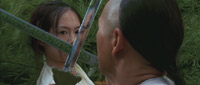 It may surprise some of you to learn that, while
Crouching Tiger, Hidden Dragon was a raging success in most of the world,
it was not particularly successful in its homeland. Why would that be? Because
this genre and style of film are nothing new in China. The term commonly used
for the genre is wuxia. "Wu" refers to war or martial arts,
while "xia" is a term difficult to translate into English, which
refers to a warrior or adventurer, often one who specifically is a swordsman.
The roots of wuxia literature run deep, but it evolved into its current form in
the early 20th century, and after World War II had strong influence from the
pulp fiction of the West. In film, these movies often use wirework and special
effects to create the fantasy element of the stories, and they often have a
grand scale. Crouching Tiger, Hidden Dragon, with all of Ang Lee's
trademark pathos, must have seemed quite dull in comparison.
It may surprise some of you to learn that, while
Crouching Tiger, Hidden Dragon was a raging success in most of the world,
it was not particularly successful in its homeland. Why would that be? Because
this genre and style of film are nothing new in China. The term commonly used
for the genre is wuxia. "Wu" refers to war or martial arts,
while "xia" is a term difficult to translate into English, which
refers to a warrior or adventurer, often one who specifically is a swordsman.
The roots of wuxia literature run deep, but it evolved into its current form in
the early 20th century, and after World War II had strong influence from the
pulp fiction of the West. In film, these movies often use wirework and special
effects to create the fantasy element of the stories, and they often have a
grand scale. Crouching Tiger, Hidden Dragon, with all of Ang Lee's
trademark pathos, must have seemed quite dull in comparison.
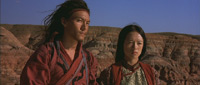 Yes, Crouching Tiger, Hidden Dragon is a martial
arts movie, but like I've said, it is so much more. I'll add parenthetically
that I was very excited to see Crouching Tiger, Hidden Dragon when it
opened locally, but my wife was rather apathetic and only went along because I
insisted that a female friend (DVD Verdict's own Judge Lindsey Hoffman, to be
precise) had loved it and said that she would too. Melanie (my wife) does not
share my love of kung fu flicks, and was not keen on seeing a subtitled movie
(one of the few foreign films I've ever talked her into watching, Run Lola Run, we watched
dubbed—the only time I've watched it like that). The large theater was
quite full, and surprisingly the audience was a healthy mix of film geeks, older
people, and families with school-aged children. I expected that the kids would
be bored and loud, but I was pleased to hear nary a whisper during the entire
movie, and the buzz in the theater after it was over was very positive. Oh, and
my doubting wife? She loved it and couldn't wait to watch it again when I
received the DVD. Her attraction to the film was Michelle Yeoh (which reminds
me…I must have her watch Supercop) and the love story between
Zhang Ziyi and a rough-and-tumble desert thief named Lo (Chang Chen). I loved it
for…well, I loved everything about it, but in particular for the
cinematography (more on that in a minute) and the amazing fight scenes.
Yes, Crouching Tiger, Hidden Dragon is a martial
arts movie, but like I've said, it is so much more. I'll add parenthetically
that I was very excited to see Crouching Tiger, Hidden Dragon when it
opened locally, but my wife was rather apathetic and only went along because I
insisted that a female friend (DVD Verdict's own Judge Lindsey Hoffman, to be
precise) had loved it and said that she would too. Melanie (my wife) does not
share my love of kung fu flicks, and was not keen on seeing a subtitled movie
(one of the few foreign films I've ever talked her into watching, Run Lola Run, we watched
dubbed—the only time I've watched it like that). The large theater was
quite full, and surprisingly the audience was a healthy mix of film geeks, older
people, and families with school-aged children. I expected that the kids would
be bored and loud, but I was pleased to hear nary a whisper during the entire
movie, and the buzz in the theater after it was over was very positive. Oh, and
my doubting wife? She loved it and couldn't wait to watch it again when I
received the DVD. Her attraction to the film was Michelle Yeoh (which reminds
me…I must have her watch Supercop) and the love story between
Zhang Ziyi and a rough-and-tumble desert thief named Lo (Chang Chen). I loved it
for…well, I loved everything about it, but in particular for the
cinematography (more on that in a minute) and the amazing fight scenes.
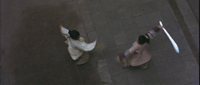 There's a reason the fights of Crouching Tiger,
Hidden Dragon are so amazing: they were choreographed by one of the greatest
fight choreographers in the business, Yuen Woo-Ping. His career in martial arts
films dates back to the early 1970s, but one of his best known early films is Drunken Master, often cited as Jackie
Chan's best film. In 1996, he choreographed Black Mask starring Jet Li, which was
little more than mindless action, but it was astounding mindless action.
Unfortunately, it would not be released in the United States until 1999, when
another Woo-Ping choreographed movie would capture the attention of our
filmgoers: The Matrix. Though enhanced
with computer gimmickry, many of its incredible fight sequences were simply
gussied-up, old-fashioned wirework. His work in Crouching Tiger, Hidden
Dragon is even more impressive than The Matrix because it feels more
authentic and grounded in "reality," and relies less on digital
trickery—yes, the women are running across rooftops, and yes, Chow Yun Fat
and Zhang Ziyi are suspended above the ground in bamboo treetops.
There's a reason the fights of Crouching Tiger,
Hidden Dragon are so amazing: they were choreographed by one of the greatest
fight choreographers in the business, Yuen Woo-Ping. His career in martial arts
films dates back to the early 1970s, but one of his best known early films is Drunken Master, often cited as Jackie
Chan's best film. In 1996, he choreographed Black Mask starring Jet Li, which was
little more than mindless action, but it was astounding mindless action.
Unfortunately, it would not be released in the United States until 1999, when
another Woo-Ping choreographed movie would capture the attention of our
filmgoers: The Matrix. Though enhanced
with computer gimmickry, many of its incredible fight sequences were simply
gussied-up, old-fashioned wirework. His work in Crouching Tiger, Hidden
Dragon is even more impressive than The Matrix because it feels more
authentic and grounded in "reality," and relies less on digital
trickery—yes, the women are running across rooftops, and yes, Chow Yun Fat
and Zhang Ziyi are suspended above the ground in bamboo treetops.
I could talk about Crouching Tiger, Hidden Dragon all day, but
perhaps I'll save myself some time (and not force you, my readers, to endure an
endless lecture on the mysteries and joys of this film) and focus on the
elements of Crouching Tiger, Hidden Dragon upon which the voters for the
Academy Awards deemed worthy to bestow their coveted prizes. Crouching Tiger,
Hidden Dragon was nominated in ten categories, and won four Oscars: Best Art
Direction/Set Decoration, Best Cinematography, Best Foreign Language Film, and
Best Original Score.
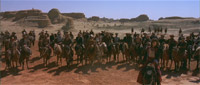 Best Art Direction/Set Decoration and Best
Cinematography are best discussed as a group, along with Best Costume Design,
for which it was nominated but lost to Gladiator. Together they inspire the
adjective most often used to describe Crouching Tiger, Hidden Dragon:
beautiful. Everything about the film is beautiful, from the subtly detailed sets
to the lavish, authentic costumes to the most breathtaking, jaw-dropping vistas
perhaps ever captured on celluloid. And all of that is before the fighters even
start moving in some of the most graceful, balletic martial arts sequences
you'll ever care to see. These aren't the violent fights of other martial arts
flicks; these are elegant, flowing displays that are like the dance sequences of
musicals—it's Gene Kelly and Leslie Caron, only duking it out with swords.
But there I go talking about the fight scenes again. Cinematographer Peter Pau
has worked with some of Hong Kong's greatest directors, such as John Woo (The
Killer), Tsui Hark (Swordsman), and Ronny Yu (The Bride With White
Hair). Unfortunately, he's also had the misfortune of following these
directors to Hollywood to work on some of their dismal stateside failures (Tsui
Hark's Double Team with Jean-Claude Van Damme and Dennis Rodman, Ronny
Yu's Bride of Chucky). It makes you wish that Hollywood would learn its
lesson, and when it brings foreign legends into its fold that it would allow
them to do what they do best rather than watering it down for our feeble
consumption. Perhaps Crouching Tiger, Hidden Dragon will teach them that
lesson.
Best Art Direction/Set Decoration and Best
Cinematography are best discussed as a group, along with Best Costume Design,
for which it was nominated but lost to Gladiator. Together they inspire the
adjective most often used to describe Crouching Tiger, Hidden Dragon:
beautiful. Everything about the film is beautiful, from the subtly detailed sets
to the lavish, authentic costumes to the most breathtaking, jaw-dropping vistas
perhaps ever captured on celluloid. And all of that is before the fighters even
start moving in some of the most graceful, balletic martial arts sequences
you'll ever care to see. These aren't the violent fights of other martial arts
flicks; these are elegant, flowing displays that are like the dance sequences of
musicals—it's Gene Kelly and Leslie Caron, only duking it out with swords.
But there I go talking about the fight scenes again. Cinematographer Peter Pau
has worked with some of Hong Kong's greatest directors, such as John Woo (The
Killer), Tsui Hark (Swordsman), and Ronny Yu (The Bride With White
Hair). Unfortunately, he's also had the misfortune of following these
directors to Hollywood to work on some of their dismal stateside failures (Tsui
Hark's Double Team with Jean-Claude Van Damme and Dennis Rodman, Ronny
Yu's Bride of Chucky). It makes you wish that Hollywood would learn its
lesson, and when it brings foreign legends into its fold that it would allow
them to do what they do best rather than watering it down for our feeble
consumption. Perhaps Crouching Tiger, Hidden Dragon will teach them that
lesson.
 I'm not a huge fan of foreign cinema. This is through no
ill will, but rather through a lack of exposure, both intentional (caused by my
lack of interest in many artsy foreign films) and unintentional (caused by their
unavailability in the theaters of the small market in which I live). In fact, I
dare say Crouching Tiger, Hidden Dragon was the only foreign film I saw
in a theater, and the others were DVD Verdict assignments that I met with
delight (Run Lola Run), apathy (Ma Vie
En Rose), or annoyance (All About My
Mother). But I digress. It does my heart some good to see American audiences
embrace a movie at the box office that required them to read subtitles. In fact,
I think it's a shame that Columbia released the DVD with an English dub track,
but that's a rant I'll save for later.
I'm not a huge fan of foreign cinema. This is through no
ill will, but rather through a lack of exposure, both intentional (caused by my
lack of interest in many artsy foreign films) and unintentional (caused by their
unavailability in the theaters of the small market in which I live). In fact, I
dare say Crouching Tiger, Hidden Dragon was the only foreign film I saw
in a theater, and the others were DVD Verdict assignments that I met with
delight (Run Lola Run), apathy (Ma Vie
En Rose), or annoyance (All About My
Mother). But I digress. It does my heart some good to see American audiences
embrace a movie at the box office that required them to read subtitles. In fact,
I think it's a shame that Columbia released the DVD with an English dub track,
but that's a rant I'll save for later.
 Crouching Tiger, Hidden Dragon's score was
composed by Tan Dun. He is best known as a classical composer, winning acclaim
for a symphony in honor of the 1997 transfer of Hong Kong from Great Britain to
China. He has composed scores for two documentaries, Aktion K and In
The Name Of The Emperor, and for the thriller Fallen. He marries energetic Chinese
percussion with the haunting cello of Yo-Yo Ma, and the result is sweet, sweet
music that will stay with you for some time after seeing the film. In fact, I'd
say it ranks right up there as one of my favorite film scores, along with Basil
Poledouris' Conan The Barbarian and
Danny Elfman's Edward
Scissorhands. Like those scores (and unlike many others), it serves to
highlight the emotions on the screen, rather than punching them up to
unrealistic and manipulative heights.
Crouching Tiger, Hidden Dragon's score was
composed by Tan Dun. He is best known as a classical composer, winning acclaim
for a symphony in honor of the 1997 transfer of Hong Kong from Great Britain to
China. He has composed scores for two documentaries, Aktion K and In
The Name Of The Emperor, and for the thriller Fallen. He marries energetic Chinese
percussion with the haunting cello of Yo-Yo Ma, and the result is sweet, sweet
music that will stay with you for some time after seeing the film. In fact, I'd
say it ranks right up there as one of my favorite film scores, along with Basil
Poledouris' Conan The Barbarian and
Danny Elfman's Edward
Scissorhands. Like those scores (and unlike many others), it serves to
highlight the emotions on the screen, rather than punching them up to
unrealistic and manipulative heights.
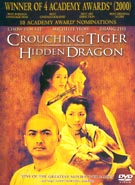
 For the DVD, Columbia presents a nice package. The film
is presented in 2.35:1 anamorphic widescreen. Peter Pau's eye-popping
cinematography is equally eye-popping on DVD. The transfer is amazing, with
perfect color reproduction. The only distractions are occasional edge
overenhancement and more dust and speckles than you'd expect from a year-old
film. Dolby Digital 5.1 audio is available in both its original Mandarin and an
English dub. Naturally, I only viewed the full film with the original audio,
though I did sample the English. Surrounds are used mostly for Tan Dun's score,
but the front soundstage is used to give space to the on-screen action. The dub
is not as bad as you'd fear. It's obvious that they went to great pains to avoid
the laughable lack of synchronization between the actors' mouths and the
dialogue, but nonetheless the dub does have the distinct feel that it was
recorded in a studio rather than on-set. Stick with the Mandarin, please.
For the DVD, Columbia presents a nice package. The film
is presented in 2.35:1 anamorphic widescreen. Peter Pau's eye-popping
cinematography is equally eye-popping on DVD. The transfer is amazing, with
perfect color reproduction. The only distractions are occasional edge
overenhancement and more dust and speckles than you'd expect from a year-old
film. Dolby Digital 5.1 audio is available in both its original Mandarin and an
English dub. Naturally, I only viewed the full film with the original audio,
though I did sample the English. Surrounds are used mostly for Tan Dun's score,
but the front soundstage is used to give space to the on-screen action. The dub
is not as bad as you'd fear. It's obvious that they went to great pains to avoid
the laughable lack of synchronization between the actors' mouths and the
dialogue, but nonetheless the dub does have the distinct feel that it was
recorded in a studio rather than on-set. Stick with the Mandarin, please.
For extra content, we get a commentary track, a making-of featurette, an
interview with Michelle Yeoh, a photo montage, and the usual filmographies and
theatrical trailers. The commentary track features Ang Lee and
screenwriter/producer James Schamus. Lee and Schamus have worked together many
times—Schamus has produced all seven films Lee has directed. The two have
an easy rapport, and they laugh and joke with each other through the entire
track. It's a little light on hard facts about the making of Crouching Tiger,
Hidden Dragon, but it's still an enjoyable listen. The making-of feature was
produced for the Bravo cable network. It's a fairly thorough look at the making
of the film, though it does seem balanced in favor of promotional material. The
Michelle Yeoh interview segment runs about 13 minutes. She's probably the best
known of the lead actors, with her performances in Supercop and the James
Bond movie Tomorrow Never Dies. She's
full of insightful comments about the film. The photo montage runs about six
minutes, and is a slide show of promotional stills and on-the-set photos. There
are two theatrical trailers, one the international version, one the U.S.
version. Almost laughably so, it shows the difference in expectations of the
filmgoing intelligence of Americans and everyone else. The international trailer
uses music very similar in tone and style to the film, shows quite a bit of the
Chinese characters, and focuses on the epic nature of the film. The American
version? It has a techno score, focuses on the movie's fight scenes, and (most
odious of all) has Trailer Voice Guy explaining the story. Ick.




 Martial arts films are nothing new to American
audiences. Bruce Lee became a sensation in 1973 with
Martial arts films are nothing new to American
audiences. Bruce Lee became a sensation in 1973 with 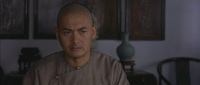 Crouching Tiger, Hidden Dragon takes place in a
fantastical version of 19th century China. Everything is very nearly the same as
the real world, only here the laws of gravity don't quite apply to the fighters
and warriors schooled in the martial arts. One such warrior, Li Mu Bai (Chow Yun
Fat) is prepared to retire from the lifestyle to settle down. He gives his
mystical sword, Green Destiny, to his partner in arms Shu Lien (Michelle Yeoh)
to entrust to a nobleman. Soon after, Green Destiny is stolen by a lithe young
thief with knowledge of Wudan, the sacred, secret martial art of Li Mu Bai's
sect. It turns out the thief is Jen (Zhang Ziyi), the daughter of the provincial
governor. Furthermore, it turns out that her governess and mentor is none other
than Jade Fox, a legendary thief who murdered Li Mu Bai's master and stole his
training manual. What follows is a tale not just of fighting and revenge, but
also of redemption and love.
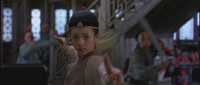
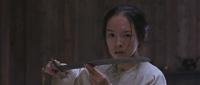
Crouching Tiger, Hidden Dragon takes place in a
fantastical version of 19th century China. Everything is very nearly the same as
the real world, only here the laws of gravity don't quite apply to the fighters
and warriors schooled in the martial arts. One such warrior, Li Mu Bai (Chow Yun
Fat) is prepared to retire from the lifestyle to settle down. He gives his
mystical sword, Green Destiny, to his partner in arms Shu Lien (Michelle Yeoh)
to entrust to a nobleman. Soon after, Green Destiny is stolen by a lithe young
thief with knowledge of Wudan, the sacred, secret martial art of Li Mu Bai's
sect. It turns out the thief is Jen (Zhang Ziyi), the daughter of the provincial
governor. Furthermore, it turns out that her governess and mentor is none other
than Jade Fox, a legendary thief who murdered Li Mu Bai's master and stole his
training manual. What follows is a tale not just of fighting and revenge, but
also of redemption and love.