| Home | About | Blu-ray | DVD Reviews | Upcoming DVD Releases | Contest | Podcasts | Judges | Jury Room | Contact |
|
|
|
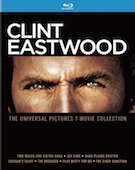
All Rise...Cigarillos give Judge Clark Douglas a coughing fit. Editor's NoteOur reviews of Clint Eastwood: American Icon Collection (published February 11th, 2009) and Clint Eastwood: Western Icon Collection (published May 14th, 2007) are also available. The ChargeSeven classics from one Hollywood legend. The CaseClint Eastwood's decades-spanning relationship with Warner Bros. is the stuff of legend, but Eastwood hasn't always been a WB man. Early in his career, he worked on several Universal Studios productions (including his first few efforts behind the camera). Seven of those films—three westerns and four thrillers—have been included in this new box set. Is it worth picking up? Let's dig in. Coogan's Bluff Imagine a version of Inherent Vice told from the perspective of Josh Brolin's character, and you have an idea of what Coogan's Bluff is like. It's the story of an old-fashioned shitkicker from Arizona, who flies into New York City and engages in some old-fashioned shitkicking. It's a movie that certainly couldn't be remade in 2015 (unless you sanded the edges off, anyway), but there's something devilishly entertaining about the movie's anti-PC swagger: it's filled to the brim with old-fashioned sexism, enthusiastic civil rights violations and dismissive potshots at hippie culture. The film probably ought to feel ugly, but Clint Eastwood's performance is so infectious and Don Siegel's direction is so snappy that it's hard to prevent a goofy grin from creeping across your face. In a number of ways, Coogan's Bluff plays like a warmup for the work Eastwood and Siegel would do on Dirty Harry. Arizona Deputy Sheriff Walt Coogan (Eastwood) is tasked with extraditing an escaped convict named James Ringerman (Don Stroud, Joe Kidd). The job seems simple enough, but when Coogan arrives in New York to pick up the prisoner, Ringerman escapes yet again. Soon, our cowboy hat-sporting hero is stomping through the weirdest corners of New York City in search of the convict. Along the way, he punches a lot of people, serves up a generous number of laconic quips and sleeps with more women than James Bond on vacation. The most amusing thing about Coogan's Bluff is that Coogan isn't particularly good at his job. Sure, he can handle anyone in fistfight, but his approach to detective work is hilariously simplistic. Generally, Coogan feels the best approach is to punch people until someone tells him what he wants to know. When that fails, he comes up with another brilliant plan: he should just sleep with Ringerman's girlfriend. When his seductive powers fail to secure a solid lead, Coogan resorts to threatening to murder the girlfriend. Coogan doesn't just break the rules, he sets them on fire and shoves them off the top of a tall building. The film's visual high point arrives when Coogan wanders into a massive hippie happening filled with naked trapeze artists, body painting sessions, hallucinatory drugs and casual orgies. "Hey, Charlie!" one stoned hippie giggles. "The name's Coogan," Eastwood growls. It plays like a friskier, less oppressive version of Jon Voight's bewildered journey through a similar event in Midnight Cowboy (a far more sensitive fish-out-of-water tale about a cowboy in New York City). The whole sequence is such loopy fun that you can practically see Siegel grinning behind the camera. Eastwood reportedly contributed quite a bit to the script, and it's easy to draw a direct line between this and the cheerfully silly Dirty Harry parody The Dead Pool. Susan Clark (Webster) plays a love interest of sorts—I say "of sorts" because Eastwood romances Clark's character between casually bedding other women. Also, when I saw that Eastwood "romances" her, what I really mean is that he harasses her until she agrees to have dinner with him. After they eat, Clark reaches into her pocket book to cover her half of the meal. "Aren't you a girl?" Eastwood mutters. "Last time I checked," she replies. "Then sit back and act like one," Eastwood orders, snatching the check. In another scene, Coogan declines to sleep with a woman who fancies him. The woman responds by angrily declaring that Coogan must be gay (though she doesn't exactly put it that delicately). This movie certainly was made in 1968. Naturally, the whole thing concludes with a violent, action-packed climax, which gives Siegel another opportunity to demonstrate that he knows how to stage an action scene. Still, the climax is less interesting than the coda, which once again inspires comparisons to the aforementioned Inherent Vice. It's a strange, sweet, unexpected moment of cross-cultural bonding that defies everything which has preceded it—perhaps the movie's way of gently acknowledging that we'd all be better off if we try to get along with each other despite our philosophical differences. If you approach Coogan's Bluff with a similarly forgiving spirit, you'll have a good time. Two Mules for Sister Sara Two Mules for Sister Sara is Don Siegel's western-themed riff on John Huston's The African Queen, pairing a gruff man with a pious woman and sending them on an adventure together. When the movie focuses on the prickly chemistry of its two leads, it's a lot of fun—but surprisingly, Siegel seems mostly disinterested in the film's big action scenes. If the explosive sections of the movie were as much fun as the quiet ones, the film might have been a blast. As it is, we're left with a reasonably entertaining (if unremarkable) rom-com adventure. The tale begins when a cowboy named Hogan (Clint Eastwood) rescues a woman named Sara (Shirley MacLaine, Terms of Endearment) from being raped by bandits. Sara reveals that she is a nun, and expresses her gratefulness to Hogan for saving both her life and her virginity. Sister Sara also informs Hogan that she's been working with a group of Mexican revolutionaries attempting to combat French forces. Hogan has little interest in politics, but agrees to help Sara reach the Mexican camp she's traveling to after realizing that he may be able to exploit the situation for financial gain. Despite the fact that Eastwood and MacLaine reportedly didn't get along terribly well during the shoot, they share an entertaining rapport that makes their dialogue scenes the film's strongest element. He's a horny rascal, she's a chaste nun, and each makes a valiant effort to influence the other's behavior. As is often the case in films like this, sinfulness quickly gets the upper hand, as Sister Sara grows increasingly comfortable with drinking whiskey and uttering swear words. Above all else, Two Mules for Sister Sara is about the pleasure of watching Eastwood raise an eyebrow in surprise as a nun chugs a bottle of hard liquor. The movie eventually winds up in a fairly silly place, but I dig the fact that the characters are permitted to remain recognizably human for a good stretch of the running time. Siegel doesn't force corny slapstick into the mix very often or create contrived conflict, instead allowing the squabbles to develop in an organic fashion. Only during the film's final third (after the arrival of an entirely predictable plot twist) do things start getting really broad. The movie's closing scene is a mildly amusing gag, but the journey there is awfully long and strained. Siegel is generally a top-notch action director, but he seems to be on autopilot during most of the film's big setpieces (the one exception: a terrific, suspenseful, funny scene involving an effort to derail a train). The violent third-act battle is just plain clumsy, and the movie does a poor job of explaining the details of the conflict between the Mexicans and the French. Every time the film's plot revs up, the movie slows down. Thankfully, there's always a generous portion of amusing character stuff just around the corner. Eastwood gets second billing in the film, and that seems appropriate: MacLaine is the one driving most of the movie, while Eastwood is just the guy tagging along for the ride. Both stars are in fine form. MacLaine strikes an interesting balance between the understated timidity of her early roles and the brassy swagger of her later ones. Hogan is certainly one of the more talkative characters Eastwood has played, and it's fun to see the way his frequent complaining undercuts his stoic "Man with No Name" persona. Composer Ennio Morricone seems to be enjoying the change of pace, too, replacing the heroic anthems of his Sergio Leone scores with a hilarious (but effective) theme which memorably employs synthesized donkey sounds. It's a fun flick, but it uses up most of its good scenes in the first 75 minutes. Joe Kidd On paper, Joe Kidd looks incredibly promising: it's directed by John Sturges (The Magnificent Seven, The Great Escape), it's written by the great Elmore Leonard (not based on one of his stories, mind you, but actually written by him), it stars Clint Eastwood (Unforgiven) and Robert Duvall (The Godfather) and it features a terrific Lalo Schifrin score. Given all of the talent involved, it's hard not to feel a little disappointed by the end result: an engaging but muddled western that suffers from confusing characterization and some poor storytelling choices. Who is Joe Kidd? He's…well, he's Clint Eastwood, more or less. But what kind of man is he? I couldn't tell you. When the film opens, he's facing prison time for hunting on Indian land. Then there's a scrap with a Mexican revolutionary named Luis Chama (the decidedly non-Mexican John Saxon, Black Christmas), who raids Kidd's ranch and assaults one of his employees. Kidd seeks revenge, so he teams up with wealthy land baron Frank Harlan (Robert Duvall), who has formed a posse to capture Chama. Frank is a fairly nasty guy, and after a while Kidd decides that Frank is a little too violent for his taste (this is after Kidd has aided in a few cold-blooded murders, but live and learn, I guess). So, he ends up in a strange sort of neutral position, casually undercutting the efforts of both Chama's revolution and Frank's killing spree. It's more than a little difficult to tell where Kidd's allegiances lie at any moment in time, and the ambiguity is frustrating rather than intriguing. The movie's politics are even messier. Chama is clearly modeled on iconic revolutionaries like Pancho Villa and Che Guevera, but Leonard's screenplay seems to suggest that those guys would have had more success if they had turned themselves into the authorities and made their case through proper legal channels. Sure, because a well-stated argument is usually all it takes to inspire lasting change. It's one thing for Joe to promote such an idea, but Chama buys it without much argument. Well, I'm glad that worked out smoothly. Despite these issues, Joe Kidd certainly has its pleasures. There are plenty of fun "Eastwood being Eastwood" moments, in which the actor uses his sly grin and steely squint to good effect. I particularly dig the scene in which Eastwood knocks a bandit unconscious by lazily swinging a flower pot above his head. The actor's relaxed confidence goes a surprisingly long way towards covering the inconsistencies of his character, as Eastwood always seems to know what he's doing. I also greatly enjoyed Robert Duvall's turn as the film's leathery villain—Duvall hasn't played a lot of bad guys, but it's fun to see that sly twinkle applied to a fairly nasty character. Sturges has certainly delivered a good-looking movie, with plenty of memorable desert vistas and Leone-inspired visual riffs (including a knowing close-up of Eastwood's eyes during the film's climax). The handful of action sequences are staged with clarity, and the tuneful Schifrin score (influenced by Morricone, but still very much its own thing) adds brisk energy to the proceedings. It's easy to watch, but never congeals into a satisfying whole: each individual scene makes sense on its own terms, but when you put them all together you realize that you're missing a few puzzle pieces. The Beguiled Don Siegel and Clint Eastwood collaborated on five films over the course of their respective careers, and one imagines that they would have collaborated more often if Eastwood hadn't gotten the urge to start directing stuff himself. The Beguiled is easily the strangest of their collaborations—a dark southern Gothic melodrama set against the backdrop of the Civil War. The film tanked at the box office (probably due to Universal's poor, sensationalist marketing), but both Eastwood and Siegel have named the film a personal favorite. It's easy to see why: it's the most atmospheric, artful film of Siegel's career, and the first real indication that Eastwood could do more than merely scowl and shoot things. Our tale begins in rural Louisiana. A young girl is wandering through the woods when she finds Union Corporal John "McBee" McBurney (Eastwood) bleeding to death. She guides him back to the all-girl boarding school nearby, and begs headmistress Martha Farnsworth (Geraldine Page, The Trip to Bountiful) to grant him shelter. Martha reluctantly agrees despite her allegiance to the Confederacy, as she knows John's injuries are so severe that he'll die if he's thrown in a prison camp. John is informed that he can stay until he's back on his feet, after which time he'll be turned over to the proper authorities. From the moment we meet him, it's clear that John is an unsavory character. When the young girl first discovers him, John asks her how old she is. "12, going on 13," the girl says. "Old enough for kisses," John replies, pulling her close and kissing her on the mouth. He's too weak to do anything more than that, but it's easy to guess what would have happened under different circumstances. The moment he begins to recover his strength, John starts making an effort to seduce three different women: the headmistress, the virginal schoolteacher Edwina (Elizabeth Hartman, A Patch of Blue) and the sexually voracious young Carol (Jo Ann Harris, Rich Man, Poor Man). He does so partially in an effort to craft an escape plan for himself, but mostly because he has an insatiable sexual appetite. Though The Beguiled initially looks like the story of a bad man working his way to some nasty comeuppance, the reality is considerably more complicated than that. Nearly everyone in this film (save for the sweet Edwina) has a nasty side, and there are moments in which we pity almost all of the characters (even the repulsive John, impossible as that sounds). The school is a cauldron that contains conflicting shades of lust, jealousy, anger and bitterness, and when all of those elements reach their boiling point, the film explodes in startling fashion. Siegel's direction is tense and sensuous—the camera restlessly moves around the house with serpentine fluidity, and the humid southern atmosphere he conjures effectively enhances the film's fever dream quality. Lalo Schifrin's score is used sparingly, but offers spine-tingling shades of dark romance when it appears. The film seems to slip in and out of a dreamlike haze, with ugly flashbacks resurrecting themselves in the minds of these of these troubled characters. In one memorable sequence, Martha has a dream of a bizarre foursome involving herself, John, Edwina and Carol, and the sequence feels less like cheap titillation than something pulled out of an unpublished Flannery O'Connor tale. It's no surprise that Page is terrific, and that she's ultimately playing someone far more complicated than a conservative headmistress. She's haunted by memories of her incestuous relationship with her brother, and she begins pondering whether John might make an effective substitute. When she discovers that John is not as noble as he claims, her reaction is horrifyingly dramatic. Meanwhile, Eastwood transforms his masculine screen presence into something unnervingly slimy—a murderous serpent with an unyielding libido. Siegel stages the film as an unsavory battle between the worst qualities of men and women—violent lust vs. vengeful jealousy—and he has the courage to deliver the tough ending the film demands (something both Eastwood and Siegel had to fight for, as Universal wanted something more light-hearted—a move that surely would have been both absurd and inappropriate). Though Eastwood's fan base reacted negatively to The Beguiled during its initial theatrical run, the film remains one of the most striking efforts of the actor's early years. It's a strange, stormy nightmare of a movie that reaches deep into the dark corners of human emotion and retrieves something profoundly unsettling—a bold, distinctive film with an unforgettably bitter aftertaste. Play Misty for Me 1971 was something of a banner year for Clint Eastwood. He starred in two terrific Don Siegel films—one of which featured his most complex performance to date (The Beguiled), and one of which significantly increased his status as a pop culture icon (Dirty Harry). Between the release of those two films, Eastwood whipped up his own directorial debut: Play Misty for Me, a thriller which has inspired a host of imitators over the years (most notably Adrian Lyne's Fatal Attraction). It's a strong, slick debut that finds Eastwood fusing a not-bad Siegel imitation with some early indicators of his own directorial preferences. In addition to directing, Eastwood stars as Dave Garver, a late-night disc jockey who broadcasts from a small radio station in Carmel-by-the-Sea, California (the town that would elect Eastwood mayor in 1986). Every night, he gets a call from a woman making the same request: "Play 'Misty' for Me." Dave is always happy to oblige, dedicating the lush Erroll Garner tune to his devoted fan. Eventually, the two share a chance encounter. Her name is Evelyn Draper (Jessica Walter, Arrested Development), and she's eager to share more than her musical preferences with Dave. Despite harboring a desire to work things out with his ex-girlfriend Tobie (Donna Mills, The Incident), Dave readily hops into bid with Evelyn (greatly encouraged by her "no strings attached" promises). Alas, what Dave thought was a mere one-night stand turns into something far more serious. Evelyn has intense feelings for Dave, and when he tries to brush her off, she turns obsessive. Evelyn emotionally blackmails Dave into staying with her, threatening self-harm if he dares to shove her out of his life. Before long, the laid-back lothario finds himself trapped in a tangled web of jealousy that threatens to derail his personal and professional life. Though this sort of tale feels awfully familiar now, Play Misty for Me essentially set the template for the modern jilted-lover thriller. While it falls into the same traps as many of its imitators (chiefly, neglecting to turn its murderously obsessive character into a convincing human being), it's a fine piece of work and a surprisingly assured directorial debut. Eastwood ratchets up the tension with the precision of a guy who's been around the block a few times, and wrings a good deal of uncomfortable suspense out of the squirm-inducing scenario he presents. Dave feels like a less despicable variation on the character Eastwood plays in The Beguiled—he's a sexually confident man who doesn't hesitate to jump into bed with any woman who will have him. As in that film, he is severely punished for his libidinous ways. Both films play like cautionary tales for men who think with their other head, though The Beguiled is a notch above this one in terms of artfulness (there's nothing in this film as visually astonishing as the Gothic dream sequence in Siegel's flick) and characterization (Geraldine Page is a considerably more nuanced female rival than the one Jessica Walter plays). Still, Walter compensates for the thin characterization with an undeniably compelling performance. Walter is genuinely frightening in the role, particularly when her sticky-sweet seduction routine is interrupted by flashes of primal rage. We may not have much in the way of depth or credible motivation, but we believe Walter when she promises to do terrible things to herself, Dave or the people Dave cares about. Eastwood's voice shines through awkwardly but memorably in an extended lull between the film's second and third acts—it starts with a lengthy romantic montage set to Roberta Flack's cover of "First Time Ever I Saw Your Face," and finishes with an even lengthier sequence set at the Montreux Jazz Festival. It's a good fifteen minutes or so of relatively plot-free material, with Eastwood using terrific music to fuel an exploration of interesting visual ideas. There's one particularly distinctive shot of Eastwood and Mills lying in the middle of a forest that deliberately evokes The Garden of Eden—a romantic paradise that will soon be shattered by the arrival of an evil force. Elsewhere, the film seems to reflect the masculine, energetic style of Siegel's films (and Eastwood acknowledges his pal's influence by giving him a small, charming role as a bartender). Despite some amusingly dated elements (most notably the ridiculous early '70s font used for the opening and closing credits), Play Misty for Me holds up reasonably well as a stylish, engaging thriller. It's not a great film, but it's probably the best movie of its sort simply because it isn't aggressively dumb or mean-spirited. I think there's a great film to be made in this vein, but it would have to look past basic primal fears and be willing to let the audience empathize with an obsessive, mentally damaged person. Too often, cinema regards such troubled souls as mere monsters. High Plains Drifter The opening minutes of High Plains Drifter feel an awful lot like the opening minutes of every other western about a strong, silent type taking on a posse of bad guys. We watch The Stranger (Clint Eastwood) ride across a deserted plain while a Morricone-inspired score soars across the soundtrack. The man arrives in the small town of Lago, gets off his horse and mutters a few terse words. We've seen this character before in every other Clint Eastwood western, and we begin to feel that we're in familiar territory. Then, the rug gets pulled out: The Stranger murders three men in cold blood and subsequently rapes a young woman who had the nerve to talk to him. The Stranger is neither a hero nor an antihero, but a straight-up villain. If that's not immediately apparent to every viewer, it's because The Stranger exists in a world every bit as corrupt as he is. The men he killed were bad men, and the town he's visiting is a bad town. The people of Lago are greedy, selfish, cowardly and bloodthirsty, leaving audiences members placed in the uncomfortable position of reluctantly rooting for Eastwood's mysterious, savage killer. It's an effectively nasty subversion of the western genre, and one that certainly inspired its share of controversy when the film was released. John Wayne despised the film, and expressed his feelings to Eastwood in a letter: "That isn't what the West was all about. That isn't the American people who settled this country." Eastwood directed the film himself, and his penchant for unsettling moral ambiguity proves one of the High Plains Drifter's biggest assets. He challenges the genre's conventional view of the west at every turn, serving up nihilistic counterpoint to familiar tales of gritty heroism in humble western towns. He further shakes up the genre by injecting a strong hint of the supernatural into the proceedings, slowly transforming what initially feels like a form of religious allegory into something more literal. In more ways than one, the film's final dialogue exchange is haunting. Much of the plot centers around the town's fear of three outlaws just released from prison. The townsfolk have good reason to believe that the outlaws will bring death and destruction to Lago, and they quickly turn to The Stranger for aid. In response, The Stranger decides to toy with the town, forcing the impotent citizens into all sorts of embarrassing positions in exchange for his aid. There are moments in which the film plays like a black comedy; a portrait of the Devil playing games with his minions. Yet again, Eastwood resists satisfying the audience in any conventional way: the laughter has a way of curdling into something deeply unpleasant, particularly when The Stranger sneeringly gloats about how much women enjoy being raped by him. It wouldn't take long for Eastwood's unique directorial voice to start shining through, but in High Plains Drifter that voice still seems heavily influenced by the work of Don Siegel and Sergio Leone. That actually works in the film's favor, as we get an even greater sense of something familiar being subverted than we do in Eastwood's later "revisionist" westerns (the similarly mysterious Pale Rider and the great Unforgiven). Likewise, much of the Dee Barton score feels somewhat derivative, but listen to the way it opens and closes—with a strange, alien sounds that clash sharply with the horse opera setting. The sounds Barton conjures would feel right at home in a haunted house movie, but feel unnervingly jarring against the dusty landscape of High Plains Drifter. This is a dark but compelling western, and a valuable reminder that Eastwood is one of the rare actors who knows exactly how to make the best use of his own image. He transforms his iconic, stoic presence into something profoundly ugly, spitting in the eye of the sanitized west Hollywood had peddled for decades. It's a film designed to make its viewers squirm in their seats, and a surprisingly intense examination of humanity's capacity for evil. "You're a man who makes people afraid," someone tells The Stranger. He dismisses the notion: "It's what people know about themselves inside that makes 'em afraid." The Eiger Sanction Clint Eastwood has always been eager to demonstrate that he's capable of doing more than grim westerns and gritty cop dramas. For every The Outlaw Josie Wales or Sudden Impact, there's a Bird or Honkytonk Man. More often than not, his efforts to do something a little different have yielded positive results, but on occasion the director finds himself out of his depth. A prime example is the 1975 thriller The Eiger Sanction, which sees Eastwood attempting to serve up his own version of a James Bond movie. I suppose it's easy enough to see why the movie was made. Everyone was attempting to mimic the James Bond franchise in the '60s and '70s, hoping to create the next big spy movie craze or at least to cash in on the popularity of the 007 flicks. The problem with The Eiger Sanction is that Eastwood's sensibilities as a director are completely wrong for a colorful, action-packed spy movie. Eastwood's relaxed style is often one of his best qualities, but in this case it leads to a movie that feels exasperatingly slack and aimless. This particularly applies to long exposition sequences featuring Eastwood's creepy-looking employer (Thayer David, Rocky) that seem to drag on endlessly. It doesn't help that The Eiger Sanction boasts a plot that makes Roger Moore's Bond movies feel entirely credible in contrast. Eastwood plays Jonathan Hemlock, a former assassin who now spends his days teaching college classes. Alas, his old employers—a shadowy government organization called "C2"—are calling him back into action for one last job. They need him to kill someone who murdered one of C2's agents, but they're not entirely certain of the murderer's identity. What they do know is that A) the killer has a limp and B) the killer will be part of a climbing team ascending the north face of the Eiger. It just so happens that Hemlock is a professional mountain climber, so he's tasked with climbing the Eiger, sussing out the identity of the murderer and carrying out a hit. The film contains endless logical deficiencies and absurd contrivances, chief among them the fact that Hemlock—supposedly C2's finest and most brilliant agent—has a tendency to overlook completely obvious evidence (like the fact that none of the climbers on the Eiger mission have a limp). The movie is so eager to deliver its obligatory quota of plot twists, sex scenes and set pieces that it doesn't really concern itself with how to find a credible path to any of those things. Additionally, the movie is surprisingly offensive. I realize it's impossible to enjoy many old movies if you filter them through modern sensibilities, so I always try to take the era in which a film was made into account. That beloved '40s comedy probably has something racist in it, and that exciting '70s thriller probably doesn't treat its female characters with much dignity. That's just the reality of things. Even so, it's a little alarming to see just how much questionable material The Eiger Sanction stuffs into the mix, from multiple rape jokes to casual racism to not-so-casual sexism to appalling gay stereotypes (one of the film's villains is a lisping, limp-wristed socialite who has a pet dog named "Faggot"). In one scene, Eastwood makes a joke suggesting that a gay character has an "incurable disease but lack the courage to kill yourself." There's another running gag involving that fact that a black woman's name is Jemima, giving Eastwood reason to toss out pancake-themed one-liners. This stuff occupies a sizable chunk of the movie—too much to overlook. However, before we dismiss The Eiger Sanction as an alternately silly and offensive waste of time, let us admit that its mountain climbing sequences are nothing short of fantastic. Eastwood did most of his stunts himself, and it's genuinely nerve-wracking to see him dangling thousands of feet above the ground as he works his way up the Eiger (full disclosure: I have a crippling fear of heights, and this movie is awfully good at tapping into them). The film was shot on location, and the expansive mountain scenery Eastwood serves up is genuinely majestic (and aided considerably by a fine John Williams score—the only time the legendary composer worked on an Eastwood movie). Additionally, the film's midsection benefits from the playful chemistry between Eastwood and George Kennedy (Cool Hand Luke), who plays the man responsible for getting Hemlock in shape to climb the mountain. The Eiger Sanction marked the end of Eastwood's relationship with Universal Studios, as the actor blamed the studio for the film's poor box office reception. While I'm glad that Eastwood went on to form a vastly richer and more satisfying business relationship with Warner Bros., it's hard to blame anyone other than Eastwood for The Eiger Sanction's fate. Despite some terrific visuals, lovely music and a handful of effective suspense scenes, the film is sunk by its lethal combination of poor pacing, ugly jokes and nonsensical plotting. I admire the majority of Eastwood's work, but this is one of his weakest efforts behind the camera. Transfers and Extras All three of the westerns in this collection had been previously released on Blu-ray, while the thrillers are making their debut with this set. This is a pretty mixed bag in terms of visual quality, with High Plains Drifter and Coogan's Bluff stand out as sharp, robust transfers and The Beguiled and Play Misty for Me looking an awful lot like upscaled standard-def transfers. These aren't particularly masterful restorations, but they're certainly a vast step up from most of the previous DVD editions (most of which were issue quite a few years ago). The audio tracks are also a mixed bag, though these tend to be a bit less problematic on the whole. High Plains Drifter gets a terrific DTS HD 5.1 Master Audio track, while the rest are given DTS HD 2.0 Master Audio tracks. The only one I found genuinely bothersome was Play Misty for Me, which offers some slightly frustrating moments of distortion here and there. Supplements are on the light side, with the bulk of the extras housed on the Play Misty for Me disc. There, you'll find a 50-minute documentary on the making of that film, three featurettes ("The Beguiled, Misty, Don and Clint," "Clint Eastwood Directs and Acts" and "Evolution of a Poster"), a photography montage and a trailer. The rest of the others only get theatrical trailers—except Coogan's Bluff, which gets nothing at all. The seven Blu-ray discs are housed in two separate While this set hardly represents Eastwood's very best work, it's a welcome look an interesting moment in the actor/director's career. The set offers two gems, two decent thrillers, two middling entertainments and one honest-to-goodness dud. That's a decent enough hit-to-miss ratio, but I'm a bit disappointed by the middling transfers and the lack of new supplemental material. We're unlikely to get anything better in the near future, but it's a pity Universal didn't put a little more effort into this one. The VerdictRecommended, but you might consider waiting for a price drop. Give us your feedback!Did we give Clint Eastwood: The Universal Pictures 7-Movie Collection (Blu-ray) a fair trial? yes / no Other Reviews You Might Enjoy
• All That Jazz (1979) (Blu-ray) Criterion Collection |
|
DVD | Blu-ray | Upcoming DVD Releases | About | Staff | Jobs | Contact | Subscribe | | Privacy Policy
Review content copyright © 2015 Clark Douglas; Site design and review layout copyright © 2015 Verdict Partners LLC. All rights reserved.