| Home | About | Blu-ray | DVD Reviews | Upcoming DVD Releases | Contest | Podcasts | Judges | Jury Room | Contact |
|
|
|
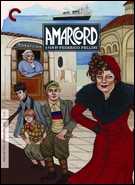
All Rise...There's no doubt about it: Federico Fellini was and remains a filmmaking master. Want proof? Just feast your eyes on this 1973 reminiscence of his early life in pre-World War II Italy, given all the more sparkle, thanks to the Criterion Collection. Editor's NoteOur review of Amarcord (Blu-Ray) Criterion Collection, published February 21st, 2011, is also available. The ChargeFellini's fabulous look back Opening StatementMemory is a funny thing. Though it literally translates as "the mental faculty of retaining and recalling past experiences," there is more to it than just the dictionary definition. No, memory has many elements and several interlocking ideas. Some people's reminiscences are almost photographic, loaded with dimensions and details while faultlessly evoking the actual events. Others approach remembrance almost wistfully, unable to see people or places clearly because of varying emotional and practical obstacles. It is safe to say that many of us are in the middle—capable of considered recall, but also wanting to filter out the occasional bad time while amplifying the otherwise ordinary good. The same can be said of art. Talent can be used to suggest precedent that is painstakingly recreated, solely enigmatic and evocative, or somewhere buried in between. What would you call a film that functions effortlessly inside all three? How would you describe a filmmaker who can provide meticulous details one minute, over-inflated romanticism the next, and a clever combination of the two throughout to forge a kind of universal flashback? The answer would be Amarcord, the Academy Award-winning memoir from master moviemaker Federico Fellini. Not only is this early '70s effort one of the director's most delightful films, it's that true cinematic rarity—a movie that utilizes all styles of memory to make its remarkable magic. Amarcord: The Criterion Collection presents it in a two-disc special edition. Facts of the CaseFor the Biondi Family, life in late '30s Rimini, Italy, is a combination of tradition and trials. When the dandelion blossoms fill the air, the town knows that spring is right around the corner. Soon, a ceremonial bonfire burning out the "wicked witch of winter" will be lit, highlighting the new season. For the two Biondi boys, Titta and Oliva, this life is a confusing mixture of familial duties, peer pleasures, and educational exasperation. At their school, the duo learn more about delinquency than any scholarly subject. Truth be told, Titta and Oliva would rather spend their days in town, staring at the promenading ladies like Grandisca, town whore Volpina, or heavy-chested Amazon who works at the tobacconist. Naturally, such longings get the boys in trouble and their parents Miranda and Aurelio are livid with how poorly behaved they are. After all, isn't it bad enough that the family has Teo, an insane relative locked up in a country sanitarium, and Uncle Patacca, a lumbering lothario who provides companionship, for a price, to the visiting European heiresses. Even Grandfather is starting to lose his marbles. With fascism on the rise and time tripping along providing its own inevitable tragedies, the young men and their friends will soon come face to face with a world out of whack over politics and pacts. Until then, they will have this year in a life, a time to create the memories that they will recall over the many decades to come. The EvidenceLike the pages of an old family scrapbook come to life or the exhibits in a town museum magically animated and alive, Federico Fellini's Amarcord (a phonetic play on the phrase "Mi Ricordo"—"My Recollections"—as spelled in the Emilia-Romagna dialect of the filmmaker's hometown) is a home movie helmed in an Italian version of Hollywood splendor. Fellini bases his work on one year, the change in seasons, and the joys and sorrows that come with the seasons. The gifted Mediterranean master of excess pulls back on the reins of overkill to forge his own portrait of an artist (presumably himself) as a young man. Utilizing a vignette approach to narrative, this winsome 1973 offering is considered by many to be the filmmaker's final attempt at greatness, a well-realized return to form that would never be repeated during the remainder of his scattered career. A companion piece of sorts to Roma, Fellini's 1972 impressionistic look at the fabled Italian city, Amarcord attempts to recreate memory out of pure cinema, using celluloid as the synaptic connections that bring all our pasts to life. There are so many thematic lines running throughout this thoughtful and kinetic motion picture—the adolescent fascination with sex, the incompetence of Italy's educational system, the iconic glow of the era's rising fascism, the impenetrable importance of family—that one wonders if the maestro will be capable of completely considering and then fleshing out each and every one. In fact, part of the fun in watching this film is seeing Fellini experiment with his subject matter, balancing merriment with the meaningful to address any and all audience concerns. What we end up with is the ecstasy of storytelling meshed with the splendor inherent in cinema's image-based medium. Fellini cannot make a visually dreary film. There is just something in his personal structure that keeps his compositions overloaded with illustrated wonder. From a lone individual walking along the seashore to a food vendor's anecdote about a hotel full of harem girls, Fellini's canvas in Amarcord is layered with nostalgia, buffered with beauty, and sprinkled with the spice this director is known for. It's not as surreal and insular as Satyricon or Juliet of the Spirits. It's not as solely symbolic and figurative as 8½. There doesn't appear to be the grudge against a certain entity (like the media in La Dolce Vita) or a clear desire to attach importance to particular interpersonal elements (as sex is in Casanova). No, for Fellini, Amarcord is a leisurely trip into the past, a chance to reconnect with his roots and joke about growing up in the shadow of Mussolini and World War II. However, Amarcord is not like John Boorman's Hope and Glory or Guillermo Del Toro's The Devil's Backbone. No, Amarcord may explain why fascism took hold in Italy, but Fellini finds more important social significance in the heart and the home. While Amarcord is not an overtly political film, Fellini obviously has mixed emotions about the fabled Il Duce and his band of black shirts. On the one hand, he paints the fascists as fools, dressed up in their gauche uniforms and traipsing around town like models on a runway. For some, Musollini and his followers are sexy and exciting, like movie stars without the screen credits to support such adulation, but when a "subversive" element sneaks in during a celebration, the fascists turn evil, cracking down on anyone they believe is a dissident. It's an interesting dichotomy to explore. Fellini fills the streets with a considered cloud of dust when Mussolini's followers march into town. Such a symbol of vision obscured and true purpose muddied is rather heavy-handed. However, when our father figure in the movie is forced to soil himself during an interrogation, the gross-out humor employed by the director is far more subtle. We are to laugh at such scatology as well as see the deeper meaning. To Fellini, fascism was obviously a joke, a ridiculous confusion of stances and statements that resulted in people fouling themselves over how to respond. It's a minor moment in the movie—the rally that occurs midway through the only real mention of the ideology and its application—yet it helps define the people we are dealing with and the town at the center of the story. Similarly, the intelligentsia of Fellini's home is given a ripe denouncement
at the hands of their most famous pupil. School is viewed in several ways during
Amarcord—as the standard social circle, the connection between
country and citizen, etc.—but the main element at play is a sense of
incompetence and insularity. There is a montage toward the beginning of the film
where Fellini runs down the various classes that his adolescent alter ego must
endure. They include a clueless instructor of Greek, an overtly sexual matron
spewing mathematics, obviously lost lecturers on history, and a choice chosen
few who can't do, teach, or teach gym. Speaking of Woody Allen, the opening
moments of Annie Hall are obviously
influenced by Amarcord, as both films take an anecdotal, almost slapstick
approach to childhood and growing up. Indeed, after watching this amazing
two-hour trip back in time, the influence on other directors is abundantly
clear. While he is well known for introducing outrageous spectacle and decadent
excess to the cinematic language, Fellini was first and foremost a visual
filmmaker. As in this sequence and several others here and throughout his
oeuvre, he would rather say in images what could also be argued in words. Indeed the most telling aspect of Amarcord is what is says about Fellini as a man and as a filmmaker. In some ways, this film is a primer on how environment and individuals came to inspire this director's varied visions and how soon to be cinematic stock elements like sex, church, authority, family, and death were deliberated and defined. While many can point to the director's varied canon and consider all these ideas, Amarcord is a purposeful record of the reasons behind a particular filmmaker's muse. Better still, it argues for Fellini's artistry in a way that no documentary or critical overview could create. Finding inspiration everywhere—in fairytales (there's a nice Brothers Grimm lift toward the end), Hollywood spectacle (the Busby Berkeley-like harem dance and the town's sea voyage to see a famed Italian luxury liner), and outright dreamscapes (the winter's wondrous first snow)—he countermands the truths of the world by consistently viewing them through the eyes of a reality romantic. Amarcord is a case of late-stage motion-picture male menopause, a chance to revisit the carefree circumstances of the past without being centered on their current consequences. Too much time has passed to worry over the influence of fascism or the tobacconist's extra large bosom. Flawlessly filmed, sumptuously styled, and as friendly as the always-available Volpina, this is cinematography of the highest caliber. As experience, Amarcord is entertaining. As memories, it's a masterpiece. By now, it's an industry given, but it never hurts to repeat such praise: Criterion consistently delivers some of the finest, more expertly realized DVD packages in the history of the medium. Beginning with the pristine 1.85:1 anamorphic widescreen transfer provided to Amarcord and the wealth of added content spread out over two entire discs, one would be hard-pressed to improve on this cinematic preservationist's flawless presentation. Even the late, great Nino Rota would be excited by the clean, crisp Dolby Digital Mono mix. Unlike most one-track mixes, this is a full-bodied and atmospheric offering, with lots of aural flavor added to the celebratory musical score. All dialogue is easily discernible and the English subtitles are excellent, never devolving into slang or formality. However, what most fans of Fellini and this film will truly enjoy is the amazing extra features added to this release. Beginning with an academic and detailed commentary from film scholars Peter Brunette and Frank Burke, and ending with a massive booklet featuring a new essay from Sam Rohdie and the full text of Fellini's own 1967 essay "My Rimini," there is a near-perfect amount of considered context provided. To be more specific, Disc One contains the aforementioned alternate-narrative track and both participants provide an excellent, erudite view of the film. Some may feel that Brunette and Burke read too much into what is really just a Fellini flight of fancy, but their insights do expand our knowledge and appreciation of the film. We are also treated to a scatological deleted scene. Presented without sound, it shows a sewer worker being called in the middle of the night to retrieve a ring for a pair of privileged swells. Even without dialogue, it's exceedingly comic. Disc Two holds just as many riches. First off, there is a 45-minute documentary that focuses on Fellini, his hometown, and the myths and realities of his past. It paints the director in a very devious, deceptive light, but also argues for the influence the village and its people had on his creative aesthetic. We learn even more about the filmmaker from his own interview with close friend and confidant Gideon Bachmann. While not the easiest Q&A subject, especially when the conversation turns personal, Fellini still offers up some tasty private tidbits. Digging even further, Bachmann adds almost an hour of conversation with friends, family, and those familiar with the director. They close the gaps the maestro chooses to ignore. The final interview subject is actress Magali Noël, who played Grandisca, and her memories are mostly fond, her views ever so slightly skewed. When you add in the restoration demonstration, the gallery of sketches the director himself made as guidelines for the characters, and a remarkable display of "Felliniana"—a selection of artifacts promoting the film—you get another stellar Criterion DVD release. If consistency were a virtue, this company would be divinity. Closing StatementThough we are always reluctant to admit it, the past is not the perfectly-preserved chronicle created by director Federico Fellini in his final masterpiece Amarcord. No, the truth is more blunt, the reality more dull than delightful. Part of the problem is the concept of memory itself. As we age, our filters falter. Too much information leaks out, while way too much melancholy remains. We grow equally poetic and prosaic, carefully crafting our recollections to maximize happiness and significantly reduce suffering. Sure, most people pretend to have a realistic handle on what happened to them in youth or in young adulthood, but the truth is far more troubling. A long time ago, we were bored just as often as we were engaged, angry just as frequently as we were carefree. While Amarcord may be an attempt by Fellini to flesh out his influences while continuing to paint his cinematic canvases with images both real and fabulously fictitious, there is no denying its brilliance as art. Biography is never as beautiful as this, and interestingly enough, fiction is never as colorful, either. No, it takes a clever combination of the two to resonate as triumphantly as this. Amarcord may not be his best, most wholly-realized work of visionary genius, but it doesn't diminish Federico Fellini as a master of the motion-picture medium either. Instead, it's a creative amalgamation of gem and joke. It's impossible not to appreciate both. The VerdictNot guilty. One of the best movies of all time is given a decidedly definitive DVD presentation. Case closed. Give us your feedback!Did we give Amarcord: Criterion Collection a fair trial? yes / no Other Reviews You Might Enjoy
• The Truman Show: Special Edition |
|
DVD | Blu-ray | Upcoming DVD Releases | About | Staff | Jobs | Contact | Subscribe | | Privacy Policy
Review content copyright © 2006 Bill Gibron; Site design and review layout copyright © 2015 Verdict Partners LLC. All rights reserved.