| Home | About | Blu-ray | DVD Reviews | Upcoming DVD Releases | Contest | Podcasts | Judges | Jury Room | Contact |
|
|
|
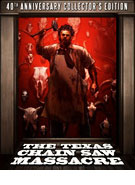
All Rise...Judge Daryl Loomis truly does love head cheese. It's really tasty. Editor's NoteOur review of The Texas Chain Saw Massacre (1974), published November 3rd, 2000, is also available. The ChargeWho will survive and what will be left of them? Opening StatementWhen somebody asks me to name my top ten horror films, it gets pretty difficult and, mostly, depends on the day and my mood. But if somebody wants to know my favorite film in the genre, the answer is easy. There are two that occupy equal space in my mind: Dario Argento's 1977 nightmare, Suspiria, and this, The Texas Chain Saw Massacre. No matter how many times I've seen it, Tobe Hooper's 1974 debut sustains its effectiveness. Over the years, I've come to regard it as one of the greatest American independent films ever made, regardless of genre. Now, for its 40th anniversary, we have the most exhaustive edition of the film ever released and, having never written a word about this movie before, I'm thrilled to be reviewing it today. Facts of the CaseFive friends head out to central Texas for some reason and decide to stop in a tiny town where an old family home sits abandoned. They drive out there to see it, but on a hunt for gas, they stumble upon an adjacent home that they wander into, where they are discovered by the homeowners, a family of maniacs who slaughter people, eat the victims, and then use the carcasses for a myriad of purposes. The EvidenceWhile its cult status is clearly established, I rarely hear it talked about in those high-tone circles that Citizen Kane, say, or Bonnie and Clyde inhabit. It's a shame, because The Texas Chain Saw Massacre is gold the whole way through, with almost nothing to diminish it. The opening narration—by Night Court's John Laroquette, of all people—immediately gives the movie a true crime feel and the Polaroid flashes that follow reinforce that with crime scene imagery. Following that, the ultraviolet sun flare scene then undermines it with a bit of surrealism. The result, even today after seeing it countless times, it gives a sense of the unknown to the movie, which carries through as the story begins. It's not even really a story so much as a sequence of events in one hell of a terrible Texas day. And I lived there; there are plenty of terrible Texas days. The kids show up, act irritating, and then die. Today, this is a commonplace narrative, but at the time, was an incredibly economical way to off your characters. There's no big twist, no dumb gimmicks, and no jokes. It's just unadulterated tension, an agonizing experience that is basically unmatched in the history of horror. But unlike so many pretenders, The Texas Chain Saw Massacre does it with class. The level of violence in the movie is through the roof, but Hooper shows little of it. There are some blows delivered, especially with the sledge hammer, but blood is at an absolute minimum. Maybe three ounces of blood is drawn over the course of the movie, no matter how gory people remember it. That's a big reason why I regard The Texas Chain Saw Massacre so highly. It's a special feat to make people remember the existence of content that doesn't actually exist; to effectively terrorize your audience so they come away shocked and disturbed when not much happened at all. If anything is movie magic, it's that. No wonder Hooper's later work has never been regarded so highly. When you come out of the box and change an entire well-established genre, people are going to harshly judge what follows. But it's not just the memory thing that makes The Texas Chain Saw Massacre special. There's a rhythm to it, a chaotic rhythm, no doubt, but one that's reminiscent of modern jazz. Just look at the infamous dinner scene. Sally (Marilyn Burns, Helter Skelter) sits tied in a chair crying and screaming. The family around her mocks her terror, laughing and pretend crying at her. All the while people are screaming and Hooper's soundtrack (a combination of screeches and found sounds) is blaring through the mix. All of this is punctuated by a staccato editing style that combines wides and tights with super close-ups of Burns' eyeballs. It's a maddening sequence that is at once horrific and hilarious, which is really one of the hallmarks of this movie. Every time I watch The Texas Chainsaw Massacre, I laugh more and more. I don't think I'm getting more jaded; I think Hooper's pitch-dark sense of humor just resonates more for me than it ever used to. The way the characters interact, with a realistic level of annoyance, and the delivery of lines from Jim Seidow (The Windsplitter), who plays the dad/brother/cook of the family are fantastic, and the ultra-irritating performance by Paul A. Partain as Franklin Hardesty is so incredibly annoying that it's funny…Hooper himself describes how happy he was to kill off the character, so you know there's something there. All of this doesn't even mention the extraordinary work by Gunnar Hansen as Leatherface. With no lines and no face, Hansen builds a complete character, one who really is more complete than those in the movie with lines and faces. It's no wonder then that, in an increasingly sequelled and franchised horror climate, producers would want to bring the character back for future films. But it turns out that it isn't the character that people care about, but Hansen's performance, which gives the character a real personality that is totally non-existent in the sequels. There are so many ways that I love The Texas Chain Saw Massacre. It's a mean, relentless film that works brilliantly from start to crazy, maddening finish. To this horror lifer, this is the essence of terror. Seriously, The Texas Chain Saw Massacre doesn't F around, and neither does this 40th Anniversary Collection Blu-ray from Dark Sky, who has released the definitive version of this seminal film. Presented over two Blu-ray discs, this thing has the works, starting with a fantastic 1.85:1/1080p image transfer. There's nothing in the world that's going to make the movie look beautiful, but it looks exactly as it should, with clarity that hasn't existed on any print I've ever seen. The grain is still heavy and there remains no doubt as to the cheapness of the movie, but there is detail here like I've never seen before, realistic warm colors that replace the yellows of old releases, and black levels that are as deep as I can image you're ever going to get from this movie. The sound mix selection should satisfy any set of years, as there are four different ones from which to choose. My preferred track, the single channel lossless, is an excellent reproduction of the original mix. It's clear and strong, with crisp dialog and a soundtrack that never gets lost in the mix. The TrueHD 7.1 track is equally excellent, but it's a whole different animal. They did a good job with it, getting heavy use out of the surround channels with a lot of spatial effects. Some will really appreciate the work that they've done for it, but I'm more of a purist when it comes to that stuff. There are also Dolby 5.1 Surround and 2.0 Stereo tracks, but these are more standard lossy affairs. For as great as the technical presentation might be, it's the slate of extra features that will draw fans to a new addition of a movie they almost certainly already have. Not all of them are new, but most of them are valuable. On Disc One, we have four separate audio commentaries. Two are from the previous Blu-ray, while two were recorded for this release. The first, best one features Hooper, Gunnar Hansen, and cinematographer Daniel Pearl (Zapped!). They go through the production very thoroughly and are an engaging, entertaining trio. The second previously recorded commentary brings us actors Marilyn Burns, Allen Danziger, and Paul A. Pertain, who are joined by production designer Robert Burns, which is also fun, though I was hoping Marilyn Burns would talk more from her perspective about the brutal filming that we hear so much about in the first one. The first new one is a more technical talk with Hooper by himself, while the second brings back Pearl, along with editor J. Larry Carroll and sound recordist Ted Nicolaou. If you didn't learn enough about the movie from those six hours, Disc two offers nearly five hours more for you. Again, some of this stuff is recycled, but it's great to have it all collected here: • The Texas Chain Saw Massacre: The Shocking Truth: This 72-minute documentary is your standard making-of documentary. It's strong and informative with some good footage. • Flesh Wounds: Seven Stories of the Saw: This second 70-plus minute documentary, this time telling some lesser known or marginally related stories about the film, like how Hansen secured the Leatherface role and what it's like to run a convention. • Off the Hook with Teri McGinn: Here, we find an interview with the actress who played Pam, who has traditionally been quiet about her part in the film, as she opens up about her experience. (17min.) • Making Grandpa: This short feature introduces us to Dr. W.E. Barnes, the plastic surgeon who designed and built Grandpa's mask (3min.) • A Tour of the TCSM House with Gunnar Hansen: Leatherface is back, this time to show you around the house, which looks like a normal house. (8min.) • The Business of Chain Saw: This interview with production manager Ron Bozman gives us the scariest side of the film: the financial side. (16min.) • Grandpa's Tales: Here we have John Dugan, the man who played Grandpa as a teenager, which has always struck me as funny. This isn't terribly interesting, though. (16min.) • Cutting The Texas Chain Saw Massacre: This interview is with editor J. Larry Carroll, who gives us his perspective on the movie and its impact. (11min.) • Horror's Hallowed Grounds: This is a 2006 episode of a fan show, in which host Sean Clark takes us on a tour of the locations. • Deleted scenes and outtakes: 25 minutes of deleted scenes come from the previous Blu-ray, while a full 15 more minutes are new additions, though presented silently. • A photo gallery, trailers, TV and radio spots close out the disc. Closing StatementI'm sure there are people out there who don't like The Texas Chain Saw Massacre, but I wouldn't know because I don't associate with those people. There are very few movies of any kind, let alone horror, which manage to remain effective after multiple viewings. That's why it's classic American cinema: its core power remains unchanged forty years after its release. The VerdictCase dismissed. Give us your feedback!Did we give The Texas Chain Saw Massacre (1974) (Blu-ray) 40th Anniversary a fair trial? yes / no Other Reviews You Might Enjoy
• The Skeleton Key |
|
DVD | Blu-ray | Upcoming DVD Releases | About | Staff | Jobs | Contact | Subscribe | | Privacy Policy
Review content copyright © 2014 Daryl Loomis; Site design and review layout copyright © 2015 Verdict Partners LLC. All rights reserved.