| Home | About | Blu-ray | DVD Reviews | Upcoming DVD Releases | Contest | Podcasts | Judges | Jury Room | Contact |
|
|
|
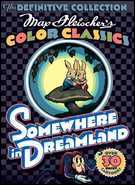
All Rise...The ChargeThe definitive collection! Opening StatementHighly acclaimed upon their original release, the 36 shorts that make up Max Fleischer's unique Color Classics series have, in recent times, not received the proper respect from historians. Through TV and public domain video exposure, the shorts have remained in the public eye. Now VCI Entertainment, in association with Kit Parker Films, has issued 35 of these classic shorts in a two-disc set. Facts of the CaseA Brief History of the Fleischer Studios It was during that period, 1924 to be exact, that Max Fleischer began to experiment with sound in his cartoons. Utilizing his rotoscope, he created the Screen Song film series. These cartoons often blended live action and animation. A popular song of the day would be performed as the centerpiece, with a large bouncing ball encouraging the audience to sing along. Critics dismissed the sound cartoons as a novelty. Thus, it was Walt Disney who received credit for the first sound cartoon in 1928 with Steamboat Willie. In 1930, the Fleischer Studios made their first serious reputation with the creation of Betty Boop. The first Boop cartoon, Dizzy Dishes, became a smash. Betty remained popular until the mid-1930s, when the Production Code forced the shorts to be radically toned down. By then, however, the Fleischers had a new ace up their sleeves—the celluloid debut of Popeye the Sailor. Things changed in 1934 when Walt Disney won the Oscar for the first color cartoon, Flowers and Trees. Max, sensing a movement, created his own series of color cartoons, titled Color Classics. Through 1941, the Fleischers made 36 unique visions. After two ambitious and brilliant feature-length animated films that proved financial disappointments at the box office, the Fleischers were ousted from Paramount. Max would produce and direct one final short, Rudolph the Red Nosed Reindeer, before retiring in 1944. Dave would continue directing until 1948's Famous Studios production, Base Brawl. He then became a songwriter and composer. The EvidenceBefore I begin, I'd like to talk a little bit about how I discovered the Fleischer shorts. Seventeen years ago, my mother gave me—for Valentine's Day—a video tape. It was one of those public domain tapes that were then starting to become popular. I remember it like it was yesterday. I popped that Little Lulu tape into the VCR and was hooked. It was from the Famous Studios period (1943-59) and it was like nothing I'd ever seen before. Over the next eight years or so, my collection grew and grew. So where am I going with this? Well, on these tapes, while famous characters like Bugs Bunny, Woody Woodpecker, and Heckle & Jeckle were prominently featured, a Max Fleischer Color Classic or a Noveltoon (another series from the Famous Studios era) would usually be thrown in as an afterthought. These unique cartoons were always something special. And that's how I learned about Max Fleischer. Max Fleischer was an animator who has never received the credit he deserves. His inventions, the rotoscope and the stereo-optical printer, were ahead of their time. They became cornerstones for various animators many decades later, most notably the Bronx-born animator Ralph Bakshi. Fleischer created sound cartoons long before Disney did. He experimented with black humor in cartoons long before it became fashionable to do so. His cartoons reflect an optimism and sophistication that have gone over too many people's heads. Fleischer included an incredible amount of detail and textures that many of his contemporaries did not bother with. His quick exit from Paramount and the subsequent sale of his cartoons to television have done damage to Fleischer's once-formidable reputation. Here are a few things to look for when watching a Fleischer cartoon: • A sense of optimism. Disney shorts usually ended with the villain getting his comeuppance via death or destruction. Max Fleischer always opted for redemption (Little Dutch Mill), dislocation (The Cobweb Hotel, The Great Vegetable Mystery), or some other non-lethal resolution. • Black humor. The Fleischers loved to sprinkle their cartoons with bizarre comic touches. An example is Poor Cinderella, when the pumpkin expresses his gratitude for not being made into pie. • Dark tones. There is some very dark material to be found in some of these shorts, an antidote to the innocence of Disney's shorts of the period. • Consistent color shades. The early Color Classics were made in CineColor, a two-tone color system based in shades of red and green. Even with the switch to Technicolor in 1936, pay close attention and you will notice that all the colors are variant shades of each other. • Three-dimensional backgrounds. Contrary to popular belief that 3D animation arrived with the Pixar films, Max Fleischer and his brother Dave were the first to experiment with the format. They built real backgrounds, filmed them on rotating table and then did their animation right on top of the image. It was quite revolutionary for the time, and in a way it still is. A brief note before we discuss the shorts featured in our program. Thirty-six shorts were made between August 1934 and January 1941. Production was halted when the Fleischers made a stab at the animated full-length feature market with Mr. Bug Goes to Town (later retitled Hoppity Goes to Town). The film failed miserably at the box office. After eight expensive ($100,000 per short) Superman shorts, Paramount decided to let the Fleischers go. Max left things in the capable hands of his son-in-law Seymour Kneitel, who renamed the unit Famous Studios and continued to make high-quality shorts until Paramount shut down the animation department for good in 1959. Meanwhile, in 1955, Paramount sold most of its animation catalog to the UM&M TV Corporation. The original Paramount logos were cut from the negatives, as were the opening title cards, replaced with a new credits sequence featuring bland yellow lettering on a red background. This practice ended in 1957, only to be replaced by an even worse system. A bland NTA logo was substituted for the Paramount logo, but the original credits were retained. Those original title cards underwent some changes. All references to Paramount were eliminated from the prints, either by blacking out the words or physically burning them from the frame. The end result looks like crude letterboxing. What VCI and Kit Parker have done is give these shorts back their dignity. The original Paramount logo has been restored to the beginning and end of each of these shorts. They have also restored the original title cards where possible. Sadly, some of these no longer exist, so new opening credits in the same style and format have been created and added to these prints. They don't look perfect, but at least they have been restored as close to their original state as technology allows. Thirty-six shorts were produced in the Color Classics series. All but one of these are featured in this collection. The missing cartoon, 1938's Tears of an Onion, is one of the few Fleischer shorts whose rights are still held by Paramount. Four shorts are presented in the accompanying documentary on Disc Two. (Those shorts were the last to be located and were considered too poor to restore. Can I get a collective huh?) The remaining 31 shorts are spread over two discs. Like my review of the Looney Tunes set, I will be using a scale of zero to four stars, since these were first shown theatrically. • Poor Cinderella, released August 3, 1934 • Little Dutch Mill, released October 26, 1934 • An Elephant Never Forgets, released December 28, 1934 • Song of the Birds, released March 1, 1935 • Dancing on the Moon, released July 12, 1935 • Somewhere in Dreamland, released January 17, 1936 • The Little Stranger, released March 13, 1936 • The Cobweb Hotel, released May 15, 1936 • Greedy Humpty Dumpty, released July 10, 1936 • Hawaiian Birds, released August 28, 1936 • Play Safe, released October 16, 1936 • Christmas Comes But Once A Year, released December 4,
1936 • Bunny Mooning, released February 12, 1937 • Chicken A La King, released April 16, 1937 • A Car-Tune Portrait, released June 26, 1937 • Peeping Penguins, released August 26, 1937 • Educated Fish, released October 29, 1937 • Little Lamby, released December 31, 1937 • Hold It! released April 29, 1938 • Hunky and Spunky, released June 24, 1938 • All's Fair at the Fair, released August 26, 1938 • The Playful Polar Bears, released October 28, 1938 • Always Kickin', released January 26, 1939 • Small Fry, released April 21, 1939 • Barnyard Brat, released June 30, 1939 • The Fresh Vegetable Mystery, released September 29,
1939 • Little Lambkins, released February 2, 1940 • Ants in the Plants, released March 15, 1940 • A Kick in Time, released May 17, 1940 • Snubbed by a Snob, released July 19, 1940 • You Can't Shoe A Horsefly, released August 23, 1940 The full frame transfers are uneven in quality. As Beck explains in his liner notes, the source material varies from short to short. Some cartoons were transferred from original 35mm copies, and those shorts look terrific. There are scratches and specks, but that is due to the fact that these are copies and not original negatives—copies sometimes tend to have these defects permanently burned into the image, due to the primitive duplication process called "dry printing." Others were culled from 16mm dubs that are, needless to say, subpar in quality. VCI and Kit Parker have done the best they could to undo the damage and clean them up, but the transfers still look mediocre at best. The Great Vegetable Mystery looks particularly awful as does The Cobweb Hotel. (I've seen better public domain copies of that short, but then again that was over fifteen years ago and on VHS to boot.) Despite these negatives, I still praise VCI for making the effort to preserve these shorts. First, Lord knows Republic/Artisan aren't doing squat in terms of restoration. Second, even the 16mm prints used here have truer, bolder colors than many of the public domain prints I have seen over the years. For example, the public domain VHS copy of Kids in a Shoe I own has an amber tone that never leaves. VCI's presentation is clean and shows accurate color. Audio is presented in Dolby Digital 2.0 mono. I praise VCI for resisting the temptation to alter the soundtracks through added music and sound effects to create "stereo" sound, as Winstar did with their Max Fleischer discs. VCI has given the tracks a digital scrub, some with spectacular results (Poor Cinderella and Christmas Comes But Once A Year both sound near perfect) and others sounding quite poor (Peeping Penguins, Hold On, and The Cobweb Hotel all retain crackling sounds, and some shorts, such as A Car-tune Portrait, are missing musical cues). Still, you will be able to understand the music and dialogue, and you won't have any serious problems with your sound system. (In short, you'll be able to keep it set at one volume throughout the two discs.) I offer high marks for just making the effort to get the sound as clean and professional sounding as possible under the circumstances. And as the icing on a very satisfying cake, VCI has included some terrific, invaluable extras. We start with Max Fleischer's Color Classics: The Lost Episodes. This 40-minute documentary presents four Color Classics shorts that were thought to be goners. Very poor prints were miraculously located and new 35mm copies were struck. There is not much in the way of restoration, but through their efforts, accessible copies are now available to us. The four shorts, on a scale of zero to four stars, are: • The Kids in a Shoe, released May 19, 1935 • Time for Love, released September 6, 1935 • Musical Memories, released November 8, 1935 • Vitamin Hay, released August Next up are ten commentary tracks, located on Poor Cinderella, Little Dutch Mill, An Elephant Never Forgets, Dancing on the Moon, Somewhere in Dreamland, Christmas Comes But Once A Year, Hold It!, All's Fair at the Fair, The Great Vegetable Mystery and Ants in the Plants. Historian Jerry Beck appears on these tracks. You might remember him from The Looney Tunes Golden Collection. This set was a pet project of Beck's for several years—the tracks are a labor of love, always interesting and insightful. Except for Poor Cinderella, he is joined by animator Mike Kazaleh, who is quick to point out details most will overlook. I recommend listening to all of these tracks, although you might want to skip through the segments in which Betty Boop's voice pops up. Last, but certainly not least, is an extensive stills gallery. Fleischer storyboards and artwork appear. This gallery is invaluable if you want to learn more about how these classic shorts were built from paper to celluloid. Closing StatementWith a suggested retail price of $29.99, this is one set you simply cannot pass up. Granted, the restorations are not in the same league as the Looney Tunes sets. Considering that the original negatives were declared off limits, VCI and Kit Parker have done a remarkable job packaging these shorts in much more presentable fashion than one has been accustomed to over the last three decades. Those still unsure…just buy the damn set! I guarantee satisfaction will be yours. The VerdictVCI Entertainment and Kit Parker Films are both acquitted of the charges brought against them. They are to be commended for doing the hard work to preserve these works of art. I would like to put a pox on Republic Pictures/Artisan Entertainment for being content to allow these shorts to gather dust in a vault somewhere. The Scheme is worthy of a DVD presentation, but not your Max Fleischer/Famous Studios shorts? With the recent acquisition of Artisan by Lions Gate Entertainment, perhaps some action will be taken to rectify this pattern of poor selection. Jerry Beck is given a citation for his involvement with the project. His enthusiasm has not gone unnoticed. Finally, Max and Dave Fleischer, along with their team of animators, are sentenced to live on in our memories. Their work has been ignored for far too long, and if this critic has anything to do with it, their reputation will rise again. Case dismissed! Give us your feedback!Did we give Somewhere In Dreamland: The Max Fleischer Color Classics a fair trial? yes / no |
|
DVD | Blu-ray | Upcoming DVD Releases | About | Staff | Jobs | Contact | Subscribe | | Privacy Policy
Review content copyright © 2004 Bill Treadway; Site design and review layout copyright © 2015 Verdict Partners LLC. All rights reserved.