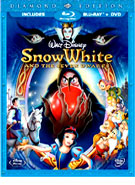
The Evidence
It's difficult to argue with a classic. Snow White and the Seven
Dwarfs is a historical landmark, the touchstone for feature animation, whose
success built an empire. Seriously. It may be sacrilege to say, but I can take
or leave many of the original Disney shorts. Save for a handful of truly
indelible experiences, many of the characters are interchangeable and most of
the stories are ultimately forgettable. But with Snow White, Walt and his
team made us care. Like any great live-action film, we're invested in the
well-being of the heroes and the eventual downfall of the villains. Yes, the
story is considerably more pedestrian than the complex, multi-layered tales
we've come to know and love from the House of Mouse and its Pixar brethren, but
it's from this font that everything else has sprung. Without the blood, sweat,
tears, love, and laughter that went into the creation of this film—despite
all odds—movies like Sleeping
Beauty, Beauty and the
Beast, and WALL-E would never have
existed…at least not in the form we know.
Loaded with Disney's trademark gags—a staple of their shorts from
Oswald the Rabbit through the Silly Symphonies—Snow White weaves
them into a rich tapestry of story heretofore unseen by 1930s moviegoing
audiences. This is not at all what they expected of the 8-10 minute cartoons
which often played before the feature film, which is why everyone though Walt
was off his nut to craft a 90 minute animated tale. But contained within we find
mystery, drama, a despicable villain, a damsel in distress, a dashing prince,
and seven clowns for comic relief. What more does a movie need?
There are those who point to Snow White as being a terrible example
for young girls, its underlying message being one of "wait around for a man
to come sweep you off your feet and care for you the rest of your life."
But let's not overlook the fact that Snow is not exactly helpless. She's smart
enough to get the hell away from her whacked out stepmother, exhibits natural
parenting skills, and is one hell of a cook. It's not like she's some celebutard
sponging off her parents fortune. And let's face, her family isn't the picture
of stability. In the original Brothers Grimm tale, The Queen was Snow's real
mother. It's bad enough your stepmother tries to have you killed, but your
actual birth mother? That's messed up. Here she only needs daily validation for
her appearance. That's whacked enough. And how catty is the Mirror to torment an
already unstable woman? That's just pure evil. Of course, we don't really know
who or what the being in the mirror truly is—an eternal, a demon, the soul
of her dead husband (Snow's father)? We may never know. Whoever it is, being
held captive by a mentally imbalanced royal who asks the same damn self-absorbed
question day in and day out is enough to make anyone cranky.
In the pantheon of Disney villains, The Queen is a one trick pony. Like
Severus Snape, she's a potions master. Big deal. Sure, she has dead prisoners in
her dungeon, and her transformation into the old hag is quite shocking, but
she's nowhere near operating on the level of Maleficent, Ursula, or Jafar. There
are a couple indications she may have control of the weather, which if true
makes you wonder why she goes to all the trouble of taking Snow out in person,
rather than creating some type of storm to wipe out the entire forest. I mean,
she doesn't seem like the type to get her hands dirty very often. And really,
even if she succeeds in killing Snow White, what's she gonna do, starting
killing off every beautiful young girl in the country the minute they come of
age? That's a battle you have no chance to winning, lady.
As a Disney princess, Snow falls on the lower end of the spectrum. Yes,
she's beautiful, she can sing, dance, and cook, but has very little personality,
no back story, and her boyfriend is little more than a Ren Faire minstrel. In
fact, we don't know anything about this guy and neither does she. This
relationship could be a disaster in the making, although that castle in the
clouds is not a bad place to get acquainted. Plus, she inherits everything her
stepmother left behind, including the mirror, which could prove to be quite
profitable…if you treat him right. So, there might be hope for these two
kids after all.
The Dwarfs themselves owe a lot to The Marx Brothers, Laurel and Hardy, and
The Little Rascals. Age those cinematic icons up 30 or 40 years and you have a
lot of the same motivations and schtick. But where those characters remained
relatively the same throughout their films, the dwarfs grow and change from
having Snow in their life, Grumpy especially, which is what makes them so
endearing even 70+ years later. These guys have personality to spare and it's
amazing the company didn't do more with them. But maybe that mystique is a large
part of their charm. Two or three sequels later and we may want nothing more to
do with them. One thing that's always bugged me is that we're never sure if
they're all related. The animals hint to Snow that they're orphans, leading one
to believe they may be brothers. Who knows, maybe their home is a European
precursor to the YMCA.
But I digress…I encourage you to read Judge Michael Rankin's beautiful
critique of the film from it's Platinum DVD release. Before that, let's you and
I cut to the chase and talk about the upgrade.
Although experimentation with the widescreen format began in the late 1920s,
the depression made it far too expensive for practical use. As such, Snow
White and the Seven Dwarfs was shot in the classic 1:37.1 format. However,
much like their Blu-ray release of Pinocchio, Disney has leveraged the
talents of artist Toby Bluth (brother of legendary animator Don Bluth) to paint
the sidebars in the style of Gustav Tenggren who defined the look of the film.
As such, we are able to view the tale through a window, rather than plain black
bars. Or you could turn off the enhancement. Your choice. I prefer additional
ambience.
In playing the Platinum Edition DVD and Blu-ray simultaneously, both images
are impeccably clean, but there's an astounding dimensionality to the high def
presentation you just don't see in the standard def transfer. Even though the
characters are well defined, the backgrounds on the DVD blur the further back
you go. On the 1080p/AVC-encoded Blu-ray, you can literally count the knots in
the wood, cracks in the plaster, and brush stokes of the painters. More
importantly, the lighting is considerably more effective in high def, making the
DVD image seem dark in comparison. Like fine silver buffed to a pristine shine,
the Blu-ray makes the previous transfer seem worn and flat. Here everything
looks brand spankin' new. With that, there are moments you'll spot odd
disconnects in color, lighting, and art quality between scenes. It's not
anything to destroy the viewing experience. If anything, it's a nod to the
accomplishments of everyone involved that there's only a handful of visible
mistakes in a film most people thought would never get made.
Disney's 7.1 audio mix is fantastic, albeit falling a bit short of previous
Blu-ray releases. Keep in mind though, the source material they're working with,
from the technology of the late '30s, makes it impossible to sound anything like
today's modern audioscapes. Where Disney has made the greatest improvement is in
the music; it's like listening to a live orchestra and foley team in your living
room, though playing over vintage dialogue. An unsurprisingly front-heavy mix,
there's little in the way of ambient effects, but it works for the environment
we're immersed in. Audiophiles will enjoy a remastered version of the film's
original mono track, truly duplicating that 1930's experience.
Now for the Bonus Features, a staple of any Disney special edition release.
And you're in for a real treat!
First up, the Magic Mirror uses your internet connection to pull down all
sorts of information and weave it into his dialogue with you—weather
conditions, number of visits, yadda yadda yadda. It's a neat trick, but the
shine wears off quickly and, if you spend any downtime between features, you'll
find yourself getting ticked off as he continually promotes disc features you
haven't viewed yet. Shut up already!
But all is forgiven, as the crown jewel of this release is a virtual
recreation of Disney's Hyperion Studios, the birthplace of Snow White,
the Silly Symphonies, and a warehouse of classic shorts. If there was ever to be
a master class on Disney: The Early Years, this is it! Pixar's Andrew
Stanton tees up the history of the long since extinct studios, now a grocery
store in the Silver Lake neighborhood of Los Angeles. From each location, you
use your remote to cycle through various hot spots on the still image to reveal
photos, film clips, interviews, and remembrances from historians, current Disney
staff, Walt, and his team. An extremely well done feature, peppered with the
tiniest of ambient details that will haunt your audio and visual senses. I'll
clue you into a few, but challenge you to find them all. And you can always
refer back to the index checklist, which keeps track of anything you might have
missed
Exterior (Where palm trees sway…)
• The
One That Started it All (17:08)—A mini-documentary on one of the great
success stories of American cinema. Walt risked everything he had and more to
show the world that animation can be just as powerful a storytelling medium, if
not more so, than live action film. The fiscal lifeblood of the animated short
was drying up and the only way to keep it going was to produce a full-length
feature. Everything about this project was groundbreaking and despite everyone
in Hollywood having prematurely buried his career, Walt ultimately proved them
all wrong. In fact, legend has it Louis B. Mayer was so envious of Snow
White's success, he fast-tracked production on The Wizard of Oz to ride its coattails.
• Where it all Began (11:48)—An informal bed of
creative genius, founded by a 24 year old man with nothing but a dream and an
unlimited supply of passion. They were only at Hyperion for 10 years, but that
decade saw so many breakthroughs, it advanced the industry and the art form by
light years. In all honesty, many of tools still being used in animation
(traditional or CG) today were pioneered at Hyperion.
•
Family Business (1:57)—Walt fostered an environment of camaraderie,
collaboration, and creativity, a feeling that made it one of best studios to
work for.
Story Room (Do you feel a breeze?)
• Babes in
the Woods (8:04)—Animator Andreas Deja introduces this 1932 Silly
Symphony, which adapts the classic tale of "Hansel and Gretel," where
the children are befriended and ultimately rescued by gnomes. I don't know if
they punched up any of the shorts for this release, or if they're the same
quality as the Walt Disney Treasures Collection, but for a film that's almost 80
years old, this thing looks amazing!
• In Walt's Words:
The Huntsman (3:25)—Director Ron Clements introduces an audio
re-enactment compiling various story meetings about the introduction of The
Huntsman, overlaying the actual film sequence as events unfold.
• Five bucks a gag (1:46)—Incentives paid for anyone on
staff who contributed visuals gags to Snow White.
•
Gabby, Blabby, and Flabby (1:14)—Naming the dwarfs.
• Stories from the Story Room (1:14)—Includes a great
story about Walt and the pushpin dartboard. He'll get schooled later.
• Abandoned Concepts Gallery—63 sketches of unused
dwarf gags and the Queen's capture Prince Charming that bears a striking
similarity to Prince Philip's imprisonment at the hands of Maleficent in
Sleeping Beauty.
• Walt's Night Prowls
(0:52)—Like his parks, when the world went to sleep, Walt kept working.
• Storyboard Art Gallery—The entire film told in 126
frames, using sketches from every facet of story development.
Music Room (Tic-Toc)
• The Music in Snow
White (6:14)—Composer Michael Giacchino is just one of the many
talking heads to discuss the power of music in Walt's work, how it fed the
narrative more than any other films of the time, and the genius of selling album
soundtracks to keep the memory of the film alive.
• The
Skeleton Dance (6:02)—Director John Musker introduces the very first
Silly Symphony (1929). A vintage Halloween classic! Color me ignorant for not
knowing that legendary composer Carl Stalling partnered with Walt on these
shorts. Carl would later go on to become the musical lifeblood of Warner Bros.
animation.
• David Hand's Dirty Trick
(1:18)—Remember what I said about getting schooled? Never embarrass Walt
in front of a crowd.
• Music Room Host (0:48)—Ron
Clements explains the complete integration of music into the Disney storytelling
process.
Art Department (It's a bit dusty in here)
•
Music Land (10:15)—Art director Michael Giaimo discusses the
influence of artist Albert Hurter in defining the visual styling of Snow
White, as an introduction to this genius 1935 Silly Symphony. Playing off
the "Romeo and Juliet" motif with much happier results.
• In Walt's Words: Cleaning the Cottage (7:03)—Animator
Eric Goldberg introduces another audio re-enactment using notes from various
story meetings on one of the film's more memorable sequences.
• Creating the World of Snow White (6:53)—Current
Disney artists and historians discuss Snow White as breathing American
life into a uniquely European fairy tale, through the eyes of Swiss
inspirational artist Albert Hurter (character and props) and Swedish
illustrator/painter Gustav Tenngren (environment, mood, and tone). Neither
worked on another Disney animated feature beyond this one.
•
The Idea Man (1:41)—Remembering the art and eccentricities of
Albert Hurter.
• Gustav Tenggren Art Gallery—16
beautifully rendered concept drawings for the story of Snow White.
• Visual Development Gallery—146 more fantastic
drawings from Tenngren, Hurter, and the entire team.
Character Design (Movie sign!)
• In Walt's
Words: The Dwarfs (5:49)—Yet another audio re-enactment, this one
focusing on story meetings surrounding the unique aspects of the individual
dwarfs' personalities and physical characteristics. Yeah, these re-enactments
are starting to bore me.
• Color Tests Gallery—12
color guides for Snow White and the Dwarfs.
• Character
Design Gallery—5 finalized sketches of Snow, the Queen, the Prince,
the Mirror, and the Dwarfs.
Background and Layout (All about the draping)
•
Setting the Stage (4:04)—Director Don Hahn takes us through a
discussion of animation staging, using the actual artwork from Snow White.
Interestingly enough, the camera is fixed and its the artwork that moves across
the frame. A time capsule for an era long since abandoned.
•
Layout Gallery—115 sketches depicting staging and camera movement
for various scenes.
• Backgrounds Gallery—25
beautifully painted environmental backdrops for key scenes in the film.
Animation Department (Finding Nemo)
• Bringing
Snow White to Life (11:33)—Andreas Deja introduces us to the animators
who taught Walt's famed Nine Old Men—Bill Tytla the legend, Fred Moore the
child genius, Norm Ferguson the vaudevillian, Grim Natwick the princess maker,
Ham Luske the lord of the dance, Art Babbitt the villain maker. They also
explore the early years of Frank Thomas, Marc Davis, Eric Larson, Les Clark,
Milt Kahl, and Ward Kimball.
• Goddess of Spring
(10:04)—Director Andrew Stanton introduces this 1934 Silly Symphony to
illustrate the studio's first serious attempt at animating effective human
characters, and how much further they still needed to go. This is Disney's take
on the tale of Persephone from Greek mythology, whose deal with her husband
Hades only allows her to live in the surface world for a short time each
year.
• Playful Pluto (8:09)—Historian Paula
Sigman introduces this 1934 short as an example of the studio's trademark
personality animation.
• Blowing Off Steam
(2:17)—Work hard, play hard, and terrorize your co-workers. The incredible
growing/shrinking turtle gag is the best story of the bunch.
•
The Animators' Favorite Animators (2:00)—Walt's Nine Old Men
reminisce about their heroes.
• Animation Art
Gallery—39 animation drawings from various stages of production,
complete with notes and instructions.
Live Action Reference
• Live Action Host
(0:50)—Director John Musker gives a brief overview of the reference
process and how the idea of rotoscoping (or tracing live performances) quickly
fell away in favor of the animators discovering their own methods for bringing
human characters to life.
• Giving Voice to Snow White
(2:46)—Adriana Caselotti shares her memories of the film's casting process
and recording sessions.
• Drawing on Real Life
(1:37)—Snow White model Marge Champion and Wicked Queen model Don Brodie
remember their moments in front of camera.
• Live Action
Reference Gallery—23 photos from the reference shoots and three sketch
interpretations from the wishing well scene.
Sweatbox
• Sweatbox Host
(0:53)—Animator Eric Goldberg explains the origins of screening rough
animation sequences and the legacy that still holds true today.
• Deleted Bedroom Fight Scene (2:26)—Painful decisions
to cut scenes is a necessary evil of the process, no matter how much work has
gone into them. Voiced by new actors, this particular rough animated sequence
sees Grumpy and Doc squaring off on whether or not Snow White should stay or
go.
• Sweating it Out (1:09)—Walt's attention to
detail in every scene drove the staff crazy.
Ink and Paint (Push me—Pull you)
• Flowers
and Trees (8:31)—Historian Paula Sigman intros this 1932 Silly
Symphony, Walt's first technicolor cartoon and the first animated film to
receive an Academy Award.
• Life in the Nunnery
(1:59)—The all-female corps of artists had their own class system, with
inkers outweighing the painters. But the girls were not allowed to fraternize
with the animators and vice/versa.
• The Challenges of Ink
and Paint (1:41)—Overt sexism at the Disney studio overshadowed the
accomplishments of some incredibly talented women.
•
Painted Cells Gallery—14 fully painted cells that don't show a bit
of their 72 years.
Camera Department
• The Old Mill
(9:06)—Ron Clements introduces the innovative Multi-Plane camera and this
1937 Silly Symphony film on which it was first put into use. A stunning musical
piece of atmosphere and one of the many legacies left to us by animation pioneer
and Disney legend Ub Iwerks.
• Decoding the Exposure
Sheet (6:47)—Don Hahn teaches us about roadmapping heavy movement
sequences through the creation of a powerful tool on one sheet of paper. Most
people think of the intricacy of the artwork created for animation, but it's
mind-boggling the level of technical work needed to make this film work. In
fact, Don uncovers an additional note showing a reshoot order on this very scene
mere days before Snow White's gala premiere.
• Stories from
the Camera Department (2:04)—The unbelievable tales of horror and
triumph that surrounded the revolutionary multiplane camera.
Sound Stage (Chime in)
• Steamboat Willie
(8:02)—Eric Goldberg uses this 1928 classic to give perspective on how far
sound recording for animation had progressed at the Disney Studios by the time
Snow White was released.
• Walt's Early Masters of
Sound (1:51)—The genius of sound men Jimmy MacDonald and Bob Cook.
Walt's Office (Mr. Disney, there's a call for you on Line 4)
• Working with Walt (1:48)—The infectious enthusiasm
and vision of the team leader and head cheerleader.
•
Publicity Gallery—19 photos from the Snow White premiere and 15
more shots of lobby cards and international movie posters.
•
Production Photos Gallery—21 photos from in and around the Hyperion
studios during the creation of Snow White.
The tour guide features on the Platinum Edition were impressive enough for
DVD, but that Hyperion feature shoots to the top of heap for Blu-ray innovation.
Take note Blu-ray producers!
Okay, moving on through the remaining materials, there's a mix of new,
updated, and old stuff from the DVD release.
Disney Through the Decades (35:55) *Updated with new material,
stripping out a segment hosted by actor DB Sweeney
•
Intro (1:27)—John Ratzenberger intros this retrospective of the
studio's history from The Alice Comedies through today.
• The 1930s (3:16)—Roy Disney guides us through the
creation of the big five—Mickey, Minnie, Pluto, Donald, and Goofy; the
innovation and artistic advancement of The Silly Symphonies; the
development and release of Snow White.
• Snow White
1937 trailer (0:31)
• The 1940s (2:47)—Angela
Lansbury continues the tale, following the success of Snow White; the studio
move to Burbank; the development and release of Fantasia,
Pinnochio, Dumbo; the implications
of World War II; the development and release of Bambi; and the theatrical re-release of
Snow White to bolster the studio's dwindling bank account.
• Snow White 1944 trailer (1:48)
• The
1950s (4:32)—Fess Parker takes us through the live-action release of
Treasure Island; the studio
delving into the realm of television with The Mickey Mouse Club; the
release of Alice in Wonderland, Cinderella, Peter Pan, Lady and the Tramp; self-funding and
distributing the True-Life Adventure series; the development of
Disneyland and the supplemental television show to help fund it; the success of
Davy Crockett, Zorro; the release of 20,000 Leagues Under the Sea, Sleeping
Beauty, and The Shaggy Dog.
• Snow White 1958 trailer (3:06)
• The
1960s (3:25)—Robbie Benson brings a laid back approach to the hipster
decade, which saw the release of The Absentminded Professor, Swiss Family Robinson, and The Parent Trap; cutting-edge Walt brings
The Wonderful World of Color to a black & white television landscape;
the Imagineers storm the 1964 World's Fair; the Academy Award-Winning release of
Mary Poppins; designing Walt Disney
World; the release of The Jungle
Book and The Happiest Millionaire; and the heart-breaking loss of
Walt to lung cancer.
• Snow White 1967 trailer
(2:13)
• The 1970s (2:20)—Dean Jones drives us
through the decades via Herbie, The Love
Bug; the 100,000,000th guest enters Disneyland, as Walt Disney World opens
its doors a mere two months before the passing of its chief architect, Roy
Disney; Kurt Russell becomes the face of Disney comedy with The Computer Wore
Tennis Shoes, The Strongest Man in
the World, and Now You See Him, Now You Don't; Don Knotts and Tim
Conway team up for The Apple Dumpling
Gang; Jodie Foster solves the mystery of Candleshoe, while Tony and
Tia Escape to Witch Mountain;
Angela Lansbury takes flight with Bedknobs & Broomsticks and Pete's Dragon frightens the neighbors;
and the animation team continues their winning streak with The Aristocats, Robin Hood, and The Rescuers.
•
The 1980s (3:34)—Jodi Benson ushers in the second golden age of
Disney animation with The Little
Mermaid; Disneyland celebrates its 25th Anniversary, Japan goes nuts for the
opening of Tokyo Disneyland, and Walt Disney World spawns EPCOT Center, the
Disney/MGM Studios, Pleasure Island, and a wealth of new resort properties; Walt
Disney Home Video enables us to own our favorite films, while The Disney Channel
beamed the magic right into our living rooms 24/7; live action goes adult with a
Splash; Donald turns 50; Michael Eisner and
Frank Wells take the helm; and the company goes to the mall with The Disney
Store.
• Snow White 1987 trailer (1:22)
• The 1990s (4:01)—Ming Na takes the good with the bad,
as Disney expands a little beyond its grasp; introduction of Hollywood Records
and Hyperion Publishing; Disneyland Paris opens amid much regional and financial
controversy; the company invests in its own NHL franchise, The Mighty Ducks;
animation highs included Aladdin, The Lion King, and Beauty and the
Beast, which later took Broadway by storm; Disney buys ABC and all its
affiliates, while helping to revitalize NYC's Times Square, and open its own
Broadway theatre with The Lion King; The Disney Magic and The Disney
Wonder take to the seas; WDW gets an Animal Kingdom; and the animation
juggernaut rolls on with Pocahontas,
The Hunchback of Notre Dame, Hercules, Mulan, Tarzan, and Fantasia 2000, but it was the
introduction of Pixar and their release of Toy Story, A Bug's Life, and Toy Story 2 which caught everyone by
surprise.
• Snow White 1993 trailer (1:15)
• A New Century (4:17)—John Ratzenberger takes us into
the widescreen decade, as Disneyland gets a brother in Disney's California
Adventure; the television empire grows with ABC Family; the animation train
begins to falter with Atlantis and The Emperor's New Groove; Kingdom
Hearts cuts a swath through the video game world; the Mouse partners with
Studio Ghibli, introducing the masses to the animated magic of director Hayao
Miyazaki; Pixar continues batting a thousand with Finding Nemo, The Incredibles, Ratatouille, WALL-E, and Up; Captain Jack Sparrow hijacks the box
office with Pirates, Pirates, and more Pirates; and the teens rock the scene
with High School Musical, Hannah Montana, and The Jonas Brothers.
• Snow
White 2001 trailer (0:55)
Audio Commentary *From the Platinum Edition
Roy Disney intros
historian John Canemaker who provides context for a fine selection of audio
interview excerpts with Walt himself. Always the master storyteller, you never
tire of hearing him share memories and motivations for the film and his team.
Canemaker, on the other, is reading from a script and his monotone voice has a
tendency to make you lose interest. Oh well. It's an interesting listen,
nonetheless, more so for diehard Disneyphiles than the casual movie lover.
Deleted Scenes *Updated
Soup Eating (4:07)—Rough pencils,
full vocals, and musical underscore highlight this Ward Kimball dinner table
sequence. Even Grumpy is won over by Snow's cooking skills, that is until she
starts teaching them table manners. The real drama comes in trying to extricate
a spoon from Dopey's stomach.
Bed Building (6:28)—Sketches, rough
pencil segments, full vocals, and a musical underscore showcase the boys' (minus
Grumpy) plan to build Snow her very own, accurately sized bed. And while their
craftsmanship is beyond reproach, they really didn't put much thought into where
it was being built and how they'd get it into the house. Oops.
Snow White Returns (8:44) *New
Don Hahn takes us deep into the
Disney Animation Research Library to reveal a mystery surrounding long-forgotten
story sketches for a potential short film sequel to the original. Two of the
sequences, designed by Ward Kimball, were developed for the feature film but cut
for time during development. Adding music and voice over narration, Hahn gives
life to these sketches and rough animation segments.
Animation Voice Talent (6:21) *Updated
A look back at
assembling the cast for Snow White. Trivia: The prince was voiced by Dean
Stockwell's (Battlestar Galactica) father
Harry.
Sneak Peek: The Princess and The Frog (7:45) *New, obviously
Co-directors John Musker and Ron Clements introduce us to Disney's latest
traditional animation feature, via the first six minutes of the film. Some of
it's rough animation and other segments have not yet been colored, but it's
definitely a return to classic Disney form.
Music Video (3:34) *New
"Some Day My Prince Will
Come" by Tiffany Thornton
Disney Channel's newest musical princess
(Demi Lovato's co-star in Sonny with a Chance) has a decent voice, but
looks like a Carrie Underwood knockoff. The network may offer them great
exposure, but these girls are starting to become interchangeable. Filmed at
night in the Disney Legends courtyard on the Disney studio lot.
"Heigh-Ho" Karaoke *Updated
Your choice of a classic
sing-along or the more bold karaoke.
Dopey's Wild Mine Ride *From the Platinum Edition
Keep your
hands and arms inside the ride at all times. Yeah, maybe not. An interactive set
top game for your little ones. You are Dopey, faced with a myriad of challenges
(trivia, comprehensive, retention, and outright guessing) to collect your fellow
dwarfs and rescue Snow White. Meh. What sucks is, once you enter the game, the
only way out is to finish it or quit BD playback. Bit of a design flaw
there.
Mirror, Mirror on the Wall *New
A six-question quiz to
determine which Disney princess you are most attune with. When finished, you can
enter your phone number and receive a personal phone call from your new
inspirational friend.
What Do You See? *New
Test your powers of perception by
recognizing 10 scrambled images for their true form. Play against the clock or
other people for fabulous cash and prizes. Well, the last part is a lie, but it
makes this thing sound more interesting.
Jewel Jumble *New
Help Grumpy collect jewels from the mine and
group them together. It's basically a variation on Tetris and good for killing a
good 10 or 15 minutes. You're going to get sick of the music real quick,
though.
Scene Stealer *New
Stick the faces of you, your family, and
your friends into a funkafied Snow White hip-hop music video and play it back to
riotous laughter and applause. Not really. If you are truly freakin' bored and
have absolutely nothing better to do, turn off the TV and go for a walk.
DVD Version *New
Yes, even if you don't currently own a Blu-ray
player, you can purchase this release, watch the DVD, and have the BD on hand
when that magic box becomes a part of your home theatre system.
BD-Live
Be prepared to wait for the system update and then be
disappointed to discover the only thing here are marketing and promotional
materials for current and upcoming releases to theatres and Disney Blu-ray. The
one plus is that is does save disc space having all this stuff available online.
Unlike the Sleeping Beauty (Blu-ray) release, the highly touted
interactive features—Movie Chat, Movie Mail, Movie Challenge, and Movie
Rewards—are nowhere to be found. I'll refrain from speaking ill of the
dead.
So what's missing from this release? A lot of pieces from the Platinum
release are woven into the various features here, whether it be in the Hyperion
Studios or showcased in other segments. Of course, they stripped out any
reference to deposed chairman Michael Eisner, and current chief Bob Iger makes
no appearance, thus preventing this release from ever being "dated."
Still, Disney completists should know the Diamond Blu-ray edition will not be
considered definitive, as its missing these previously released bonus
materials…
• The 39-minute, Angela Lansbury hosted documentary Still the
Fairest of Them All: The Making of Snow White
•
"Vintage Audio" (50 min)—Three radio broadcasts featuring Walt
discussing the film, and a deleted song
• "Camera
Tests" (13 min)—Restoration head Scott MacQueen talks about analyzing
the original print
• "Storyboard to Film
Comparisons" (10 min) for four specific scenes
•
"Tricks of Our Trade" (8 min)—A segment from the
Disneyland television show about the multiplane camera
• "Abandoned Concepts" (8 min)—John Canemaker
details three discarded sequences
• "The
Restoration" (6 min)—Lansbury talks about the painstaking cleanup
done for DVD
• "Original RKO Credits" (2
min)—Long before Disney had their own distribution company, they used
RKO
• The Barbra Streisand music video for "Some Day My
Prince Will Come"
• A text-based production
"History"