| Home | About | Blu-ray | DVD Reviews | Upcoming DVD Releases | Contest | Podcasts | Judges | Jury Room | Contact |
|
|
|
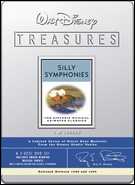
All Rise...Judge Mike Pinsky loves classic Disney cartoons, and doesn't find them at all silly. Him sitting in front of the TV wearing mouse ears...that's silly. The Charge"The great satisfaction in the first animated cartoons was that they used sound properly."—Gilbert Seldes The CaseKing Midas wants the power to turn everything to gold. When the magical Goldie grants the wish, Midas learns to his terror that wealth will destroy him: he cannot eat or drink or even pet his cat. The lesson: we must distrust affluence, limit change and difference, work hard and keep our place. Of course, this is 1935, and such a lesson is consistent with the conservative rhetoric of the Depression. Love of wealth got us into this mess, and humility and conformity will get us out. Compare "The Golden Touch" to the exploits of Scrooge McDuck after World War II. Now capitalism becomes our salvation, our weapon against fascism and communism. Everything Uncle Scrooge touches turns to gold, and he is all the better for it, cavorting joyously in his Money Bin and celebrating the American victory over all. Depression-era audiences wanted escape from their sense of economic and cultural failure, while post-war audiences would seek to embrace commercial success. Consider the success of the screwball comedy in the 1930s. Consider the wild antics of pulp heroes. Consider cartoons. Walt Disney, whom myth has reshaped into an uncle with a magic touch, celebrating the victory of American capital over its enemies (just listen to the governor of California's speech at Disneyland's opening, on the Disneyland USA DVD), knew that animated escapism was worth its weight in gold. So when musical director Carl Stalling suggested utilizing the new sound technology in film to choreograph animation and create "silly symphonies," Walt jumped at the experiment. For ten years, from 1929's "The Skeleton Dance" to 1939's remake of "The Ugly Duckling," the Disney team produced about 75 "Silly Symphony" shorts starring a variety of characters. Disney includes about half of these (36 shorts) on the limited edition, tin-case Silly Symphonies DVD set. Curiously grouping by theme, rather than chronologically, Disney offers a collection that ranges from brilliant to merely entertaining, with hardly a dud in the bunch. Although the thematic categories are a bit awkward, they do provide us with some sense of the key motifs repeated throughout Disney's world. Fables and Fairy Tales: Stay at home and work hard: this theme is repeated in "The Robber Kitten" (rambunctious little Ambrose learns the perils of running away from home) and "Lullaby Land" (a baby's dreamland is filled with scissors, curling irons, and matches). The peak of this work ethic comes with 1934's "The Grasshopper and the Ants" (offered as an Easter Egg on this disc, with Walt's introduction from television), featuring Pinto Colvig singing "The World Owes Me a Living" (later to turn up as Goofy's theme song), and 1935's "The Tortoise and the Hare," in which Toby Tortoise's diligence pays off in victory over the dissolute and vain Max Hare. Another popular theme in Walt's fables was the problem of difference. In "Elmer Elephant," a dress rehearsal for Dumbo five years later, our hero (who has a crush on the painfully cute Tillie Tiger) learns that his awkward nose, for which the other children have roundly mocked him, helps him save the day when fire strikes. In "The Flying Mouse," a young mouse gets wings from a fairy, only to discover that he is now no longer mouse nor bird nor bat. He is now "nothing but a nothing." Contradictory messages about difference? In Walt's world, accepting differences you are born with is important, but you should not rise above your station by wishing yourself different from others. Favorite Characters: "Who Killed Cock Robin?" (a hidden cartoon on this disc that includes Walt's discussion of the satire's historical origin) features several familiar faces, including caricatures of Mae West and Harpo Marx. Harkening back to the earlier "parade" cartoons, like 1930s black and white "Mother Goose Melodies" (included by Disney in the previous Fables and Fairy Tales section), in which a succession of arbitrary gags would be paraded (often in the form of an actual parade or show), "Cock Robin" allows Disney animators to grab the audience's attention by showing familiar characters. While 1936's "Toby Tortoise Returns" plays this game quite conspicuously (as a sequel to "Tortoise and the Hare," featuring cameos by the Three Pigs, Elmer Elephant, and characters from "Cock Robin," all assembled at a boxing match), our recognition of a scene-stealing Donald Duck in the moralistic "The Wise Little Hen" is only hindsight: this was Donald's screen debut, a few months before he would steal the spotlight from Mickey Mouse in "Orphan's Benefit." If Walt had one more rule evident in the "Silly Symphony" series, it is that baby butts are a source of unlimited humor. The stunningly animated "Wynken, Blynken and Nod" (included in the "Leonard's Favorites" section, as well as a hidden feature with Walt's homage to author Eugene Field) and the stunningly inane "Water Babies" (included as a hidden feature, but even with Walt's introduction, you may find yourself more confused than entertained by this army of genitalia-free cherubs wagging their butts in a plotless free-for-all) offer whimsical caricatures of children, a favorite topic for animators of the 1930s in general. Innocence, after all, was a great defense against the strain of the world suffering outside the cinema. Disc Two of Silly Symphonies suggests two additional key themes of Walt's cartoon world. The lack of chronological organization is even more conspicuous on this disc than on the first, leading me to wonder why Disney did not simply offer multiple menu options for this set (thematic or chronological—how easy could that be?) or a clearer sense of structure in the included booklet. Nature on Screen: Pluto also turns up in an early appearance in the black and white "Just Dogs," featuring a horde of escaped canines wandering through a city park. Another early "parade" cartoon, "Birds of a Feather," shows off Disney's attempt to draw dozens of different kinds of birds, all singing and performing for the audience. But only the breakthrough 1937 short, "The Old Mill," offers an even vaguely realistic depiction of nature, as Disney makes strong use of many experimental animation techniques (multiplane camera, splash effects, rapid editing) and detailed artwork in an effort to depict a seemingly authentic environment, at least by animation standards. But most of the techniques used in "The Old Mill" were incorporated directly into the features wing of Walt's studio. The shorts stuck to their tried and true formulas. Accent on Music: Later musically-oriented shorts would take advantage of color, although they would keep their plots simple: romantic melodrama punctuated by musical numbers. This formula sustains "The China Plate," "The Cookie Carnival," and "Music Land," a 1935 short in which classical and jazz marry. Did Walt recognize this metaphor for miscegenation, given the public connection between jazz and black culture? He certainly allows conspicuously "black" characters as the house band (they even say they are in Harlem) in 1937's "Woodland Café," although the cartoon surprisingly (for the time) portrays no overly negative stereotypes. All in all, Walt tended to prefer classical music as the foundation for "Silly Symphonies" (leading of course to Fantasia in 1941). In his introduction to "Farmyard Symphony" (included as a hidden feature), Walt plays up the cartoon as a version of the Chanticleer story (Walt toyed for years with a feature based on this fable, before abandoning it—this did not stop Don Bluth, though, who made the awful Rock-a-Doodle). But there really is not much of that fable here: "Farmyard Symphony" is merely an excuse to string together bits of classical music (the subtitles will identify some of them for the classically impaired) with more realistic animals in the vein of "The Old Mill." The result is Walt's effort to tame "highbrow" music for the masses, just as dreams of affluence and success are tamed into fairy tales, or Mickey's wild friends are limited to nine or ten minutes of fun before they iris out to black. Both discs in this Silly Symphony set offer a section entitled "Leonard's Favorites." Leonard Maltin, whose face is familiar by now to anyone exploring the Walt Disney Treasures series, introduces a selection of key entries in the series. Often, his introductions provide strong context. He also offers two interviews in the supplemental section on Disc Two. For "The Song of the Silly Symphony," Maltin interviews Richard Sherman. While Sherman and his brother Robert wrote a great deal of fantastic music for Disney through the 1960s and '70s, they really had nothing to do with the "Silly Symphony" series, which was long over by the time they joined the studio. Nevertheless, while Maltin and Sherman spend some time gushing over Walt, this interview is welcome for its insight into what makes a successful song (like Frank Churchill's monster hit "Who's Afraid of the Big Bad Wolf?"): in the words of Sherman's father, "simple, singable, and sincere." Maltin also conducts an interview with Dave Smith, curator of the Walt Disney Archives, who shows off plenty of merchandising tie-ins from the cartoons (especially for "Three Little Pigs"), Sunday comic strips, and even a couple of unauthorized knockoffs. Smith also offers some good tips for collecting Disney memorabilia on a reasonable budget. Some of the advertising art and comic strips are also viewable in a photo gallery that also includes pencil art and production drawings for several cartoons. The evolution of the "Silly Symphonies" from simple parades to story-driven features-in-training is evident in the only remake Walt authorized during the entire series: "The Ugly Duckling." The 1931 version, filmed in black and white, is rather different from the fable we tend to remember. Mother hen hatches her eggs in a farmyard and finds one of her baby chicks is a scrawny, ugly duck. All the animals on the farm reject the duck, until a twister threatens the henhouse, dropping the baby chicks in the river. Only the ugly duckling can swim and rescue the others. Again, the theme of acceptance of inherent difference is present, developed in a fairly simple manner, with sketchy backgrounds and standard cartoony character design. Compare this to the 1939 version, the final entry in the "Silly Symphony" series. A mother duck hatches her eggs, and one child appears out of place. The husband is startled, then suspicious, and argues with his mate over this evidence of adultery. All this takes place in quacks, of course, but the detailed character animation conveys a wide range of emotions. The rejected duckling wanders through a richly textured watercolor world, looking more introspective than his monochromatic counterpart. When he finally settles in with a family of swans, an odd moment occurs: when he sees his original duck family, who all give a friendly wave as if all is forgiven, he turns his back on them, sticks up his tail, and swims away. Has the ugly duckling refused to forgive them, or is he merely exhibiting pride in his new station? The complexity of character here marks an enormous difference between the "silly" and the sublime. It should probably come as no surprise that this final "Silly Symphony" does not even bear the label, even if it fits the theme and structure. By the remake of "The Ugly Duckling," "Silly Symphonies" no longer seemed mere exercises in escapist entertainment. "The Old Mill," "Wynken, Blynken, and Nod," "Farmyard Symphony": these last two or three years of the series saw Walt aspiring to art. In the end, fleshing out the characters and developing emotional resonance was the undoing of the "Silly Symphonies." Once it became clear that well-defined characters and stories needed greater length (and budgets) to develop, the short cartoon became for Walt little more than a dumping ground for gags (he would return later to mid-length cartoons in the "package" features in the late 1940s). With the possibility of feature-length films to satisfy the storytelling urge, and the experimental "Concert Feature" (Fantasia) in the works to satisfy the musical urge, Walt no longer needed the "Silly Symphonies" by 1939. Walt may have loved innovation, but he also had a short attention span. But looking back on this collection of the landmark "Silly Symphony" series—its strengths and its flaws, its artistic experimentation and its accession to formula, its attempt to create unique experiences and its marketing savvy, its joyous escapism and its bourgeois rhetoric—it is clear that when Walt did decide to touch something, he could still usually turn it into gold. And if he did not, at least he could try again later. Give us your feedback!Did we give Walt Disney Treasures: Silly Symphonies a fair trial? yes / no Other Reviews You Might Enjoy
• VeggieTales: Larryboy And The Bad Apple |
|
DVD | Blu-ray | Upcoming DVD Releases | About | Staff | Jobs | Contact | Subscribe | | Privacy Policy
Review content copyright © 2004 Mike Pinsky; Site design and review layout copyright © 2015 Verdict Partners LLC. All rights reserved.