| Home | About | Blu-ray | DVD Reviews | Upcoming DVD Releases | Contest | Podcasts | Judges | Jury Room | Contact |
|
|
|
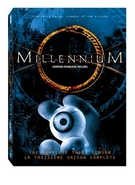
All Rise...For some reason, Appellate Judge Mac McEntire's computer thinks this is the year 1906. Editor's NoteOur reviews of Millennium: The Complete First Season (published June 1st, 2005) and Millennium: The Complete Second Season (published October 12th, 2005) are also available. The ChargeWait. Worry. Opening StatementIn the first season of Millennium, we met criminal profiler Frank Black (Lance Henriksen, Aliens), a former FBI agent who used his psychic-like "gift" to hunt down and catch various serial killers. In the second season, Frank explored the background of his mysterious employers in the Millennium Group, and their plans and theories about the upcoming apocalypse. As the third season begins, it's post-apocalypse (but not really) as Frank finds himself back where he started, at the FBI. He's lost and alone, looking for some direction in his life. The series follows suit, and spends most of its last 22 episodes finding its own direction. Now, viewers can experience all the ups and downs leading to the end of this Millennium. Facts of the CaseA lot has happened since we last saw Frank Black. His wife Catherine (Megan Gallagher, National Lampoon's Van Wilder) is dead, thanks to a Millennium Group-engineered virus. Convinced that the group's leaders are full-blown bad guys, Frank relocates from his Seattle home to Washington, D.C., both to return to the FBI and to take care of his daughter Jordan (Brittany Tiplady, The Pledge). He's paired with newcomer agent Emma Hollis (Klea Scott, Lullaby) and goes back to the daily grind of tracking down those pesky serial killers. But the forces of darkness are always there, hiding in every shadow. Whether it's a murderer's lunacy, the Millennium Group's scheming, or an unidentified supernatural evil, everyone seems to have an interest in Frank and his daughter. The time is near… The EvidenceAs stated above, each season of Millennium had its own personality. Chris Carter (creator of The X-Files) started it out as a dark detective series. Then the writing duo of Glen Morgan and James Wong (Willard) opened the history and mythology of the Millennium Group. In season three, showrunner Chip Johannessen and others borrowed liberally from the previous seasons, while adding a new emphasis on stories about family. With so many elements thrown into the mix, it should be no surprise that this season is hit or miss in terms of storytelling. Although many fans have dismissed the third season as crap, there's just as much here that's enjoyable as there is that falters. The Good • Father-daughter relationships Later in the season, as we learn more about Emma, we're introduced to her father, who suffers from Alzheimer's disease. These are some of Scott's best scenes, in which she reveals her own fears that her father not only no longer recognizes her, but could become dangerous to both him and her. All this leads to the Millennium Group making a tempting offering for her, and her character ends up in a surprising place when it's all over. • The group goes bad This doesn't mean Watts is relegated to nothing but dastardly deeds. Occasionally, his human side shows through as well. This is most notable in the wonderfully suspenseful episode "Collateral Damage" in which a deranged soldier (James Marsters, Buffy the Vampire Slayer) kidnaps Watts's daughter. Here, Frank is put in a position where he must choose whether to help his sworn enemy. Watts's exit from the series in the final episode is mysterious, and we're left to wonder just where his loyalties really were. • Gloom n' doom The Bad • The big ret-con • "Thirteen Years Later" • Lucy Butler butts in • Samiel I am The frustration I felt over Samiel's character reveals the big flaw that haunted Millennium from the beginning: Ambiguity. For all the great acting, the creepy atmosphere, and the high-quality production design, the show was too ambiguous for its own good. Just who is the Millennium Group? What is the group's stake in the whole apocalypse/end-of-the-world thing? What do all these serial killers really have to do with the whole apocalypse/end-of-the-world thing? What, exactly, is the nature of Frank's gift? Does Jordan have that same gift or doesn't she? What's with all the devil stuff? And on and on. The more you watch, the more questions get raised. Nothing about the series is easily defined. This makes it something of a turn-off for casual viewers, and potentially confusing for first-timers going into just this season. It all does come together in a way, but only for patient viewers who watch aggressively and pay strict attention to all the little details, there's a rewarding experience to be had. It's up to you if you want to make that much of a commitment to your entertainment. Millennium: The Complete Third Season oozes its way onto DVD with excellent audio and video. The dark, foreboding atmosphere that is the series' signature comes through clearly, with vivid colors and deep, rich blacks. The 2.0 surround audio is rich and immersive, and composer Mark Snow's moody theme song sounds terrific. The highlight of the bonus features here is the "End Game" documentary, which covers the troubled behind-the-scenes history of the third season, detailing how the writers and producers scrambled to put it together after assuming the show would be cancelled. Henriksen and Scott reunite for a commentary for "The Innocents" and director Thomas J. Wright (Unspeakable) comments on "Collateral Damage." Both commentaries suffer from the participants watching the show more than talking about it, but their fondness and excitement for the series is still evident. "Between the Lines" is another look at the Academy Group, a group of retired FBI agents who consult for law enforcement, and the real-life inspiration for the Millennium Group. Finishing off the set is an episode from The X-Files, appropriately titled "Millennium," in which FBI agents Mulder (David Duchovny, House of D) and Scully (Gillian Anderson, Bleak House) cross paths with our own Frank Black. Although many have criticized the episode for being anti-climatic, I say pay closer attention. The finale here is actually not related to the Millennium Group, making this more of a side story to Frank's adventures, rather than the final confrontation between good and evil. What makes this episode a true standout has nothing to do with Frank Black. It's the big Mulder-Scully moment at the end, which is cleverly written and well acted. The Rebuttal WitnessesThis is nit-picky, but it nonetheless deserves to be addressed: What is going on with Frank Black's hair this season? In some episodes, it's all brown. In others, it's all white. But at most times, it's a little of both, mixed together Dennis Rodman-style. Henriksen's performance is still great, but some continuity with that hair would have been a big improvement. Closing StatementAs of this writing, we're about two months into the year 2006. Some really horrible events have happened in the new millennium, what with the terrorists and all, but there have also been moments of great joy and wonder, like the Red Sox winning the World Series. Mirroring real life, Millennium: The Complete Third Season also has its low points and its high points. Placed within the context of the series as a whole, I'd say the good outweighs the bad. The VerdictAlthough Millennium: The Complete Third Season appeared guilty at first, we used our "gift" and looked deep into the unseen trenches of its soul, where we discovered it's not guilty after all. Give us your feedback!Did we give Millennium: The Complete Third Season a fair trial? yes / no Other Reviews You Might Enjoy |
|
DVD | Blu-ray | Upcoming DVD Releases | About | Staff | Jobs | Contact | Subscribe | | Privacy Policy
Review content copyright © 2006 Mac McEntire; Site design and review layout copyright © 2015 Verdict Partners LLC. All rights reserved.