| Home | About | Gift Guide | Blu-ray | DVD Reviews | Upcoming DVD Releases | Contest | Podcasts | Judges | Jury Room | Contact |
|
|
|
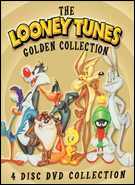
All Rise...Editor's NoteOur reviews of Looney Tunes: Golden Collection, Volume Two (published January 24th, 2005), Looney Tunes: Golden Collection, Volume Three (published December 12th, 2005), Looney Tunes: Golden Collection, Volume Four (published January 8th, 2007), Looney Tunes: Golden Collection, Volume Five (published November 14th, 2007), Looney Tunes: Golden Collection, Volume Six (published October 21st, 2008), Looney Tunes Platinum Collection: Volume Two (Blu-ray) (published October 22nd, 2012), Looney Tunes Platinum Edition: Volume One (Blu-ray) Collector's Edition (published November 27th, 2011), and Looney Tunes: The Premiere Collection (published November 10th, 2003) are also available. The ChargeFully restored. Completely uncut. Totally Looney! Opening StatementThis is my pick for the best DVD of the year. There are some tiny flaws present (which we will discuss later) but there is plenty of great material to be found in these four discs and that easily outweighs the bad. Facts of the CaseA Brief History of the Looney Tunes It all began with Walt Disney. His theatrical shorts were becoming quite popular and that wasn't lost on the other major studios. MGM would eventually get into animation, but Warner Bros. wanted some product immediately. They hire producer Leon Schlesinger to oversee production and he in turn hires a pair of Disney animators, Hugh Harman and Rudolf Ising. They in turn hired an assistant: Isadore Freleng (), best known as "Friz." Harman and Ising's first production was "Bosko the Talk-Ink Kid" (1929). Its wacky irreverence and experimental nature laid the groundwork for all future cartoons. Harman and Ising would depart for MGM in 1933, leaving Freleng as the senior animator (despite his youth). The Looney Tunes animation department had six major directors: Freleng, Bob Clampett (), Fred "Tex" Avery (), Robert McKimson (), Arthur Davis () and Charles Martin "Chuck" Jones (). But there were others: Ben "Bugs" Hardaway (), who left for Universal's animation studio in the early 1940s; Frank Tashlin (), who left in 1950 to become a full time film director (a good one at that); and Abe Levitow (), who came in a few years before the shutdown of the animation department. The first Looney Tunes character was Foxy, who bore more than a passing resemblance to Mickey Mouse. The high point of his brief screen career was "Smile Darn Ya Smile" (1932) directed by Friz Freleng. The next attempt at a recurring character was Beans, who made his screen debut in 1935's "I Haven't Got A Hat." But he was upstaged by a cute fat pig named Porky, who became the first major animated star. Porky would usher in the screen debut of Daffy Duck in "Porky's Duck Hunt" (1937) and a wacky hare named Happy Rabbit in "Porky's Hare Hunt" (1938). Happy Rabbit would be rechristened Bugs Bunny, after his creator, for the next short "A Wild Hare" (1940). Other characters would follow over the fertile decades before the final shutdown of the animation department in 1969. The EvidenceFifty-six classic shorts have been restored to the best condition possible and have been spread out over four discs. For this set, I have decided to use a zero to four star rating system. I feel that system is more appropriate since these shorts were released theatrically. Anyhow, here we go: Disc One: The Best of Bugs Bunny "Baseball Bugs" (1946) dir. Friz Freleng "Rabbit Seasoning" (1952) dir. Chuck Jones "Long-Haired Hare" (1949) dir. Chuck Jones "High Diving Hare" (1949) dir. Friz Freleng "Bully for Bugs" (1953) dir. Chuck Jones "What's Up Doc?" (1950) dir. Robert McKimson "Rabbit's Kin" (1952) dir. Robert McKimson "Water, Water, Every Hare" (1952) dir. Chuck Jones "Big House Bunny" (1950) dir. Friz Freleng "Big Top Bunny" (1951) dir. Robert McKimson "My Bunny Lies Over the Sea" (1948) dir. Chuck Jones "Wabbit Twouble" (1941) dir Bob Clampett "Ballot Box Bunny" (1951) dir. Friz Freleng "Rabbit of Seville" (1950) dir. Chuck Jones Disc Two: The Best of Daffy Duck and Porky Pig "Duck Amuck" (1950) dir. Chuck Jones "Dough for the Do-Do" (1949) dir. Friz Freleng "Drip-Along Daffy" (1951) dir. Chuck Jones "Scaredy Cat" (1948) dir. Chuck Jones "The Ducksters" (1950) dir. Chuck Jones "The Scarlet Pumpernickel" (1950) dir. Chuck Jones "Yankee Doodle Daffy" (1943) dir. Friz Freleng "Porky Chops" (1949) dir. Arthur Davis "Wearing of the Grin" (1951) dir. Chuck Jones "Deduce, You Say" (1956) dir. Chuck Jones "Boobs in the Woods" (1950) dir Robert McKimson "Golden Yeggs" (1950) dir. Friz Freleng "Rabbit Fire" (1951) dir Chuck Jones "Duck Dodgers in the 24 1/2th Century" (1953) dir. Chuck Jones. Disc Three: Looney Tunes All Stars Part One "Elmer's Candid Camera" (1940) dir. Chuck Jones "Bugs Bunny and the Three Bears" (1944) dir. Chuck Jones "Fast and Furryous" (1948) dir. Chuck Jones "Hair-Raising Hare" (1946) dir. Chuck Jones "The Awful Orphan" (1949) dir. Chuck Jones "Haredevil Hare" (1948) dir. Chuck Jones "For-Scent-imental Reasons" (1949) dir. Chuck Jones "Frigid Hare" (1949) dir. Chuck Jones "The Hypo-Chondri-Cat" (1950) dir. Chuck Jones "Baton Bunny" (1959) dir. Chuck Jones, Abe Levitow "Feed the Kitty" (1952) dir. Chuck Jones "Don't Give Up the Sheep" (1953) dir. Chuck Jones "Bugs Bunny Gets the Boid" (1942) dir. Bob Clampett "Tortoise Wins By A Hare" (1943) dir. Bob Clampett Disc Four: Looney Tunes All Stars Part Two "Canary Row" (1950) dir. Friz Freleng "Bunker Hill Bunny" (1950) dir. Friz Freleng "Kit for Cat" (1948) dir. Friz Freleng "Puddy Tat Trouble" (1951) dir. Friz Freleng "Bugs and Thugs" (1954) dir. Friz Freleng "Canned Feud" (1951) dir. Friz Freleng "Lumber Jerks" (1955) dir. Friz Freleng "Speedy Gonzales" (1955) dir. Friz Freleng "Tweety's SOS" (1951) dir. Friz Freleng "The Foghorn Leghorn" (1948) dir. Robert McKimson "Daffy Duck Hunt" (1949) dir. Robert McKimson "Early to Bet" (1951) dir. Robert McKimson "Broken Leghorn" (1959) dir. Robert McKimson "Devil May Hare" (1954) dir. Robert McKimson The Looney Tunes have always been very special to me. I have many happy memories of watching them on television with my grandfather. His particular favorite was Bugs Bunny, who he claimed was his great friend for many years. I laughed then, since I was a young boy. But now that I'm an adult, I find myself thinking that his remark is actually a very valid and agreeable point. These characters may be cartoons, but think about it. They're such well drawn, developed characters that we feel like we really do know them personally. It's a shame he didn't live to see this set; he would have loved it. What the geniuses of Termite Terrace understood was to make cartoons with wide appeal. They're entertaining enough for children, with the hijinx and slapstick. But they're also a lot of fun for adults, with the zany in-jokes and subtle comedy. Many insiders said they made them for adults, so it comes as no surprise. Mel Blanc was the first man to receive a screen credit for vocal characterization and he deserved it. He voiced many different types of roles for the Looney Tunes, and it was amazing that he invested so much feeling into them. Also, he was supported by a top-notch supporting cast including Arthur Q. Bryan (Elmer Fudd), June Foray (Granny), and Stan Freberg (Pete Puma, Junior Bear, etcetera). Things to look for the Looney Tunes: • If Friz Freleng directed it, the word Friz is somewhere in the
background. There are many others, but some I will leave you to discover. The full frame transfer is appropriate. Sometimes on television, the opening credits feature windowboxing and even very slight letterboxing. Unlike many other studios experimenting with widescreen (MGM having made several years worth of CinemaScope shorts), the Looney Tunes shorts weren't composed or intended to be seen in that fashion. I'm glad Warner Bros. took notice before the transition to DVD. As Judge Byun pointed out in his review of The Looney Tunes Premiere Collection, there are imperfections present, despite the restoration efforts. The same problem is present in The Golden Collection. Some shorts are in beautiful virgin condition. Others are less than stellar but a major improvement from any previous incarnations. And there are some, such as "Yankee Doodle Daffy" and "Lumber Jerks," which have fallen in the public domain and suffer from the aftereffects of thousands of dupe prints being made over decades past. Those shorts have very visible grain and dirt present. Despite these shortcomings, these are the best the shorts have looked since their theatrical premieres. Colors are appropriately bold and vibrant looking and those used to seeing these shorts on television will drool over this set. Taking into consideration all the factors, The Golden Collection is still a first class presentation. Audio is presented in Dolby Digital 1.0 Mono. This is appropriate, remaining true to the original sound schemes of the shorts. Again, while other studios were experimenting with stereophonic sound, Warner Bros. stuck with what they knew best. The sound mix here is excellent. There are, again, problems such as tape hiss and assorted tell tale signs of analog recordings, but nothing that will agitate potential viewers to the point of distraction. Carl Stalling's music has never sounded better. There are many extras included in this set. After reviewing several box sets with minimal extras, what a pleasure it was to see so many here! First up are 26 commentary tracks: film historian Michael Barrier appears on seventeen of them, official Looney Tunes historian Jerry Beck appears on three, voice talent Stan Freberg appears on two, and contemporary Looney Tunes director Greg Ford appears on three. Barrier's commentaries are the most informative, but his delivery is very dry. Beck's commentaries are entertaining to listen to. Ford is okay, but could have given some more insight into the inspiration these shorts gave him. Freberg's commentaries are, as Herman's Hermits would put it, a must to avoid. He devotes most of his commentaries to reciting the dialogue he voiced in the individual shorts. Who wants to hear this? Not I. Soundbites from various Looney Tunes directors and crew are sprinkled throughout some of these tracks. It is nice to see that even in death, these geniuses are "still" participating in reevaluations of their work. Eleven shorts contain a music-only track selection. You can listen to Carl Stalling's scores without the dialogue or sound effects. Listen to them and you'll see what a major contribution Stalling made to these shorts. A "Greeting from Chuck Jones" is exactly that. Taped shortly before his death, this is a must-see for all fans alike. It also shows us how long this project was in gestation. Twelve featurettes are included, all running about three and a half minutes in length. All contain comments from family members of Looney Tunes directors, surviving animators, vocal talents, historians, and even current Looney Tunes animators. All are worth seeing and provide great insights into their subject matter. Four documentaries, all gems, are worth seeing. The first is split into two parts on the first two discs: "Camera Three: The Boys from Termite Terrace." This is outtake footage from a 1975 United Artists compilation film Bugs Bunny Superstar, which combined interviews and selected shorts. Here the subjects are Chuck Jones, Bob Clampett, and Friz Freleng. "Toonheads: The Lost Cartoons" is a May 2000 Cartoon Network special containing several goodies: the first Merrie Melodies production "Lady Play Your Mandolin" (1930), an Academy Award winning instructional short featuring an adult Ralph Phillips (the boy dreamer Chuck Jones so wonderfully created) that is a four-star classic, and surviving outtakes from a failed "Road Runner" pilot for ABC-TV in 1969. A must for all animation buffs. "Behind the Tunes" is what it says, an inside look into the production of the classic shorts. Lastly, there's the hour long "Irreverent Animation: the Golden Age of Looney Tunes," a well detailed, in depth look at their history with invaluable interviews with many now-dead animators. "Blooper Bunny: Bugs Bunny's 51st Anniversary" is a 1991 short subject directed by Greg Ford, lampooning the often unfunny bloopers we DVD owners are so often subjected to. There is optional commentary by Ford that is worth a listen. Bridging material from the 1960s primetime TV series "The Bugs Bunny Show" is basically padding, but it's worth seeing from a historical perspective and you will see where the opening from the ABC-TV Saturday morning series "The Bugs Bunny and Tweety Show" originated. Surviving footage of the debut Looney Tunes short "Bosko the Talk-Ink Kid" gives you a look at how much this series evolved over the next forty years. Definitely worth watching at least once. "Bugs Bunny at the Movies" features two clips from two Warner Bros. musicals that each featured Bugs Bunny. My Dream is Yours features a cameo from Tweety and is also one of Doris Day's first features (she dances with Bugs!). Two Guys from Texas features Bugs giving advice to Jack Carson on how to get the girl. Again, interesting from a historical perspective and a must see. Virgil Ross' pencil tests and schematics for two classic shorts give us an idea of the work that went into developing these shorts into their final cinematic form. Excellent. "The Astro Nuts Recording Sessions" features Mel Blanc and gives us a front seat look at his amazing talent. Four extensive stills galleries featuring sketches, theatrical posters, promotional cards, and cels are included. This is what a stills gallery should be. Other studios, pay attention! Two theatrical trailers for two '60s Looney Tunes compilation films are in rough shape but worth a look. The Rebuttal WitnessesIf I have any complaints, it's there are more confirmed classics out there that could have been selected for this set. But that's a moot point. The fact is that all of the Looney Tunes shorts are undergoing restoration and all will be available in future compilations. It's just a matter of waiting and being patient. Me, I'm just glad to see these shorts in such good condition. Closing StatementWith a retail price of $62.99, this is an expensive purchase that is worth investing your hard-earned money on. Some will no doubt choose The Premiere Collection since it is selling for less than half the price of this set, but in the long run, your money is better spent on The Golden Collection. Plus, there are no extras in the cheaper set. How much longer do I have to argue here? Just buy this set! The VerdictThe fact that any charges were brought up against this wonderful collection is absurd. Dismissed! Give us your feedback!Did we give Looney Tunes: Golden Collection, Volume One a fair trial? yes / no Other Reviews You Might Enjoy
• Bikini Bandits Save Christmas |
|
DVD | Blu-ray | Upcoming DVD Releases | About | Staff | Jobs | Contact | Subscribe | | Privacy Policy
Review content copyright © 2003 Bill Treadway; Site design and review layout copyright © 2014 Verdict Partners LLC. All rights reserved.