| Home | About | Blu-ray | DVD Reviews | Upcoming DVD Releases | Contest | Podcasts | Judges | Jury Room | Contact |
|
|
|
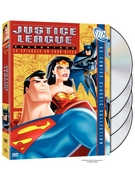
All Rise...Chief Justice Mike Jackson fights for truth, justice, and your right to save on your car insurance. Editor's NoteOur reviews of Justice League (published May 16th, 2002), Justice League: Season One (Blu-Ray) (published September 1st, 2008), Justice League: Season Two (published July 19th, 2006), Justice League: Justice On Trial (published April 9th, 2003), Justice League: The Brave And The Bold (published November 17th, 2004), Justice League: The Complete Series (published November 23rd, 2009), Justice League Unlimited: Season One (published January 3rd, 2007), Justice League Unlimited: Season Two (published May 2nd, 2007), and Justice League Unlimited: Saving The World (published March 23rd, 2005) are also available. Opening StatementBruce Timm has made a string of highly regarded animated series over the past 13 years. He started with Batman: The Animated Series in 1992, which aired (in several incarnations) until 1999. Less traditionally, he created a new Batman as a successor to Bruce Wayne in Batman Beyond, which ran from 1999 to 2002. He brought the other big DC Comics icon, Superman, under his care with Superman: The Animated Series, which ran from 1996 to 2000. As his other series ran their courses, Timm looked for a new project to bring his beloved superheroes to the small screen. Moving away from the traditional Saturday morning ghetto on over-the-air networks (their previous series aired on Fox and The WB), his next venue would be Cartoon Network, looking for a prime-time adventure series to complement their other series like The Powerpuff Girls and Samurai Jack. Timm and his cohorts turned their sights to the Justice League. A comic title in its own right, running in various manifestations since 1960, it was a team-up of DC Comics's most popular characters in one neat package. Showing their reverence for comic history, their heroic line-up would very nearly match the original Justice League: Superman, Batman, Wonder Woman, Green Lantern, The Flash, and Martian Manhunter. The only exception would be to swap out Aquaman for another female character, Hawkgirl; they saved Aquaman for guest-starring status. They'd also use "alternate" versions of the more, shall we say, mortal characters. Instead of the classic Hal Jordan Green Lantern, they'd use second-stringer John Stewart, injecting some (much-needed) diversity into the team. (Incidentally, Superman: The Animated Series featured an origin story for Green Lantern, but an entirely different GL, Kyle Raynor.) The Flash of the original Justice League in the comics was that era's Flash, Barry Allen; instead, Timm and Co. used The Flash of modern comics, Wally West (who was the Barry Allen's nephew and had been known as Kid Flash before graduating to full The Flashhood; he was also one of the founding members of the Teen Titans, who incidentally Timm and Co. would also translate to animated form, though thankfully without the original comic's gimmick of pint-sized versions of the first-string heroes). Justice League's first-season episodes were two- or three-parters, which allows the stories room to breathe and to exist on the epic level that they so deserve. It borrowed characters and villains not only from the Justice League comic proper, but from the comic continuities of each of its seven heroes, not to mention from the Batman and Superman animated series that preceded it. The result is something truly special. It's not only a fine animated series, but a comic nut's dream. Facts of the CaseSeason One's 26 episodes are spread across four discs. Since each episode is part of a larger story arc, I'll group them into their 12 story arcs: • "Secret Origins" Pilot episodes are nearly universally weaker than what follows. On the one hand you need to draw viewers into the story, you also have a lot to establish to tell the stories that follow. That neatly sums up "Secret Origins." While this series follows Batman and Superman (not to mention Batman Beyond, which takes place well after Justice League), and treats Flash (who had appeared on Superman), Green Lantern (who had also appeared on Superman, but that was a different Green Lantern, Kyle Raynor), and Hawkgirl (who has no previous Timmiverse exposure) as established heroes, it still must take time to establish Wonder Woman and J'onn J'onzz (better known to comic fans as the Martian Manhunter, though he wasn't called that in the first season of JL) as credible heroes. Some of the action is a bit redundant; this could probably have been pared down to a two-parter. • "In Blackest Night" Right from the start, you'll notice that Season One is heavy on Green Lantern-centric stories, and that the writers rarely find action for all seven JLers in the same episode. Here, Wonder Woman and Batman are absent. • "The Enemy Below" In their commentary on the second part of this story arc, the producers comment that the massive climatic Artic battle between Orm's forces and the Justice League (not to mention Aquaman, riding a killer whale) was their first large-scale action sequence. In fact, the action at the end of the second part is what makes this arc shine. Aquaman is a strong character here, and they wisely let him stand on his own rather than making him a part of the Justice League and desperately try to find things for him to do. • "Injustice For All" If the episode guide at TV.com is to be believed, this episode is presented out of airing order; according to them, it aired between "Legends" and "A Knight with Shadows," after "Fury," which features basically the same team-up of minor villains. I'm certain that the placement on the DVD is correct, as this seems to be their first team-up. The villains are culled from nearly every heroes' individual comic continuity—Green Lantern (Solomon Grundy), Flash (Star Sapphire, The Shade), Wonder Woman (Cheetah), Batman (The Joker, Copperhead, Solomon Grundy on occasion), and Superman (Lex Luthor, Ultra-Humanite)—making for a nice cross-section of geekdom. Unfortunately, they all seem like less that credible threats against the full Justice League, even when combined. • "Paradise Lost" The action-packed finale, along with the revelation of Hades's demonic nature, might be too much for very young children. This is one of the weaker stories in the season, but it's still better than most cartoons. Better bone up on your Greek mythology if you hope to follow along! • "War World" Why do all sci-fi series trot out their own version of the gladiator ring planet? Few can improve on Star Trek's "Arena"…or "Gamesters of Triskelion"…or "Amok Time." But they all try. • "The Brave and the Bold" I'd completely write this one off along with "War World" if A) I didn't enjoy the Flash-centric episodes so much and B) the introduction of Gorilla Grodd didn't pay off so handsomely in the fifth season of Justice League Unlimited. Seriously, life doesn't get any better than seeing Wonder Woman turned into a fat, furry ape. Oh, but that's not this episode, and this one's not that great. • "Fury" Sure, it sounds like a hokey premise, but it works…and works well. It takes the five-sevenths of the JL with a Y chromosome out of the picture, allowing the girls to have all the fun and glory. Any episode that gives Hawkgirl a chance to shine is all right in my book. Oh, and there's chick fights. Lots of chick fights. But, there's one thing that really bugs me about this episode, and I will freely admit that this is the obsessive nerd in me coming out: the lack of continuity. The entire Justice League visits Themyscira in "Paradise Lost." Hippolyta meets the entire team, and awards them for their bravery in helping save the Amazons. But then why does she act like she doesn't recognize Hawkgirl when she goes to the island to find out more about Aresia? The episode feels out of place, like it belonged somewhere in the series' run after "Injustice For All" but before "Paradise Lost." [Note: Alert reader Ray pointed out that Hawkgirl and Green Lantern weren't in "Paradise Lost," so there's no reason for Hippolyta to recognize her. Geez, so much for my nerdy obsessiveness.] • "Legends" In their commentary track, the producers comment that many fans seem to hate this episode. I may have been among them until I heard their justification for the story. As hokey as it may seem, as similar as it may be to Superfriends, their intention was to make an earnest homage to the Golden Age of comics, not a parody thereof, and to contrast that era's comics with the modern age as you typically see in Justice League. If you go in with that in mind, and if you pay attention to the small nuances that illuminate the '50s culture, it works much better. I love how they created the feel of the era, right down to Hawkgirl bristling as she's treated like a woman, or when the Guild's version of Flash makes an obliquely racist comment to Green Lantern ("You're a credit to your people, son"). • "A Knight with Shadows" I'm not sure why they chose the Philosopher's Stone as the Macgufffin of the story. Oh, wait, Harry Potter—Pottermania was in full swing at the time, with the release of the first film and fourth book in close proximity to the creation of this episode arc. The Philosopher's Stone is connected to a wide variety of stories—appearing in everything from the aforementioned Harry Potter to Indiana Jones novelizations, from Donald Duck comic books to the Tomb Raider video games—but I'm not aware of any connection to Arthurian legend (I'm sure readers will correct me if there is). It dates back to the 8th century, and is typically credited with alchemic properties or creating an elixir of eternal life, not with granting the sort of limitless magical power Morgan seems to seek. But hey, that's more nerdy obsessiveness. The story itself is a great adventure romp. The best part, though, is Wonder Woman and Flash visiting a publishing magnate named Harv Hickman, who happens to be in possession of the Philosopher's Stone. If I tell you that he lives in a mansion and is throwing an elaborate costume party (the theme of which happens to be superheroes), and that Flash hits on two bikini-clad beauties in a lagoon, you can guess who he's modeled upon. • "Metamorphosis" I've yet to comment on any of the guest voices, but this was the first episode that I recognized a voice but could not pinpoint where I had heard it before—Simon Stagg's voice seemed so familiar. Turns out it was the great character actor Earl Boen, perhaps best known as Dr. Silberman in The Terminator and Terminator 2. Funny that I recognized his voice but not that of a better-known name also in the cast, Tom Sizemore. Oh, the episode? Meh. Metamorpho is the sort of villain you expect to give Batman or Superman some trouble on their own, but not stymie the entire Justice League. • "The Savage Time" Wow! The creators really pulled out all the stops for this three-part season finale. Few cartoons attempt stories of this scale, and Justice League pulls it off brilliantly. Time travel is another sci-fi staple, but here they make it work at a level that not many shows can muster. There's so much great stuff here. Every character gets their moment to shine (except for Batman, who is absent for most of the story), and their various stories connect together beautifully. This would easily be the greatest story told in a superhero cartoon if the JL gang wouldn't one-up themselves with the second-season finale, "Starcrossed." The EvidenceI know I've already talked about the series and its characters at length, but I still have more nerdy obsessiveness stored up. Ready? The really great thing about Justice League is that, unlike Batman: The Animated Series with its brooding hero, or Superman: The Animated Series with its highly principled protagonist, there's a wider variety of personalities and heroic archetypes to play into the stories. • Green Lantern • J'onn J'onzz • Wonder Woman • The Flash • Hawkgirl • Batman • Superman Warner Bros. presents Justice League: Season One on four discs, with either six or seven episodes per disc. Video is 1.33:1 full frame, which is the original aspect ratio; the series switched to widescreen in the second season, and when the first season episodes were presented thusly, they were matted. Video quality is excellent for the material, with vibrant colors, no bleeding, and no haloing. Some very thin lines exhibit pixel breakup, but it's not distracting. Audio is simple stereo, and while it has nice frequency range, it's simple stereo. Extras are limited, though worth watching. Bruce Timm, James Tucker, Glen Murakami, Rich Fogel, and Dan Riba provide commentary tracks on three episodes: "The Enemy Below, Part 2," "Legends, Part 2," and "The Savage Time, Part 2." Listening to their comments on these episodes, you wish they'd done more than just three commentaries; behind-the-scenes info flows freely, they're honest about the show's failings, and their choices make a lot of sense. But, they also seem to be all too ready to stop talking when the credits roll, so perhaps more commentaries would've been too taxing. On Disc Two, there's "Inside Justice League," a nine-minute panel discussion with Bruce Timm, James Tucker, Rich Fogel, and Dan Riba. They discuss the origins of the show, the challenge of bringing a series with a more epic scale to the small screen, their choices for the characters, and more. If you haven't seen the second season, or the Starcrossed "movie" release of its season finale, be forewarned: they discuss spoilers for that story arc. Another four-minute feature, "The Look of the League," is Bruce Timm discussing the stylistic choices behind the characters, how they were adapted from the comics to a more animation-friendly style. "Storyboards: The Blueprint for Justice" is a seven-minute piece with Bruce Timm, Dan Riba, and James Tucker discussing the work that goes into designing the storyboards, which serve as an illustrated script for the animators to complete the actual animation. Naturally, there's examples of the storyboards as compared to the finished animation, in particular a fight scene from "Injustice For All." On Disc Four, there's another roundtable discussion, this time just with Bruce Timm and James Tucker. Their job: to introduce a "never-before-seen" promo for Justice League. It was produced on the cheap, cobbled together in two weeks from remnants from Batman: TAS, Superman: TAS, and Batman Beyond, as well as some original animation. Its intention was to sell Kids WB on the concept, but they wound up selling it on a phone call to Cartoon Network. Closing StatementLet's see a show of hands, shall we? How many of you are planning on buying Justice League: Season One (if you haven't already)? How many of you are planning on buying it for yourself? How many of you are over the age of 18? Damn, I still see a lot of hands out there. We all know that you're supposed to stop watching cartoons or reading comics at a certain point. Move on to other more adult pastimes and diversions. Football. Boring, pretentious films that comment on society. The latest legal drama on TV. Do these people know what they're missing? Sure, Justice League is made for kids, but that doesn't mean us adults can't enjoy it too. It has big stories to tell. It features larger-than-life characters that it cares about and makes us care too. But most important, it's fun. If you need one guilty pleasure, one link to your childhood, this isn't one to feel guilty about. Justice League rocks. Out loud. One note before I finish: I know some of you might question the credit I give to Bruce Timm for the various series in which he's been involved. Fact is, there's a certain amount of reviewer shorthand at work. Others, like Paul Dini and Alan Burnett, have been involved but not in every series to the extent that he's been. Yes, there have been other very active participants, but Timm's been the sole connecting thread between all the superhero series in which he's been involved. The VerdictHow can I convict the Justice League? Not guilty! Give us your feedback!Did we give Justice League: Season One a fair trial? yes / no |
|
DVD | Blu-ray | Upcoming DVD Releases | About | Staff | Jobs | Contact | Subscribe | | Privacy Policy
Review content copyright © 2006 Mike Jackson; Site design and review layout copyright © 2015 Verdict Partners LLC. All rights reserved.