| Home | About | Blu-ray | DVD Reviews | Upcoming DVD Releases | Contest | Podcasts | Judges | Jury Room | Contact |
|
|
|
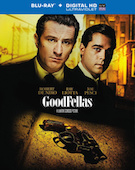
All Rise...Judge Jim Thomas thinks you're funny, like a clown. Editor's NoteOur reviews of Goodfellas: Special Edition (published December 6th, 2004), Goodfellas (Blu-ray) 20th Anniversary Edition (published March 4th, 2010), Goodfellas (Blu-ray) (published March 5th, 2007), Goodfellas (HD DVD) (published May 15th, 2006), and Ultimate Gangsters Collection: Contemporary (Blu-ray) (published May 31st, 2013) are also available. The ChargeThree decades of life in the Mafia. Opening Statement1990 was a pretty amazing year in terms of gangster movies: The Godfather: Part III; Miller's Crossing; Dick Tracy; The Freshman. And, of course, Goodfellas, a movie many have tagged as Martin Scorsese's masterpiece. When people decry the ridiculous wait for Scorsese to win an Oscar, this is usually the first film they bring up. With good reason. Before 1990, the industry viewed Scorsese as a director with tremendous potential; afterwards, with slack-jawed awe. The movie is a tour-de-force of design, editing, acting, and, of course, directing. Scorsese takes a story that could easily have been a generic "The Rise and Fall of [fill in the blank]" and transcends every rule of the genre and the medium with an overwhelming combination of style, detail, and above all, raw adrenaline. After three previous hi-def releases—one HD DVD and two Blu-ray—Warner Bros. brings us Goodfellas (Blu-ray) 25th Anniversary Edition. Facts of the CaseIt's The Rise and Fall of Henry Hill (Ray Liotta, Something Wild), who goes from just another Irish kid on the block to being a gofer for mob boss Paul Cicero (Paul Sorvino, Nixon), working his way up to Gangster, Third Class (he's half-Irish, which denies him further advancement). He hangs with his two best friends, wily Jimmy Conway (Robert deNiro, Taxi Driver), and loose cannon Tommy DeVito (Joe Pesci, My Cousin Vinny). Henry has it made, with a loving wife Karen (Lorraine Bracco, The Sopranos), a mistress on the side, and everything just there for the taking. But when Henry gets involved in dealing drugs, against Cicero's express orders, Henry finds out just how quickly the tables can turn. The EvidenceGoodfellas opens with three guys driving along a dark road when they hear a noise from the trunk. Pulling over, they open the trunk to reveal a bloody mess of a man, barely alive and begging for mercy. Two of the guys savagely finish him off, while the screen zooms in and freezes on the apprehensive face of the third: "For as long as I can remember I always wanted to be a gangster. To me that was better than being president of the United States. To be a gangster was to own the world." Boom. You're sucked in because of the juxtaposition of statement and image. Why would anyone want to live in such a world? And so Scorsese proceeds to show us, winding the story back all the way back to Henry's childhood. It's one of the most effective uses of in media res you'll ever run across in film. Let's get this out of the way: I will not be discussing whether Goodfellas or The Godfather is better than the other. It's a mug's game; while technically they are both "gangster movies", that's damn near the only thing they have in common. Coppola uses the gangster milieu to tell what is, essentially, a Shakespearian character tragedy—you can easily see tropes from King Lear and the Henry plays weaving in and out of the narrative as people attempt to assume mantles of power. The Godfather is so romanticized, it opens with a freaking wedding, for crying out loud. Goodfellas, on the other hand, is cut from the same cloth as Public Enemy and Little Caesar. These are blue-collar gangsters, the rank and file guys who do all the day to day dirty work. It's a world that Scorsese knew intimately from his own childhood, and he brought his eye for detail to the proceedings with a vengeance—Ray Liotta commented that Scorsese himself tied Liotta's tie every day, and had his mom press Liotta's suit to ensure that it was done just right. But the level of detail was just one aspect; Scorses brought a focused directorial style as well. in the extra "Made Men: The Goodfellas Legacy," a number of acclaimed directors (including Frank Darabont, the Hughes brother, Antoine Fuqua, and Richard Linklater), prostrate themselves in front of Scorsese chanting "We're not worthy!" OK, they don't actually do that, but rhetorically, yeah, they do, going on about how the movie pretty much blew up all their preconceived notions of how to direct a movie. And that is certainly true; Scorsese's inventive use of camera movement, the use of a narrator, his famed tracking shots, his editing, his use of songs—not only was it effective, but it was effective because none of it was done simply for the sake of a "Hey look at me" arty moment, but instead everything was in service of the larger narrative—the result is a sprawling narrative that retains a laser-like focus. But while the direction may have broken all of the rules, the narrative (the script was by Nicholas Pileggi, from his book Wiseguy, and Scorsese) broke none of them—this is about as classically structured a film as they come, with three clearly defined acts: Act I: Henry's Rise—Henry's childhood up through Karen and his wedding. Henry is seduced by the gangster life, as is Karen. Act II: Hi, Fiddle Dee Dee, A Gangster's Life for Me—Their day to day life. At the beginning, the heady rush of crime dominates, as they plan, execute, and celebrate several major heists. The persistent threat of violence is there, but it remains in the background. The act pivots on the Lufthansa heist, a six million dollar job that has just about everybody flashing around too much money not to draw notice from the police. At this point, the violence takes center stage, the bodies piling up so that Henry, and the audience, understands that he is just as likely to get whacked by his friends as his enemies, a realization that sets up… Act III: A (Really Bad, Coked-up) Day in the Life—Scorsese isn't just putting you in Henry's shoes for the ride up; you're taking the express elevator all the way down with him, my friend. By the time the police slap the cuffs on Henry, the frenetic camerawork and editing make you think you've been on coke for a few years. And so we go from Henry being dressed to the nines almost the entire movie, even showing off his first suit to his mom to a rumpled figure in witness protection, stepping out the door in a worn bathrobe to get the paper, a visual accompaniment to the concluding narration: Today everything is different; there's no action…have to wait around like everyone else. Can't even get decent food—right after I got here, I ordered some spaghetti with marinara sauce, and I got egg noodles and ketchup. I'm an average nobody…get to live the rest of my life like a schnook. After all that, Hill ends up living exactly the kind of life he wanted so desperately to avoid. And that, my friends, is karma. As if the detail, direction, and narrative weren't enough, the movie is awash with great performances, with three key players—Liotta, Pesci, and Bracco—easily turning in career-best work. Liotta combines youthful enthusiasm with a desperate desire to be somebody; it's a tricky role, because he has to embrace the realities of being a gangster while acting as the audience surrogate (he, like the real Henry Hill, never kills anyone). Bracco shows the heady rush of being drawn into Henry's role, and then the growing realization of what she's gotten herself into. Pesci takes the role most likely to turn into a caricature and provides just enough humanity to the character that you almost feel sorry for him by the time the end credits roll. On top of that, you also have De Niro, whose performance would have been a career-best for anyone but De Niro. He's the least flashy of the three lead performances, but his presence is more compelling, because he's the one who keeps everything under control. No matter how genial he behaves, Jimmy's eyes are always scanning the terrain for threats and opportunities, like a wolf stalking unwitting prey. Even the smaller roles are memorable, particularly Paul Sorvino as mob boss Paul Cicero—the extras include a number of nice anecdotes about his performance. Warner Bros. has delivered this gem in a pretty solid package. For years, Scorsese has been one of the most outspoken advocates for film preservation, founding the non-profit Film Foundation in 1990 to further the cause. So when Scorsese supervised the new transfer, he didn't mess around. Scanned at 4k, the AVC video is simply stunning. Most of the extras are on a second disc, and the higher resulting bitrate undoubtedly helps matters. The result is a rich, layered image that revels in texture, in shadow, in mood (Early on, there's a tight closeup on young Henry's eye's as he looks out of the window on the gangster world he wants to inhabit. If it were any sharper, you could use it to beat a retinal scan.) The movie sports a newly-remastered DTS-HD track that allows you to hear every word in all of the overlapping dialog—quite an accomplishment right there. You also get the Dolby 5.1 English track that accompanied the previous hi-def releases, as well as twelve different foreign language tracks. Extras are plentiful. New to this release is "Scorsese's Goodfellas", a 30 minute retrospective, with new interviews from many of the participants. The rest of the extras are retained from the 2010 blu-ray release. Two commentary tracks, one is a cut and paste job with cast and crew—informative, but dry. The other, the "crook and cop" track, has the real Henry Hill along with FBI agent Edward McDonald—who plays himself in the movie. This one has pauses every now and then, but is still compelling, partly because of the odd relationship between the two men, partly because they often talk about what really happened, which gets chilling at times. Other standouts include a brief demonstration of how carefully Scorsese worked out eh film in advance, with storyboards and script notes giving way to the finished product. Another notable inclusions are Public Enemies: The Golden Age of the Gangster Film, a full-length documentary on the gangster genre up to the 1960s. At times it loses focus, bouncing between the development of the movies and the careers of some of the key players, but it effectively traces the development of Goodfellas forbears. There are several other extras as well. There are a lot of extras, some of them are pretty good, but no one extra really stands out. Closing StatementOkay, yeah, Goodfellas got robbed at the Oscars. Not that Dances With Wolves is bad—it's a good movie in its own right—it just can't hold a candle to arguably the best movie of the decade. Warner Bros. has produced a solid package, and while the extras tend towards quantity over quality, it's easily worth an upgrade just for remastered picture. The VerdictNot guilty. Like I want these guys mad at me. Give us your feedback!Did we give Goodfellas (Blu-ray) 25th Anniversary Edition a fair trial? yes / no Other Reviews You Might Enjoy
• Cruel Intentions |
|
DVD | Blu-ray | Upcoming DVD Releases | About | Staff | Jobs | Contact | Subscribe | | Privacy Policy
Review content copyright © 2015 Jim Thomas; Site design and review layout copyright © 2015 Verdict Partners LLC. All rights reserved.