The Evidence
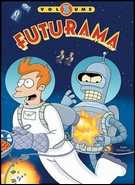
Like its Volume Two predecessor, Volume Three comes on four discs packed in
individual slim keep cases, each case decorated with one segment of a four-part
panoramic mural. Unlike Volume Two, there are 22 episodes (vs. 19) in this
production run—among them, several considered by fans to be the best of
the show's entire history. I'd call that a bargain—the best I've ever had.
At least from Fox.
Disc One
"Amazon Women in the Mood"
Long, long ago—in Volume
One—Zapp Brannigan's poor, downtrodden sidekick Kif met, and fell
hopelessly in love with, Amy Wong. Kif, though, is painfully shy, and even now
can barely manage to dial Amy's phone number, let alone actually speak to
her. He unwisely turns to Zapp for help in wooing Amy. During the course of a
very poorly planned double date, Zapp crashes a space restaurant into what turns
out to be the planet Amazonia, populated by gigantic jungle females. Fry and
Bender soon wind up there as well, after learning of the restaurant crash.
Amazonia is ruled by Femputer (Bea Arthur, The Golden Girls), a female
computer (duh) the Amazon women worship and obey. Femputer's main
political/religious stance is "men bad." Hence, the men are quickly
sentenced to death by "snu-snu" for their trespassing.
"Snu-snu" turns out to be what we humans refer to as "the
boot-knockin' nasty"—which is downright hazardous when all the women
are 20 feet tall and extremely athletic. Can Amy and Leela save Fry and Kif?
(Zapp's on his own, of course.) Do they really want to be saved from
non-stop snu-snu? And what is Femputer's deep, dark secret? An all-time classic
episode.
"Parasites Lost"
Fry unwisely eats an extremely old egg
salad sandwich from a truck stop vending machine. When near-fatal wounds start
to heal impossibly rapidly, the Professor discovers that Fry has been infected
by parasites—tiny worms that have established a small, yet advanced,
civilization in Fry's colon. A Fantastic Voyage is undertaken when
the Professor sends microclones of the Planet Express crew inside of Fry to
cleanse him of the parasites. But there's a catch—the parasites are
benevolent—they're actually improving Fry from the inside out,
making him better…smarter…more attractive to Leela. Plus, they
really don't want to leave. Leela fights to save the parasites. But Fry worries
that Leela doesn't love him for his real self; she loves him for his parasites'
version of him. Hijinks ensue.
"A Tale of Two Santas"
The evil robot Santa Claus is back
again! The Planet Express crew is forced to deliver letters to Robot Santa at
his evil death fortress on the planet Neptune. Fry decided that Xmas needs to be
happy and jolly again, and convinces everyone to end Santa's nefarious reign.
With the help of the Neptunians, toymakers and practitioners
of…um…alternative lifestyles, they do, freezing Santa Claus in ice.
Bender takes over Santa's job, and tries to deliver toys to all the good girls
and boys. However, nobody told Earth about the change in plans…Featuring
Coolio as Kwanzaabot. A historical note: Fox refused to air the first
"Xmas" episode (which is found on Volume Two) at 7:00 PM, the show's
normal airtime, due to the whole Evil Santa Claus issue; this episode
they refused to air at all. It took a year of lobbying on the part of the
producers to finally get it aired, a whole Christmas after it was meant to be
shown.
"The Luck of the Fryrish"
At long last, we finally start to
learn something about Fry's personal history. Beset by some bad luck, Fry
attempts to find his old lucky charm, a four-leaf clover he had hidden in the
sleeve of the soundtrack to The
Breakfast Club. He finds the ruins of his house, and the album—but no
clover. He also discovers a large statue of his brother Yancy, but labeled
"Philip J. Fry: The First Man on Mars." Yancy's statue has a four-leaf
clover carved on its lapel. Fry becomes convinced that his brother, who always
stole stuff from him, had purloined his clover and used it to steal the luck
that was rightfully Fry's. After some flashbacks, some research, and a little
bit of grave robbing, Fry discovers how wrong he really was about his brother.
The first in a series of overtly sentimental episodes during the final two
seasons of the show.
"The Birdbot of Ice-catraz"
Planet Express is contracted to
tow a barge full of an oil-like substance over a route that runs dangerously
close to a penguin preserve on the planet Pluto. Leela thinks this is stupid,
and joins a protest group (Penguins Unlimited) that's picketing the transport.
Bender, who takes over as captain, crashes the barge into Pluto (of course). To
hide from the cops, he disguises himself as a penguin and blends in with the
locals. After a killer whale attack, a malfunction causes him to actually go
into "penguin mode." Hijinks ensue.
"Bendless Love"
Bender starts to bend things in his sleep,
including the professor. Turns out he's subconsciously frustrated at his
bending-free lifestyle, since that's what he was born to do. He goes out and
gets a job as a scab bender at a plant being picketed by the union. He falls in
love with a top-heavy fembot co-worker named Anglelyne (Jan Hooks, Saturday
Night Live), who just happens to be the ex-wife of…Flexo, Bender's
identical twin (except for an evil goatee). Flexo is also the scab foreman at
the plant. Bender gets paranoid, and pretends to be Flexo in an attempt to prove
that Anglelyne isn't over the relationship. Along the way, he annoys the Robot
Mafia. Things eventually unbend themselves, sort of.
Disc Two
"The Day the Earth Stood Stupid"
Has nothing to do with the
Robert Wise sci-fi classic The Day
the Earth Stood Still. Instead, it's the first entry in a long-term story
arc concerning Nibbler, Leela's pet. Leela enters Nibbler in a pet show, and
wins an award—for the dumbest pet in the show. (The winner of Best in
Show? The Hypno-toad. All hail the Hypno-toad!) Soon, everyone has bigger
problems, as giant brains invade the Earth and make everyone really, really
stupid. Nibbler runs off and retrieves his spaceship (!), and brings Leela to
his home planet of Eternium, where the Nibblonians—a super-powerful and
super-adorable race—have been monitoring the invasion of Earth by their
arch-enemies, the Giant Brains. The Nibblonians tell Leela that there is only
one person who can save Earth. The one person who is already so dumb that he's
immune to the brains' intelligence-sapping effect. Philip J. Fry.
"That's Lobstertainment"
Exhibit #1 for why Futurama
never struck it big. This episode, believe it or not, is a rough retelling of
the story of silent movie star Harold Lloyd, whose popularity was probably
second only to Charlie Chaplin during the silent film era. Lloyd's career
completely disappeared with the advent of "talkies"; much later in
life, he attempted an unsuccessful comeback at the behest of director Preston
Sturges. Maybe .0000001% of the country would pick up on this when
watching the episode. (I sure didn't, until I read about it elsewhere.) Lloyd
becomes Harold Zoid, the washed-up entertainer uncle of Dr. Zoidberg. Zoidberg
flies to LA to solicit his advice after failing in his attempt to be a stand-up
comic. Zoid convinces Zoidberg to invest all his money in a comeback film.
Unfortunately, they're a little short in fundage. About a million dollars short.
Enter Bender, who arranges for his new best friend Calculon, star of the robot
soap opera "All My Circuits," to chip in a million in funds. Just two
things, though—Calculon has to have a starring role, and Bender kinda
promised Calculon that he'd win an Oscar(tm), guaranteed. Unfortunately, the
movie is awful. Hijinks ensue.
"The Cyber House Rules"
At a reunion for her orphanage,
Leela reunites with a cute boy on whom she had a crush. He's now a doctor, and
offers to add a second prosthetic eye to her face via plastic surgery. Leela
jumps at the chance to finally look "normal," notwithstanding Fry's
insistence that she looks just fine when she's abnormal. Meanwhile, Bender jumps
at the chance to adopt as many orphans as he can, since the government cuts a
$100 weekly check for each one. None of this ends well.
"Where The Buggalo Roam"
Amy takes Kif home to Mars to meet
her parents, Leo and Inez Wong, who own half the planet. (The good half.) Her
parents, of course, think he's a wimp. Kif has a chance to prove himself to them
when the Wong herd of buggalo (buffalo-sized bugs) are rustled out from under
them during a dust storm. Kif's journey of pseudo-Western adventure brings him
in contact with the real Martians, who sold their interest in the planet to the
Wongs for one bead long ago. The Martians kidnap Amy, leading the Wongs to hire
a rescuer—Zapp Brannigan, of course. Can Kif rescue Amy before Zapp screws
up the whole planet?
"Insane in the Mainframe"
Fry and Bender run into Roberto,
an old robot friend of Bender's, at the bank. He's robbing it. Bender and Fry
accidentally help him, and are arrested. Fry's all set to rat out Roberto in
court when Roberto corners him outside the courtroom and threatens him. Fry and
Bender wind up pleading insanity, and both are sentenced to a robot insane
asylum. (The human asylum was full.) Over time, Fry comes to believe he actually
is a robot, and acts accordingly. Lots of references to One Flew Over The Cuckoo's Nest.
"The Route of All Evil"
The Professor's clone Cubert (Tress
MacNeille, The Simpsons) and Hermes' son Dwight (Bumper Robinson,
Sabrina the Teenage Witch) are forced to get jobs by their fathers. They
start a paper route. Normally, fathers are proud when their sons are successful
in business—but here, it turns into a competition. Cubert and Dwight, via
some maneuvering that would make Gordon Gecko proud, wind up taking over Planet
Express itself. It all comes crashing down on them, Enron-style, in the end. But
everyone learns a valuable lesson about not being a bully. Bender also gives
birth to some pretty good beer.
Disc Three
"Bendin' in the Wind"
After a freak accident involving a can
opener, Bender is paralyzed. In the hospital, he meets the head of Beck (voiced
by some guy named Beck Hansen), who inspires Bender to find his inner loser and
play that funky music with a pair of robotic arms. He joins Beck's tour as a
washboard player, playing his own washboard abs. Fry, Leela, Amy, and Zoidberg,
having discovered the functioning remains of a VW microbus, follow the tour.
Bender is moved by the sight of broken robots being melted down, and organizes a
benefit concert for broken robots—Bend Aid. Enthused by his new purpose in
life, Bender suddenly regains the use of his arms and legs. But he can't tell
anyone, because he's got a pretty sweet deal going on. So he tries to fake his
way through the benefit concert. Things don't end well, and Bender doesn't get
to keep the Official Oversize Check.
"Time Keeps On Slipping"
The Harlem Globetrotters arrive
from the Globetrotter homeworld to announce that Earth isn't jive enough to take
them on. The Professor rises to the challenge of the 'Trotters, and creates a
team of mutants to defend the honor of our planet. Unfortunately, they're all
infants. To rapidly age the mutants, he needs a bunch of chronotons: little
particles of time itself. Fry, Leela, and Bender go off to fetch some
chronotons, and accidentally create the proverbial rip in space-time. Time does
indeed start slipping, slipping, into the future; leaping ahead randomly.
Jump-cut gags abound. The Professor and the Globetrotters join forces to stop
the time/space disturbance before it consumes the universe. Along the way, Fry
and Leela somehow wind up married, then divorced. But Fry can't remember why
Leela agreed to marry him in the first place. Bender fruitlessly tries to become
a Globetrotter, and everything turns out relatively fine in the end. We all
still have Zoidberg, but we all are jive turkeys.
"I Dated a Robot"
Fry decides to do all the things he wanted
to do in the past but couldn't—destroy a planet, ride a dinosaur, visit
the edge of the Universe. You know—tourist stuff. And have a romance with
a celebrity. For that, he goes to Nappster.com, where you can download
celebrities and imprint them on blank robots. Fry asks for someone like Lucy
Liu, but it turns out they don't have anyone like that. They do, however, have
Lucy Liu (as voiced by Lucy Liu). Fry embarks on a relationship with his new
robot pal, unaware of the dark taboo associated with human/robot love. Plus, the
real head of Lucy Liu is upset at the illegal downloading going on. Popcorn
ultimately is involved in the story, and Fry, as usual, winds up alone.
"A Leela of Her Own"
The Planet Express crew befriend their
new neighbors, a family of immigrant aliens who own and operate a pizza parlor.
They're not completely familiar with the concepts of "pizza"
and "toppings"—but they're very enthusiastic about fitting in.
Hence, the gang introduces them to the national pastime, blernsball. It's sort
of like baseball, except for…well, everything. But the uniforms are the
same. Leela takes the mound as pitcher, but can't manage to get a ball over the
plate. She does manage to hit every single batter she faces. One thing
leads to another, and she's hired by the woeful New New York Mets for publicity
purposes, becoming the first professional female blernsball player ever. Leela
thinks she's a role model for young female players everywhere, but it turns out
she's just a laughingstock, helping to keep the really talented female
blernsballers out of the league. Will Leela go down in history as the worst
blernsball player ever? Probably. But the alien immigrants quickly learn the
American Way and sell out to Fishy Joe (from the Futurama: Volume Two
episode "The Problem with Popplers.")
"A Pharaoh To Remember"
The crew makes a delivery to the
planet Osiris 4, and wind up as slaves under the tyrannical rule of the local
pharaoh. Bender exploits the pharaoh's semi-timely death, as well as some
quickie hieroglyphics, to establish himself as the One Whom Prophecy Deemed
Would Appear From Space To Be The Next Pharaoh. And let me tell you—Bender
isn't a very good boss. After forcing the slaves to build a gigantic
statue—which almost reaches orbit, it's so tall—in his honor, Bender
decides that it isn't big enough, and that they should all try again. The slaves
declare that oops, Pharaoh Bender "accidentally" died, and seal him up
inside his own statue. Can Fry and Leela save him? Do they even want to? Will
fruit really stay fresher if you keep it under a statue of Bender?
Disc Four
"Anthology of Interest II"
Another three-part collection of
mini-stories along the lines of The Simpsons' "Treehouse of
Horror" episodes. The Professor fixes up his old "What If"
machine, and gives the crew another crack at asking it appropriate questions.
Bender asks "what if I were human?" Well, he'd have a great time, but
would lack any semblance of self-control, leading to his ultimate messy fate.
(Contains one of the greatest "sound effects" ever. If you've seen the
episode, you know what I mean.) Fry asks "what if life were more like a
video game"? The machine shows him an alternative timeline where he, Fry,
is called upon by Colonel Colin Pacman (wacka wacka) to fight—you guessed
it—Space Invaders from the planet Nintendu 64 ("Tremble in fear at
our three different kinds of ships!!!"). Guest starring Q-bert as himself
(itself?). Finally, Leela asks "what if I found my true home?" The
machine hits her on the head, and she wakes up in a strange land. One might even
call it, oh, Oz-like…yes, a Wizard of Oz parody. (I think these are
now mandatory for any sitcom, animated or flesh-and-blood.) Unlike the original,
in this version Dorothy is a bit more interested in the dark side of
Oz…
"Roswell That Ends Well"
Anyone remember that old Ray
Stevens song "I Am My Own Grandpa"? The writers of Futurama
sure do. 'Nuff said. I don't think Ray's song involved the harmful effects of
attempting to cook Jiffy-Pop popcorn in the microwave, though. A surprisingly
well-constructed time travel episode (nary a glaring logical inconsistency in
sight) that won the 2002 Emmy Award for Outstanding Animated Program. (Side
note: an episode from the final production run of the show, "Jurassic
Bark," was nominated for an Emmy in 2003. It's one of the finest
sitcom episodes ever made, let alone animated show episodes—a show
that had an ending so moving that I literally broke down in tears when I first
watched it. It lost to the The Simpsons' "Three Gays of the
Condo" episode, thereby proving conclusively that Satan does, in fact,
exist; and his hellish, dark schemes and contrivances apparently control the
Emmy voting. But I digress.)
"Godfellas"
Bender is sleeping on the job as usual, but this
time it bites him in his shiny metal ass. Because he's sleeping in a torpedo
tube (who knew the ship had torpedoes?), and the ship's just been attacked by
pirates. Bender is accidentally fired at the pirates, and winds up careening off
into space at an incredible speed. While zooming through the cosmos, he collides
with a tiny chunk of an asteroid that—wonder of wonders—contains a
teeny, tiny functioning society of teeny, tiny little anthropomorphic creatures.
They go about their merry lives and worship their new robot God. Bender,
however, discovers that being God isn't all good times and butterflies; you have
to do nasty stuff like answer prayers and decide who lives and dies. He botches
the job royally, but learns a lesson from a mysterious being who may actually be
the real God him/her/itself.
"Future Stock"
Fry attends a cryogenic support group and
meets up with a Gordon Gecko-like fellow who was frozen back in the 20th
Century. One thing leads to another, and That Guy (as he is called) winds up
taking over Planet Express thanks to some shareholder conflict. That Guy, now
ensconced as CEO, decides to take on Mom's Delivery Company, the market leader.
Fry functions as his brown-nosing toady. (He's got a really neat chair, too.)
But wait—deviously That Guy secretly intends to sell out to Mom,
thereby enriching himself and putting everyone out of work. More stockholder
shenanigans ensue, and the gang is ultimately saved thanks to the heartbreak of
boneitis. (Special appearance by a robot Bar Mitzvah, complete with "Today
I Am A Robot" spelled out in Hebrew. Attention to detail!!!!)
"The 30% Iron Chef"
Star Wars meets The Karate Kid meets The Food Network. Bender,
the ship's chef, is absolutely horrible at cooking, due mainly to his lack of
taste buds. When he overhears the crew complaining about his latest atrocious
meal, he runs away. Winding up at a hobo camp (Bumbase Alpha), he meets Helmut
Spargel, who once was the most famous chef in the world—until his pupil,
celebrity chef Elzar (think Emeril with extra arms—BAM!), usurped his
culinary throne. Spargel agrees to train Bender in the ways of the
Force…er, I mean, in the ways of cooking. Bender passes his test, but
Spargel's stomach explodes in the process. Before death, Spargel gives bender a
vial of the Essence of Pure Flavor. Bender vows to avenge Spargel by taking on
Elzar—on the popular show "Iron Cook." The mystery ingredient?
Soylent green. There's also a somewhat silly and unnecessary subplot involving
Zoidberg and a ship-in-a-bottle. Don't ask. (Fun fact: "spargel" is
German for "asparagus.")
The extras package in Volume Three is essentially the same as that for
Volume Two: an animatic (for "Anthology of Interest II"), a set of
storyboards (for "Parasites Lost"), assorted clips, and—of
course—commentary for every episode. There's also a still-frame gallery of
"how to draw characters" that gives budding animators or cartoonists a
quickie guide to drafting the main characters from the show, and a set of clips
showcasing the 3D animated models generated by the animators for use in the
show.
The best, and most worthwhile, of these extras is the set of commentary
tracks. The number of different speakers used here is greater than in the
previous sets, allowing the listener to hear a broader range of stories and
opinions. Producer David X. Cohen is the one constant through all the
commentaries; Matt Groening participates in most as well. The commentary for a
given episode usually has the writer or director of the episode on the
track—often both. The tag team of Billy West and John DiMaggio return, and
some of the other voice actors pop up from time to time as well. (Still no Katey
Sagal, though.) Through it all, one thing comes through loud and clear: all
these people truly loved this show, and working on it. (Especially
interesting are the stories about the year-long fight with Fox over "A Tale
of Two Santas.")
Picture and sound are both as outstanding as the prior volumes—in
fact, the picture may be a bit better in Volume Three, since by this time
the animators and editors were getting much better at handling the show's blend
of hand-drawn and computer animation. Audio tracks (Dolby Digital Surround 2.0)
are provided in English, Spanish, and French; captions in English and
Spanish.
On a much smaller note, the menus on the DVDs have been improved from
Volumes One and Two. They now feature voiceovers from various characters (one or
two characters per disc). The comments they make are, to a certain extent,
randomized as well—wait a while, and you'll eventually hear something
different. Some of the comments are downright hilarious. You can never get
enough Bender in your life.
Futurama: Volume Three is, on the whole, the best of the four
Futurama production seasons. Volume One was the initial
season—short, and mainly devoted to introducing characters. Volume Two is
admittedly more consistent in quality than Volume Three—some of the Volume
Three shows are relatively weak. The best shows of Volume Two, though, don't
quite match the quality of the best of Volume Three. Volume Four (as yet
unreleased in the US), while containing some outstanding episodes (including the
aforementioned "Jurassic Bark"), contains many that were obviously
written under the cloud of the show's imminent cancellation; there's a feeling
that the writers were trying to tell the show's full story in what little time
was left, leading to some awkwardly rushed storytelling. Volume Three has
several of the all-time best episodes of the show, which more than make up for
the few clunkers along the way—and even a "bad" Futurama
show is better than most TV. If you're looking for the best the show had to
offer, Futurama: Volume Three is for you.