| Home | About | Blu-ray | DVD Reviews | Upcoming DVD Releases | Contest | Podcasts | Judges | Jury Room | Contact |
|
|
|
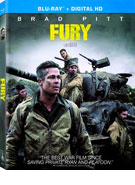
All Rise...Judge Clark Douglas thinks this prequel to The Fast and the Furious is way more violent than what followed. Editor's NoteOur review of Fury (1936), published May 10th, 2005, is also available. The ChargeHonor. Glory. War. The CaseWriter/director David Ayer has built a career out of making films about tough men (usually cops) trapped in tough situations (usually violent). Consider some of the titles he's worked on: Training Day, Street Kings, Dark Blue, End of Watch. This is a guy who seems fascinated with the brutal realities of the world we live in (I mean, he called his directorial debut Harsh Times), respects the men trying to maintain order within that world and understands how easily those men can find themselves corrupted by circumstances. As such, it's no surprise that Ayer's first period film—the WWII drama Fury—continues to explore these same themes. As usual, the men are resilient, the violence is visceral and the morality is complicated. The story begins in 1945, as the the war is drawing to a close and the Allies are in the midst of a death march across Germany. Don "Wardaddy" Collier (Brad Pitt, The Tree of Life) is the commander of a Sherman tank dubbed Fury, and he has three loyal men under his command: gunner Boyd "Bible" Swan (Shia LaBeouf, Transformers), driver Trini "Gordo" Garcia (Michael Pena, World Trade Center) and loader Grady "Coon-Ass" Travis (Jon Bernthal, The Walking Dead). The tank's gunner was a man named Red, who was killed in action and whose remains still occupy the gunner's seat. Red's replacement is Norman Ellison (Logan Lerman, 3:10 to Yuma), a green, intellectually-minded young soldier who has never seen any action. Wardaddy is unhappy with being asked to babysit a fresh recruit, but begrudgingly accepts Ellison as part of his team. If all of this is sounding a little familiar, well, it is. The seasoned veteran/fresh-faced rookie dynamic is often found in Ayer's cop dramas, but the trope is just as prevalent in war movies dating back to John Wayne's heyday. Like many of those movies, this one features an ensemble that is less a group of individuals than a series of types: the no-nonsense leader, the religious guy, the scary psycho, the smartass and the quiet bookworm. To Ayer's credit, he makes a stab at bringing some real human dimension to these characters, but they ultimately feel more like symbols than people. That's forgivable: Fury is built on potent symbolism. There's certainly something symbolic about the particular time and place the
film zeroes in on. Many would contend that WWII was America's last legitimately
"good war," but that doesn't mean it didn't have elements of senselessness.
Fury sees men killing men at a time when the outcome of the war has
essentially been decided. There's no question that Germany will lose, but Hitler
would rather squander the lives of his soldiers than surrender. As such,
Americans will also die for the sake of beating Germany to a pulp; taking life
after life until Germany recognizes that surrender is the only remaining option.
"It will end, and it'll be soon," Wardaddy tells Ellison, "But a lot more people
are gonna have to die first."BR> This isn't really a performance-driven film, but the actors fare reasonably well under the circumstances. Pitt is playing a considerably more realistic version of the alpha male leader he essayed in Quentin Tarantino's Inglourious Basterds (complete with drawl). In Wardaddy's mind, what's good and what's evil are both secondary concerns to what's necessary, and Pitt does a fine job of capturing that steely resolve. LaBeouf is also surprisingly convincing, toning down his usual twitchiness to play a deeply spiritual character who tries to find ways to reconcile his faith with the things he's required to do. Bernthal and Pena are a little less complex (and the former occasionally flirts with cartoonishness), but their performances are largely believable. Lerman's performance is the only one I found problematic, as Ellison is dealing a lot of complicated emotions the actor's mortified stare isn't quite capable of containing. The film's strongest sequence is an extended set piece placed squarely in its midsection, as Wardaddy and Ellison find themselves in a quiet encounter with two German women. It's a sequence that begins as a polite, touching portrait of cross-cultural communication, but turns terrifyingly tense once Wardaddy's other soldiers enter the picture. It's a masterful stretch of filmmaking which perfectly summarizes the ever-present conflict between nobility and savagery. It's a conflict these men find themselves in every day (perhaps an inevitability when your daily routine involves killing people), and some veer closer to one side of the equation than others. The sequence almost feels like a great one-act play, but it isn't self-contained: it provides us with a lens through which to view the rest of the film. Fury contains many scenes of battle, but it speaks loudest during its quietest moments. Ayer faces the age-old problem of attempting to stage battle scenes without glamorizing war. I'm not sure that he succeeds, but it's not for lack of effort. Intentionally or otherwise, Fury makes the case that war can be both exciting and horrible, creating a murky moral climate which feels appropriate for the story Ayer is telling. The film has been criticized for devolving into simplistic war movie formula during its third act. I agree that the film's ending is a little limp (and it's not the first time Ayer has struggled to deliver a satisfying conclusion), but I disagree with the charge that Ayer has suddenly betrayed the values of his film. It is possible for a man to be a monster and a hero, and that's certainly the case in more than one instance here. Sins which would be unforgivable in civilized society are overlooked within the confines of war, because war is dangerous enough without losing the support of your fellow soldiers. Ayer is more interested in raising questions than in answering them, but Fury has both a conscience and a willingness to challenge the mentality of both jingoistic flag-wavers and cynical pacifists. Fury (Blu-ray) sports a fantastic 1080p/2.40:1 transfer which captures Ayer's gritty vision in vivid detail. There's an intentionally desaturated, grimy look to the film, but the level of detail on display is remarkable. You can see every nuance of the men's war-battered faces, and every clump of dirt, strip of flesh and blade of grass is rendered with remarkable definition. There's a very small measure of grain present, as well, which adds to the "old-fashioned war movie" vibe. The DTS HD 5.1 Master Audio track is similarly tremendous, and the battle sequences will give your speaker system quite a workout. While I found Stephen Price's score distractingly anachronistic at times (it's pretty similar to his work on Gravity), it's an effectively overwhelming work that sounds tremendous. Dialogue is always crisp and clear, and I never found myself forced to adjust the audio. Supplements include a boatload of deleted and extended scenes, a handful of featurettes ("Blood Brothers," "Director's Combat Journal," "Armed Warriors: The Real Men Inside the Shermans" and "Taming the Beast: How to Drive, Fire & Shoot Inside a 30-Ton Tank"), a photo gallery and a digital copy. Fury may not be the next Saving Private Ryan or The Thin Red Line, but it's nonetheless a thoughtful, forceful portrait of war. If the entirety of the film were as strong as its midsection, this would be a masterpiece. The VerdictNot guilty. Give us your feedback!Did we give Fury (2014) (Blu-ray) a fair trial? yes / no Other Reviews You Might Enjoy
• The Marine 2 |
|
DVD | Blu-ray | Upcoming DVD Releases | About | Staff | Jobs | Contact | Subscribe | | Privacy Policy
Review content copyright © 2015 Clark Douglas; Site design and review layout copyright © 2015 Verdict Partners LLC. All rights reserved.