| Home | About | Blu-ray | DVD Reviews | Upcoming DVD Releases | Contest | Podcasts | Judges | Jury Room | Contact |
|
|
|
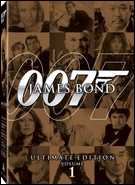
All Rise...You know Appellate Judge Rob Lineberger's name. You know his number...don't you? We think it is 1083, but best to make sure. Editor's NoteOur reviews of Diamonds Are Forever (published October 16th, 2000), Goldfinger (published October 31st, 1999), The Living Daylights (published October 24th, 2000), The Man With The Golden Gun (published May 10th, 2000), and The World Is Not Enough (published May 3rd, 2000) are also available. The ChargeNOW meet the most extraordinary gentleman spy in all fiction!…JAMES BOND, Agent 007! Opening StatementThis first volume of the James Bond Ultimate Edition is a mixed bag. It offers what is arguably the most popular Bond film (Goldfinger) alongside clunkers like Diamonds Are Forever and The Man with the Golden Gun. It spans four actors and four decades, including one of the infamous Dalton entries and an underrated Brosnan flick. Yet every Bond fan must wrestle with the same question: Are the new features, new DTS mixes, and new restorations worth plunking down the cash for this James Bond Ultimate Edition when high definition is on the horizon? It depends…do the words "Pussy Galore" do anything for you? Facts of the CaseJames Bond travels to exotic locations, beds lots of beautiful women, and blows lots of stuff up. He confronts evil masterminds and foils plots for world domination. Along the way, he makes enemies, plays dice, goes boating, gets served mint juleps, and generally acts like a wisecracking badass. The EvidenceFirst, you're entitled to fair warning. As my review of James Bond Ultimate Edition (Volume 4) suggests, I'm imbalanced when it comes to James Bond. Judge Johnson (James Bond Ultimate Edition (Volume 2), James Bond Ultimate Edition (Volume 3)) is a righteous Bond freak with a great take on the franchise, but he's (arguably) healthier than I am. We're talking week-long trips to London with a signed copy of James Bond's London in hand, asking the clerks in shops like Dunhill and Turnbull & Asser for "James Bond's lighter" or "James Bond's Sea Island cotton shirt." Regular re-readings of the entire Bond canon from Casino Royale to "The Hildebrand Rarity." The other day, my wife asked me how to make a martini like James Bond would drink. Before I could finish the words "three measures of Gordon's, one of vodka, half a measure of Kina Lillet" she called me a pedantic asshole and moved on. (By the way, you can't get Kina Lillet anymore, and Gordon's gin sucks.) Just wanted you to know where I'm coming from so you'll understand when I rank The Living Daylights over Goldfinger. To judge the audio quality of this set, I began with the pre-credits sequence of The World is Not Enough. For several years, the speedboat chase in the Special Edition release has been my audio demo material. The Dolby Digital 5.1 mix in the older release is superlative, with a enveloping stage, clarity, oomph, and enough sonic effects to give any production team pause. From the booming torpedoes to the high-pitched whine of the speedboat controls to the swooping waves of misplaced water, this sequence is a challenging test of separation, dynamic range, and positioning. I wondered whether the new DTS 5.1 surround track could possibly improve upon it; though audiophiles generally prefer DTS tracks, there is no technical reason why a Dolby Digital track can't match or exceed DTS. In practice, the DTS is slightly more crisp and less mellow than the Dolby track, which boils down to a matter of personal preference. I prefer the Dolby Mix in this case because I'm used to its nuances, and the DTS track doesn't offer anything substantially better. In other words, they did an oustanding job with the original mix and DTS doesn't offer much improvement. The Living Daylights, on the other hand, can stand some improvement on the original stereo mix. The soundtrack is music-heavy given that female lead Kara Milovy is a cellist at the Bratislava Conservatory (incidentially, this was Barry's last Bond score, and it is a love letter to music). Between Necros dishing out grenades and Kara strumming the cello, The Living Daylights has a demanding sonic field to convey. The previous release did a competent, unexciting job with this task. I'm generally against post-humous surround remixes, but in this case the new DTS mix provides a welcome boost in clarity and separation while retaining the feel of the original stereo mix. As we move back further in time past the '70s and into the '60s, the DTS mix becomes less and less relevant. Goldfinger is a monaural film; does the artificially widened soundstage and slight boost in clarity justify tearing apart a superlative mono track? For its time, Goldfinger's brassy intro song, roomy sonic effects, and crackling dialogue were ear-opening. Nevertheless, if you venture to try the Goldfinger DTS 5.1 track, your ears will be opened, and then crammed full of throbbing motors, explosions, and gutsy vocals. I didn't like the change; it seemed too dynamic and cranked too loud. As for Diamonds are Forever, no remix is going to solve the slight (but persistent) lip synch issues and generally blah sonic field present in the film. It just isn't a great sounding film, despite its Oscar nomination for Best Sound. The Bond team is superb when it comes to audio, so good for them, but I truly don't get the nod for this particular soundtrack. At least The Man with the Golden Gun has surreal funhouse laughter and lots of echoey, '70s-era gunshots. All told, the DTS tracks are a welcome addition to the arsenal and do sound crisper, though The Living Daylights is the only film with a clear improvement from the DTS treatment. How do the visuals fare? Again, the transfer of The World is Not Enough was already up to snuff, though it was a little dark, which rubbed out detail in low-contrast areas. Unlike Tomorrow Never Dies, The World is Not Enough doesn't have any strange color pushes. The new transfer improves detail almost imperceptibly. Dark scenes get the most benefit, though the whole transfer has a slight warmth added throughout. The Special Edition release of The Living Daylights was noticeably soft, with washed-out colors and a greenish-gray cast. The night scenes under the Ferris wheel in Vienna present a challenging contrast of blacks and jewel tones that the Special Edition struggled to meet. The improvement in this new Ultimate Edition transfer is immediately noticeable. Much of the softness is gone, replacing the haze with details I've never seen before in the rocks and buildings of Gibraltar. The red lights at the base of the rock have greatly improved saturation so that they look like red lights instead of reddish-brown spatter. If you've ever wondered whether there is actual nudity in a Bond film, the new detail in The Ultimate Edition of The Living Daylights definitively answers that question when Puskin's bodyguard barges through the doorway. Interior scenes still have a greenish-gray cast, but contrast and detail are much higher. And the Ultimate Edition finally meets the challenge of nighttime Vienna's blacks and jewel tones, although blues seem oversaturated in these scenes. The Man with the Golden Gun shows a similar improvement in detail, contrast, and saturation. Colors pop and the lush island paradise looks like a lush island paradise. The first reel is slightly rough, but things settle down quickly. This movie benefits from increased stability in the frame; Lowry's process makes the image rock stable. Diamonds are Forever also enjoys newfound stability and has no detectable edge enhancement, yet the transfer is very dark in outdoor night scenes and lacks contrast overall. Nevertheless, increased detail makes up for color biases any day. The most dramatic improvement belongs to Goldfinger. The quality of the final projection print for this 1964 film was limited by the precision of the sprocket-hole alignment of three color masters. Film is essentially a big ribbon, and though the tension is tightly controlled at the point of duplication vibrations and misalignments can occur. But Lowry Digital has no such limitations. The color masters in this case line up 100% perfectly, which makes this scan of Goldfinger superior to the original master. No matter how many times you've seen Goldfinger, you'll see it anew with this transfer. Even this transfer is not perfect. Goldfinger's popularity must have left the masters with more than their fair share of dirt: slight edge enhancement is clearly discernable in the opening scenes. As with the other Ultimate Editions, these new Lowry Digital restorations had BluRay in mind. If these Standard Definition transfers show such marked improvement, it means that the High Definition treatment will blow this Ultimate Edition away. If you distrust the future of BluRay and you want the best image quality available, this is the set to own. If you can hold out for the High Definition releases, you have to ask yourself how patient you are. That does it for the technical discussion—except for one little annoyance: The trailer that plays if you forget to pull up the main menu is lame. This gee-whiz promotion of the Ultimate Edition restorations boldy exclaims that the Ultimate Editions are the pinnacle of DVD video quality. Why, then, is this "Ultimate" footage shown non-anamorphically in letterboxed format? Anyway, the heart of this set is the movies and bonus features (I used a list compiled by Dimitris Kiminas to describe the special features listed for each film). Let's take a look at the bounty offered in Volume One. Goldfinger But none of these trappings would be enough if the central tension wasn't compelling. Connery is at his easy best, casually slipping into bedsheets and violence with a roguish grin. Bond's manner infuriates Auric Goldfinger, which creates a simmering, escalating schoolyard rivalry that quickly turns nasty. Bond's grudging respect for Goldfinger's caper is unmatched in the rest of the franchise. In short, the two are equals. The laser table exchange is but one payoff of this rich rivalry: "Do you expect me to talk?" Not until Goldeneye would we be treated to such a fine match for James Bond. Yet in their sentimental zest for Goldfinger, people sometimes gild what should be shoveled out of the stall. I'm talking about some of the worst acting and plot holes in the history of James Bond, if not all of cinema. I'm looking at you, gangsters…"Hey, what's with that trick pool table?" I tell you. That trick pool table, and many minutes before it and after it, are horrific gaffes in screenwriting. Goldfinger hauls in the gansgsters, explains his plan in great detail, allows Mr. Solo to leave, kills him, then kills the gangsters. Why? So Bond (and by extension, the audience) can absorb the plan. Why not have Goldfinger explain it to Odd Job, or even directly to Bond? While I'm griping, the ending of the film is atypical and unsatisfying. In the book, Pussy Galore is a trifle and there simply for conquest value. Bond hides a note in an airplane lavatory that tips Leiter off (remember that bad acting thing? Cec Linder's Leiter reeks). Bond sweats it out, but only because he is playing a chance. In the movie, Pussy is brassed up considerably by Honor Blackman and given more to do. This is great—but James Bond might as well be a bump on a log. He sits, watches the plot unfold, and waits to die. My problem isn't that Pussy saved the day, rather that Bond did nothing, made no sacrifice, which weakens his heroism considerably. To a lesser extent, Bond's direct disobeyance of M's orders in the opening scenes led to Jill's death. In the book, Bond's skirmish with Goldfinger is by chance, which complicates the later events without putting the blame directly on Bond. Speaking of Jill, Shirley Eaton stole my heart in her scant few minutes. Is there a more pure flirt in the franchise than Jill Masterson? Her palpable relief at being out from under Goldfinger's thumb charges her lusty bedroom play with Bond. We're meant to fall in love with her, or course, because the script turns our love against us to reveal Auric's cruelty. The image of Jill Masterson suffocated by gold and left draped over the bed like a soiled sheet is visceral and metaphorical; an indeliable image. Goldfinger thinks of women as things, and will break his toys rather than let Bond play with them. While Goldfinger provides some of the franchise's icons—from the villain to the henchman to the girl to the car—it tells a clumsy story and is full of irritations. It is deservedly in the upper tier of James Bond films, but gold-filtered hindsight has elevated it's reputation a little too high. New Special Features • "On Tour With The Aston Martin DB5" (11:13) • "Honor Blackman Open-Ended Interview" (3:48) • "Sean Connery From The Set Of Goldfinger" (3:03) • "Theodore Bikel Screen Test" (5:23) • "Tito Vandis Screen Test" (3:59) • "Exotic Locations" Diamonds Are Forever Yet Diamonds Are Forever isn't interesting at all. In fact, it is nearly robotic in its ineptitude. The trouble with Diamonds Are Forever is that it's a conscious clone of Goldfinger. After an alarming decline in box office receipts between You Only Live Twice and On Her Majesty's Secret Service, the producers were tripping over themselves to repeat their early smash hit. The problem is that films are creative endeavors, and creative people hate copying their own work. Boredom and the rote mechanics of making a Bond film color every frame. Bassey's theme song performance is forgettable. The exchange between M and 007 about port vintages (while at the home of a noted commodities expert concerned that smuggling will destablize British currency, even) has none of the sizzle of the "disappointing brandy" exchange from Goldfinger. In this one, Bernard Lee rolls his eyes and huffs in a fit of pique while Connery recites the vintage with a stone face. It is embarassing—but not as embarassing as Bond's perfuctory flirtation with Moneypenny. As each homage to Goldfinger mounts, so falls Diamonds Are Forever. Plenty O'Toole is no Pussy Galore (though wouldn't that be an epic matchup!). The Ford Mustang Mach 1 is no Aston Martin DB5. Neither is the Moon Buggy. Norman Burton is no Cec Linder. And Charles Gray's Blofeld is no Goldfinger. For that matter, Charles Gray's Blofeld is no Blofeld, either. He is smarmy, effeminate, and completely ineffective as a bad guy. The queer henchmen duos (Mr. Wint and Mr. Kidd, Bambi and Thumper) leave little impression, to say nothing of the generic hoods Bond faces at every turn. This lackluster display isn't entirely Cubby's fault. Fleming's Diamonds are Forever is a dull read without much screen-translatable plot. The basic story is the same, with Bond impersonating Franks to infiltrate a diamond smuggling ring. But Fleming's novel is full of dated, fawning fascination with Americana, particularly American gangsters. It has an Old West town with a steam locomotive, which might have been cute. Wint and Kidd at least make sense in the book; a homoerotic pair of football teammates who attack after yelling out the play. None of this works as a Bond film, so they had to fill the run time with something. Who better than Bond's arch nemesis Blofeld? What better story than diamonds smuggled to make a giant, death-wielding space ray—in order to start an atomic auction? These stakes are absurd. The James Bond franchise finally goes over the top, flattening everything in a whoosh of deflation. Connery is obviously not engaged with the role, but he makes some scenes work. For example, he is knocked out and dumped into a crematorium. His cool mixture of resignation and quick thinking is prototypical Bond, as is his breezy exit. It is one of the few moments of actual suspense in the series. But even Connery's brief moments of charm cannot salvage a series in creative turmoil. Diamonds are Forever goaded Cubby and friends into making the drastic choice they feared most: selecting a new Bond. New Special Features • "Lesson #007: Close Quarter Combat" (4:20) • "Sean Connery 1971: The BBC Interview" (5:00) • Alternative Angle Scenes • Expanded Angle Scenes • Test Reels • Expanded Scene: Oil Rig Attack (2:20) • Deleted Scenes • Photo Gallery • "Featurette-Exotic Locations" The Man with the Golden Gun Yet the film has kitschy elements that inspire a disproportionate level of like or loathing in Bond fans. The funhouse with a statue of Roger Moore is one. Knick Knack, played by a famous little Frenchman named Herve Villechaize, is an absurd, yet complex, addition; he blends in with some garden statues, naked and wielding a trident. There's the 360 degree spiral roll and the flying AMC. How about kung-fu schoolgirls? Or a reprise from the worst character this side of Jack Wade, J.W. Pepper? In a word, The Man with the Golden Gun is tacky. This tackiness inspires perverse joy in some misguided souls. Even with its overall malaise and velvet Elvis asthetic, The Man with the Golden Gun is not Moore's worst Bond effort. Bond's strongarm approach to Andrea Anders (Maud Adams, Octopussy) is laced with misogyny, but is oddly compelling. His exasperation with Knick Knack is a running gag that works. And let's not forget the film's strongest asset, Brit Ekland. True, her character was grossly miswritten, which makes Mary Goodnight among the most annoying Bond Girls in the series. Yet their incompetence could not mask Brit's stunning form and natural appeal. Even when acting like a ditz, she is beguiling. Had she been given a modicum of grace by the screen writers, Mary Goodnight could have been one of Bond's hottest conquests. The Man with the Golden Gun also creates more icons for the Bond franchise. Scaramanga's titular Golden Gun, assembled from innocuous items he carries around in his pockets, is an enduring gadget that was referenced in In the Line of Fire. Phang Nga Bay's majestic islands give us some of the best travel footage in the franchise. And though the finale was flubbed, the image of Bond and Scaramanga pacing off in a shoreside duel is arresting. Let's talk about that last item for a moment. Fleming's novel The Man with the Golden Gun sketches a brutal, repugnant character. Scaramanga is freakish and freakishly talented. Bond works himself into a blood lust for the man, which makes the showdown tinged with malice. It is one of the few occasions where Bond wants to kill someone. The directors begged Christopher Lee to downplay Scaramanga's repugnance and establish himself as an equal to Bond. As a result, Lee and Moore's confrontation feels like two catty members of the garden club sitting down to a distasteful social obligation. Bond seems like an ill-mannered guest to Scaramanga's thinly polite host. Their showdown is pedestrian as a result. Had Lee been allowed to let his menace through, and had Bond been given reason to hate the man, this could have been a marquee matchup. And the less said about the painful solar compound, the better. It exists only to be blown up. Between the lackluster duel and the obvious explosion fodder, the end of The Man with the Golden Gun reeks. With its third nipples, trident-wielding midgets, and kung fu fighting, The Man with the Golden Gun packs a potent dose of '70s kitsch. Ekland and Adams are easy on the eyes and Moore is a decent Bond. But fans of the serious James Bond have good reason to be disappointed by this missed opportunity. New Special Features • Audio Commentary with Roger Moore • Roger Moore Interview from The Russell Harty Show
(2:51) • "Girls Fighting" (3:29) • "American Thrill Show Stunt Film" (5:03) • "Guy Hamilton: The Director Speaks" (5:04) • "The Road To Bond: Stunt Co-ordinator W.J Milligan"
(8:01) • "Exotic Locations" The Living Daylights Both camps have become, whether through indifference or overexposure to the facts, desensitized to the sheer bravery of Dalton's risk. Timothy Dalton stood in the path of a jaggernaut—a well-oiled, lucrative, painstakingly marketed, world-recognizable, decades-old film franchise with clearly established conventions—and turned it aside with a raised hand. "We need to get back to the character," he said, "millions and formula be damned." No witty banter, no casual womanizing, no mindless killing. The branch had grown very far from the trunk, turning a fallible, human, and tired agent into SuperSpy. Dalton perceived that the cartoonishness of the character could not support its own weight. He insisted on portraying a man who killed only with studious (and often contemptuous) intent, one who did what he did for a barely perceptible higher purpose no matter the personal toll. In short, Dalton went directly against the grain to play a grim, emotionally distant weapon, one without time for pleasure. And Dalton's take, though unpopular, paved the way for Brosnan's dark edge and Craig's lance-like approach to James Bond. What would happen to Dalton if he was wrong? Would he piss off millions of people, and relegate himself to dark, cerebral roles in fringe films? What if he were right? He'd preemptively save the life of cinema's most popular franchise. As it turns out, both things happened, though it took the slow, sad deterioration of scripts during Brosnan's increasingly wasted tenure for the producers to face up to their jinxed spy capers. Dalton did save James Bond—and he became unpopular in the process. Dalton's Bond begins kicking ass immediately in an introductory shot that rivals Connery's famous "Bond, James Bond." Unlike Connery's mocking repartee in a high-stakes game of Chemin De Fer, Dalton's intro is silent and depends on screen presence. As a fellow 00 tumbles to his death, Bond takes in the scene. He surmises foul play and coils grimly. In that instant, you know that this Bond will not be stopped. There is no sympathy in Dalton's Bond, only effectiveness. The ensuing chase scene is worthy of any other pre credits sequence in the franchise. Dr. No is the only pure Bond film, but The Living Daylights gives us the purest take on James Bond. There are three reasons for this. First is that the source story is a short, concentrated character study. It is mostly internal, wherein a surly James Bond mulls over the task ahead of him and plays out several imaginary scenarios to pass the time. With the possible exception of You Only Live Twice, "The Living Daylights" is the clearest written distillation of what it means to be Bond. That's well and good, but "The Living Daylights" is also Fleming's greatest short story, one that rivals his novels in detail and depth. This enthralling read dumps years of nervous energy and misspent anger directly into your brain. But the translation of Fleming's cerebral story to screen belongs entirely to Dalton. His every grimace, impatient gesture, and studied grace when approaching the firing position tells. But dialogue is where Dalton truly shines. The venom in his comebacks to Saunders are as effective as the words themselves (even where Fleming would have used an expletive): "[Stuff] my orders. If M fires me, I'll thank him for it. Whoever she was, I must have scared the living daylights out of her." What, no witty throwaway line, like "She should have used her bow" or "I'd rather have taken her out for a drink?" Many people praise Daniel Craig as finally returning the character to us. Ironically, Craig's take is often dependent on contrast with the franchise's cartoonish formula to be effective. In part, we know Craig's Bond is different because he doesn't give a damn whether his martini is shaken or stirred and knows nothing about fashion; in other words, his Bond is the anti-Bond. With Dalton, you knew he was Bond because he regarded you like a tuxedoed mantis would a bug, and the cold set of his mouth meant business, and because he offered a secret smile of self-congratulations when he'd economically dispatched a foe. Craig does some of these things. He offers his own style of physical intimidation and brute curiosity in search of the truth, and his is an impressive debut. But it isn't as brave or as total as Dalton's re-writing of The Franchise. Fleming's story was cerebral and brief, both of which shorten the possible run time of a movie adaptation. After a stellar pre-credits sequence and phenomenal interpretation of "The Living Daylights," what follows? The franchise's most complicated story, one that depends on quick thinking and actual spy work to uncover. Though The Living Daylights is on my short list of Best Bonds, even I must admit that this sinuous story is hard to follow and often slow. It deals with deception: Bond deceives Kara (Maryam D'Abo), Koskov (Jeroen Krabbe) deceives Bond/Kara/Pushkin, Puskin deceives Koskov, and so forth until everybody is dead—or at the concert hall in formal dress. The Living Daylights takes us through arms deals, drug deals, KGB defections, the mujahadeen, kidnappings, assassinations, and wargames until the central plot becomes hazy. Hastening the film's decent in the popularity polls are irritating and/or incompetent villains. Jeroen Krabbe's buoyant villany works in The Fugitive, but grates in The Living Daylights. When he prances in place and kisses Bond on both cheeks, I want to reach into the screen, shove him back into his seat, and make him get serious. But I'll take three Koskovs over one Brad Whitaker. Krabbe's prancing is extremely irritating, but Joe Don Baker's slack-jawed slouching is downright painful. He accentuates every word with overplayed gestures that reek of discomfort, like he is trying out for a school play and has a bad case of jock itch. Joe Don Baker's continuing work in the franchise is a sign of the apocalypse. At least The Living Daylights was decent enough to give us Necros, one of the baddest adversaries Bond has ever faced. When he waltzes into the Bladen safehouse and dishes out a rain of destruction, you're watching an action movie masterpiece. Lest we rail too hard against the villains, let's not forget the forgettable heroes. Maryam D'Abo is an attractive, poised woman who could have been an amazing Bond Girl. Poor costume choices and an over-earnest script turn her into a petulant pawn. The best Bond Girls give men ungentlemanly urges, but D'Abo is never allowed to express her natural sex appeal. (Look at the D'Abo in the screen test playing Tatiana Romanova for a beguiling Bond Girl.) Saunders is well played by Thomas Wheatley, though his character is a whiny bureaucrat and thus not likeable. Robert Brown's M still can't erase the memory of the irascible Bernard Lee. Art Malik's mujahadeen leader Kamran Shah channels Koskov and prances about like a loon before becoming serious and dull. Even the redoubtable John Rhys-Davies suffers; the key player was supposed to be series regular General Anatol Gogol (Walter Gotell), which would have given the plot instant credibility. Gotell's health prevented this. Puskin is a last-minute fill in and never precisely fits, which Rhys-Davies echoes with a bad case of eyelid flutteritis. John Terry gives Cec Linder a run for worst Leiter, and there is a notable absence of desireable, available women. Despite its often slow plot, excrutiating villains, and bland heroes, The Living Daylights is jammed full of classic Bond moments. Those who say Dalton is humorless obviously overlook his bone-dry running riff on the cello that Kara insists on bringing with her. (And for humorless? Check out Diamonds Are Forever.) Indeed, The Living Daylights is probably the funniest Bond of them all if you appreciate subtle humor over puns. The ice chase sequence is both exciting and funny, while the Bladen Safehouse fiasco is superlative. There's another impressive fight in an Afghan jail and a breathtaking aerial fight. Though it fails utterly because Joe Don Baker has the gravitas of a schoolboy on a sugar high, the ending sequence is a welcome change from elaborate stainless steel compounds that get blown up by space-age technology. The first 50 minutes of The Living Daylights is the best Bond movie. The remaining 80 minutes could stand some improvement, though plenty of great scenes lurk there. Dalton's take was impressive enough to usher in the darkest Bond film of them all, Licence to Kill. If you liked Brosnan's darker moments or Craig's spin on the character, you should write Dalton a thank-you letter. New Special Features • "Happy Anniversary 007" (47:56) • Silver Anniversary Featurettes • "Timothy Dalton: The New James Bond/Vienna Press
Conference" (4:34) • Dalton and D'Abo Interviews (5:29) • "Timothy Dalton: On Acting" (6:53) • Deleted Scenes with Introduction by Director John Glen • "The Ice Chase Outtakes" (8:04) • "Exotic Locations" • Photo Gallery The World is Not Enough The biggest weakness is not Denise Richards per se, but Denise Richards as a ludicrous character with a ludicrous name who has no bearing on the plot. I love watching her butt ascend the ladder in those tight military-issue shorts as much as the next bloke, but her raison d'être is scant even for a Bond Girl. During the raid on the caviar plant she's so superfluous that they make her sit awkwardly in the corner, as though they forgot Christmas Jones was a character when they were blocking the scene. Her lot doesn't improve much from there. Now that we've unwrapped Christmas (wink wink), will we allow her to overshadow one of the more mature entries in the series? The pre-credits sequence in The World is Not Enough is outstanding. Bond ogles a "perfectly rounded" Maria Grazia Cucinotta while trading witty repartee with a bunch of thugs. A mystery is introduced that ties in with the movie proper. Bond uses gadgets (and handy bodies) to get out of a jam in high style, fluttering to the street while stunned pedestrians stare. Then The World is Not Enough pulls off a rare coup. After some erotically (and politically) charged banter with Moneypenny (and one of the Brosnan era's few comfortable exchanges with M), Bond is pulled into an even bigger action setpiece. Fighting through his own back yard in an attempt to save Sir Robert (David Calder), Bond launches into an aggressive speedboat chase through the Thames. If you're an action movie fan, this chase scene is probably stamped into your cerebral cortex—and if it isn't, it should be. From the depth charges and machine guns to the "motorboat in the cafe" sequence, it offers enough explosions and tinkling glass to satisfy any action afficionado. The sound peple even threw in details like the pop of Bond's shoulder dislocation. This is hands down the best pre-credits sequennce in the franchise. So much for the explosions and destruction of British property. Does The World is Not Enough have any substance to offer, any brash Bondisms? Why yes…yes it does. After the credits (which are eye-popping) there's a somber funeral scene and an even darker mission brief. Bond confronts two women. The first is M, and the sparks fly furiously. The second is Dr. Molly Warmflash (Serena Scott Thomas), whom Bond seduces with criminal ease and much stroking of silk-clad flesh. If you're counting, that's a brunette, a redhead, and a blonde that Bond has hit on in quick succession. The aforementioned blonde and redhead have a meow moment as Dr. Warmflash presents an impressive three-dimensional bust of Renard (Robert Carlyle, The Full Monty) after clearing Bond for field work. This short sequence, from funeral to briefing, packs more innuendo and darkness than most Bond films ever muster. But the best pair is yet to come, and I'm not talking about Denise Richards. The World is Not Enough gives us one of James Bond's most complex and engaging friends in Valentin Zukovsky, a welcome reprise by Robbie Coltrane. He capitalizes on his roguish charm from Goldeneye and assumes more screen time. When Bond barges into Valentin's casino, we feel the same comaraderie Bond must feel. Likewise, Valentin's later sacrifice is all the more touching because we've come to know him. We get a complex friend, and also a complex foe. Sophie Marceau is arresting as Elektra, the scarred daughter of the late Sir Robert King. Not only is Marceau beautiful and sensual, she can act. Her character arc is not written particularly well, which makes her eventual demise anticlimactic. But when she's on, Marceau charges the screen. Elektra's plan is straightforward and brutal, but most importantly, achievable. This ranks it as one of the most chilling of dastardly plans—even if its subtlety doesn't make it as memorable as gassing Fort Knox. It is difficult to overstate Sophie Marceau's presence in the film. Brosnan's chemistry with her is tangible, and she makes a lackluster Robert Carlyle seem tougher. Dame Judi Dench squares off with her as though with an equal. Even Robbie Coltrane gets a boost in her presence. She gives a generic (but perfectly executed) aircraft/ski battle extra oomph; her last-minute character study of a frightened kidnap victim makes the scene work. Later, when Bond is convinced of her guilt, she still manages to cast doubt. In short, Elektra is an elite Bond villain with the proper mix of arrogance, surety, vulnerability, and charm. Sadly, Robert Carlyle is sorely misused as Renard. Neat idea: give a baddie a bullet that erases all feeling, making him stronger and tougher than any other man. Give him a complex emotional entanglement to boot. Yet Carlyle is never given a clear direction to take the character, so his melancholy, would-be threats seem like rejected Eeyore monologues. Between Christmas Jones's superfluous jiggling, Renard's introspective musings, and Elektra's unchanneled haughtiness, the last third of The World is Not Enough collapses into self parody. The submarine fight sequence offers nothing we haven't seen before in action movies, which translates to boring. The only emotionally relevant moments in that last third are when Valentin gets it and when M witnesses the final exchange between the star-crossed lovers, Bond and King—and M shouldn't even be there, no matter what the stakes. By the way, how sexy is Elektra straddling a tied-up Bond and getting off on his impending death? With (mostly) complex characters and more darkness and maturity than is typical of James Bond films, The World is Not Enough is worthy of Bond's family motto. It has several great (and one bar-setting) action sequences. Between Sophie Marceau, Denise Richards, Maria Grazia Cucinotta, Samantha Bond, and Serena Scott Thomas, the film rockets up the eye candy chart. M, Valentin, and even Sir Robert King make great allies. These strengths should not be overshadowed by poorly directed roles for Denise Richards and Robert Carlyle (both of which could have been great if used judiciously), nor by a script that collapses in on itself in the final act. New Special Features • "Creating An Icon: Making the Teaser Trailer" (4:25) • Interviews from Hong Kong Press Conference (9:46) • The Thames Boat Chase, including: • Deleted Scenes with Introduction by Director Michael Apted: • Extended Scenes with Introduction by Director Michael Apted: • Alternative Scene with Introduction by Director Michael Apted:
Trouble in the Pipeline (1:14) • "Exotic Locations" • Photo Gallery Closing StatementVolume One is a curious mix. It gives us the best and worst of Connery's Bond and a middling Moore effort. The modern Bond is ushered in with distinction by the criminally overlooked Dalton; that torch is carried with pride by Brosnan in a film with more high points than people give it credit for. In any case, don't write off the rest if the franchise if you're one of those post-modern Craig supporters with an itch to recast history. James Bond kicked a lot of ass and kissed a lot of girls before Craig came along. The VerdictThis court expects James Bond to live a long, unhealthy life. Give us your feedback!Did we give James Bond Ultimate Edition (Volume 1) a fair trial? yes / no Other Reviews You Might Enjoy
• The Europeans |
|
DVD | Blu-ray | Upcoming DVD Releases | About | Staff | Jobs | Contact | Subscribe | | Privacy Policy
Review content copyright © 2007 Rob Lineberger; Site design and review layout copyright © 2015 Verdict Partners LLC. All rights reserved.