| Home | About | Blu-ray | DVD Reviews | Upcoming DVD Releases | Contest | Podcasts | Judges | Jury Room | Contact |
|
|
|
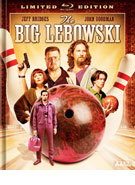
All Rise...Judge Dan Mancini treats objects like women, man. Editor's NoteOur reviews of The Big Lebowski (published August 25th, 2000), The Big Lebowski: Collector's Edition (published October 31st, 2005), The Big Lebowski: 10th Anniversary Edition (published September 9th, 2008), and The Big Lebowski (HD DVD) (published July 12th, 2007) are also available. The ChargeThe Dude abides. Opening StatementSometimes there's a movie—I won't say a classic, 'cause what's a classic? But sometimes, there's a movie—and I'm talkin' about The Big Lebowski here. Sometimes, there's a movie…well, it's the movie for its time and place. It fits right in there. And that's The Big Lebowski in 1998. Facts of the CaseOne of the laziest men in Los Angeles county (which places him high in the running for laziest worldwide), hippie, avid bowler, and drinker of White Russians Jeffrey Lebowski (Jeff Bridges, True Grit), aka The Dude, finds his mellow world turned upside down when thugs working for pornographer Jackie Treehorn (Ben Gazzara, The Killing of a Chinese Bookie) break into his house, give him a swirly, demand that he pay his wife Bunny's sizable debts to Treehorn, and pee on his rug. The none-too-bright goons, it seems, have mistaken The Dude for another Jeffrey Lebowski (David Huddleston, Blazing Saddles), a millionaire whose trophy wife is involved in the dealings of a rogues' gallery of seedy Los Angelinos. When The Dude pays the Big Lebowski a visit looking for compensation for the loss of his rug (which really tied the room together), he's drawn into an increasingly convoluted series of events involving the possible kidnapping of Bunny (Tara Reid, Josie and the Pussycats) by marmot-owning German nihilists who threaten to cut off The Dude's Johnson, the Big Lebowski's avant-garde artist daughter Maude's (Julianne Moore, Short Cuts) insistence that Bunny is a double-dealing nymphomaniac, the theft of The Dude's car by the implacable teenage son of an aged former television writer, and Jackie Treehorn's threatening insistence that Bunny repay her debts. All the while, The Dude and his bowling partners, high-strung Vietnam vet Walter Sobchak (John Goodman, Barton Fink) and perpetually confused Donny Kerabotsos (Steve Buscemi, Fargo) navigate the rigors of league play against flamboyant pederast Jesus Quintana (John Turturro, O Brother, Where Art Thou?). The EvidenceAfter the breakout critical and box office success of 1996's Fargo, writing-directing-producing team Joel and Ethan Coen took a stylistic left turn with The Big Lebowski, a movie that filters Fargo's labyrinthine kidnapping plot through way-out Los Angeles comic sensibilities. Borrowing liberally from the crime fiction of Raymond Chandler (The Big Sleep), the Coens crafted a detective story driven less by the machinations of plot than by a parade of picaresque characters whose off-kilter personalities must be navigated and accounted for in order to draw back the veil on the movie's central mystery. In the middle of the action is no professional private investigator, but middle-aged, unemployed hippie and bowling fanatic The Dude, who is assisted (in a manner of speaking) by his opposite number/best friend, blowhard Vietnam veteran Walter Sobchak. The movie is so weird and unique that critics and audiences alike were left scratching their heads upon its release in theaters. But a strange thing happened in the years since The Big Lebowski debuted in various home video formats: It rapidly built a following that grew beyond cult status, transforming the one-time box office dud into one of the most beloved comedies of the 1990s. The high reputation that the flick currently enjoys is well deserved. It is a work of keenly observed comedy brilliance, a dense tapestry of verbal motifs. In some ways, it is a movie about language itself. Every word in The Big Lebowski is tightly written and perfectly delivered by its cast. Certain phrases are repeated, their meanings changing with the shifting context. "Where's the money, Lebowski?" Jackie Treehorn's thugs ask The Dude at the beginning of the picture, a line of dialogue that is turned on its head when The Dude poses the same question to the Big Lebowski during the final act. The Dude, in fact, makes a habit of appropriating the words of others for his own use. In the movie's first scene, he watches a television broadcast in which President H.W. Bush declares that Iraq's aggression against Kuwait "will not stand," a phrasing The Dude later repeats verbatim in describing the outrage of having his rug peed on. The movie earns two of its many big laughs when The Dude, with matter-of-fact frankness, turns Maude Lebowski's use of the words "vagina" and "coitus" back on her. The Coens deftly use political correctness as a pretext for not only allowing their characters to use distinctive and colorful language, but to talk about language itself. When The Dude refers to Woo, Jackie Treehorn's rug-peeing goon, as a "Chinaman," Walter pleads with him to use the politically correct term "Asian-American" instead (this from a guy who later refers to Saddam Hussein as "that camel-f&#%er in Iraq"). When The Dude refers to the wheelchair-bound Big Lebowski as "a cripple" and "handicapped," Lebowski's assistant Brandt (Philip Seymour Hoffman, Almost Famous) awkwardly offers up the more acceptable term "disabled" as an alternative. Walter's assumption that the German kidnappers are Nazis leads to a bowling alley conversation about the relative merits of National Socialism versus nihilism. And there's no getting around the notable fact that the characters employ the f-bomb so frequently and in so many colorful ways that viewers become inured to it. In The Big Lebowski, the Coens use imminently quotable punchlines, pervasive profanity, and intentional repetition to craft an entertainment that coaxes viewers into thinking about language even as it makes them laugh. The brothers crafted their dialogue to twist in on and deconstruct itself in a way that mirrors (and supports) the movie's labyrinthine plot. The Big Lebowski is a brilliant piece of screenwriting. The entire cast of The Big Lebowski is exemplary, delivering the Coens' meticulous dialogue with such casual expertise that much of it appears improvised (Bridges has said in interviews that even the pauses in his delivery were a result of ellipses in the screenplay). Jeff Bridges' anchoring performance has been grossly underrated mostly because he's so thoroughly immersed in the character that audiences assume he's just playing himself. But let's face it: If The Dude and Bridges were interchangeable, Bridges would never have left his apartment long enough to building such a fine film career. In The Big Lebowski, Bridges' cadences are perfect, and he moves effortlessly from The Dude's generally mellow, stoned-out demeanor to his hot-tempered exchanges with Walter (whose blustery, terrier-like tenacity is played to perfection by John Goodman). Bridges' work is bolstered by the sort of secondary and tertiary cast that few filmmakers but the Coens can assemble: Julianne Moore, Steve Buscemi, John Turturro (who makes hay with a miniscule role), Peter Stormare, Jon Polito, Philip Seymour Hoffman, Sam Elliott, David Thewlis, and Ben Gazzara. The extraordinarily high quality of the cast lends the picture an abundance of style and a rich texture that renders its world lived-in and absurdly believable. The Big Lebowski was shot by longtime Coen collaborator Roger Deakins. Eschewing an intrusive stylized look, Deakins gravitated toward clean naturalism in lensing the film. Colors are natural, though clarity and depth are frequently eye-popping—thanks in large part to the way that Deakins makes full use of the bright lighting of bowling alleys and sunny Los Angeles exteriors. The Big Lebowski has a deceptively unostentatious look born of one of the movie business' most gifted cinematographers taking a (mostly) straight-forward approach, but doing so with a maximum of carefully studied skill. The Blu-ray transfer is sourced from the same 1080p/VC-1 master used for the previously release HD DVD. The 1.85:1 image delivers accurate colors and detail that vacillates from adequate to superb depending on a scene's lighting. The disc's DTS-HD Master Audio mix offers a discernible upgrade over the HD DVD's Dolby Digital Plus track. Dialogue has richer midrange, effects are brighter, and Carter Burwell's music selections make superb use of the entire soundstage. The vast majority of the extras on this single-disc release are reheated from previous home video releases of the movie (which is difficult to complain about considering the thin slate of supplements on the HD DVD). An Exclusive Introduction (4:40) The Dude's Life (10:08) The Dude Abides: The Big Lebowski Ten Years Later (10:37) Making of The Big Lebowski (24:35) The Lebowski Fest: An Achiever's Story (13:53) Flying Carpets and Bowling Pin Dreams: The Dream Sequences of The
Dude (4:20) Interactive Map The disc also contains a traditional photo gallery, as well as a 17-minute featurette in which Jeff Bridges walks us through the primo photo book that he made, using his own photographs, as a gift to the movie's cast and crew. In addition to all of the recycled extras, there are a few in-feature supplements exclusive to this Blu-ray release: Worthy Adversaries: What's My Line Trivia U-Control Also of note is this set's digibook packaging. Most of these glossy booklets are easy on the eyes but disposable in terms of actual content. Not so The Big Lebowski's. The slick book contains a four-page graphical representation of the movie's twisting turns of plot; quotes; trivia; a recipe for mixing a White Russian; an interview with Jeff Dowd, the movie producer and friend of the Coens who was the primary inspiration for The Dude; amusing descriptions of the movie's characters; photos by Jeff Bridges; a brief essay about the movie's cult status; and a trivia challenge. It's a fun and graphically inventive piece of packaging. Closing StatementThe Big Lebowski is one of the funniest, most quotable movies ever made. This Blu-ray, which offers a gorgeous video transfer and pristine audio, as well as a comprehensive collection of supplements both old and new, is easily the best possible home video option for the movie's legion of fans. The VerdictDonny, please. Give us your feedback!Did we give The Big Lebowski (Blu-ray) Digibook a fair trial? yes / no Other Reviews You Might Enjoy
• Wayne's World 2 |
|
DVD | Blu-ray | Upcoming DVD Releases | About | Staff | Jobs | Contact | Subscribe | | Privacy Policy
Review content copyright © 2011 Dan Mancini; Site design and review layout copyright © 2015 Verdict Partners LLC. All rights reserved.